13 results for "Technology"

Palo Alto: a history of California, capitalism, and the world

Harris, Malcolm
"Palo Alto's weather is temperate, its people are educated and enterprising, its corporations are spiritually and materially ambitious and demonstrably world-changing. Palo Alto is also a haunted toxic waste dump built on stolen Indian burial grounds, and an integral part of the capitalist world system. In Palo Alto, the first comprehensive, global history of Silicon Valley, Malcolm Harris examines how and why Northern California evolved in the particular, consequential way it did, tracing the ideologies, technologies, and policies that have been engineered there over the course of 150 years of Anglo settler colonialism, from IQ tests to the "tragedy of the commons," racial genetics, and "broken windows" theory. The Internet and computers, too. It's a story about how a small American suburb became a powerful engine for economic growth and war, and how it came to lead the world into a surprisingly disastrous 21st century. Palo Alto is an urgent and visionary history of the way we live now, one that ends with a clear-eyed, radical proposition for how we might begin to change course"--Provided by publisher.
Little, Brown and Company 2024-03-19 712 pages

Speed tribes: children of the Japanese bubble

Greenfeld, Karl Taro
A leading Japanese journalist gives an analysis and descriptive account of Tokyo's current youth culture and modern Japanese society. He examines why 40 million young people between the ages of 15 and 30 are breaking away from traditional society to seek quick money and new ways of life - technology, drugs, free sex, punk rock. Many school drop-outs join the tribes of lawless bikers hoping to be accepted into the immensely wealthy underworld gangs of the Yazuka. is broad - from drug dealers, office girls and hostesses, to students at Tokyo's most prestigious university.
Boxtree 1994 242 pages

The birth of Korean cool: how one nation is conquering the world through pop culture

Hong, Euny
A revised edition of this celebrated cultural history features a new afterword and three new chapters focusing on the global K-pop phenomenon BTS, as well as the Academy Award–winning film Parasite and the hit Netflix series Squid Game. In this fresh, funny, and insightful cultural history, Euny Hong recounts how South Korea vaulted itself into the twenty-first century, becoming a global leader in business, technology, education, and pop culture. Along the way we meet teachers, cultural critics, Michelin-starred chefs, pop music superstars, and government ministers in charge of creating boy bands with highly synchronized dance moves. The strict rigors of the Korean education system now lead to a society that works and plays hard—with a Ministry of Culture that churns out movies, television dramas, pop bands, and video games exported throughout the world. The Birth of Korean Cool reveals how a really uncool country became cool, and how a nation that once banned miniskirts, long hair on men, and rock and roll could come to be known for its pop music and the smartphone in everyone’s pocket. This revised edition features a new afterword and three new chapters focusing on the global K-pop phenomenon BTS, as well as the Academy Award-winning film Parasite and the hit Netflix series Squid Game.
Picador 2025-04 352 pages

The birth of Korean cool: how one nation is conquering the world through pop culture

Hong, Euny
"A fresh, funny, up-close look at how South Korea remade itself as the world's pop culture powerhouse of the twenty-first century. By now, everyone in the world knows the song "Gangnam Style" and Psy, an instantly recognizable star. But the song's international popularity is no passing fad. "Gangnam Style" is only one tool in South Korea's extraordinarily elaborate and effective strategy to become a major world superpower by first becoming the world's number one pop culture exporter. As a child, Euny Hong moved from America to the Gangnam neighborhood in Seoul. She was a witness to the most accelerated part of South Korea's economic development, during which it leapfrogged from third-world military dictatorship to first-world liberal democracy on the cutting edge of global technology. The Birth of Korean Cool recounts how South Korea vaulted itself into the twenty-first century, becoming a global leader in business, technology, education, and pop culture.Featuring lively, in-depth reporting and numerous interviews with Koreans working in all areas of government and society, Euny Hong reveals how a really uncool country became cool, and how a nation that once banned miniskirts, long hair on men, and rock 'n' roll could come to mass produce boy bands, soap operas, and the world's most popular smartphone"--
Simon & Schuster UK Ltd 2014 267 pages

Too much magic: wishful thinking, technology, and the fate of the nation

Kunstler, James Howard
""Too Much Magic" is what Kunstler sees in the bright visions of a future world dreamed up by optimistic souls who believe technology will solve all our problems. In Too Much Magic, Kunstler articulates a number of issues relating to the unsustainability of our high-energy lifestyle, including: The pernicious cult of "Happy Motoring" and our desire to preserve an ailing and backwards automotive industry at all costs; The upcoming demise of suburbia and the mass migration and demographic shifts that will ensue; The inadequacy of both renewable energy sources and alternative fossil fuels such as biodiesel, tar sands, and shale oil and gas to make up the energy shortfall when our conventional sources of fuel dry; The effect of the continuing increase in global population even after resource shortfalls of oil and fossil fuels become acute; How the diminishing returns of technology collide with hypercomplexity to scuttle our wishes for an easy way out of our epochal predicaments. With vision and clarity of thought, and an antic, comic spirit, Kunstler argues that the time for magical thinking and hoping for miracles is over, and the time to begin preparing for the long emergency has begun."--Jacket.
Atlantic Monthly Press 2012 245 pages

The end of modern history in the Middle East

Lewis, Bernard
The author examines in detail the issues most critical to the region's future. He describes oil as the current, most important export to the outside world from the Middle East but warns that technology will eventually make it obsolete, leaving those who depend solely on oil revenues with a bleak future. The three factors that could most help transform the Middle East, according to Lewis, are Turkey, Israel, and women. He also argues that there is enough in the traditional culture of Islam on the one hand and the modern experience of the Muslim peoples on the other to provide the basis for an advance toward freedom in the true sense of that word and to achieve the social, cultural, and scientific changes necessary to bring the Middle East into line with the developed countries of both West and East.
Hoover Institution Press 2011 188 pages

Israel has moved

Pinto, Diana
Israel has changed. The country was born in Europe's shadow, haunted by the Holocaust and inspired by the Enlightenment. But for Israelis today, Europe is hardly relevant, and the country's ties to the broader West, even to America, are fraying. Where is Israel heading? How do citizens of an increasingly diverse nation see themselves globally and historically? In this revealing portrait of the new Israel, Diana Pinto presents a country simultaneously moving forward and backward, looking outward and turning in on itself. In business, Israel is forging new links with the giants of Asia, and its booming science and technology sectors are helping define the future for the entire world. But in politics and religion, Israelis are increasingly self-absorbed, building literal and metaphorical walls against hostile neighbors and turning to ancient religious precepts for guidance here and now.
Harvard University Press 2013-02-28 215 pages

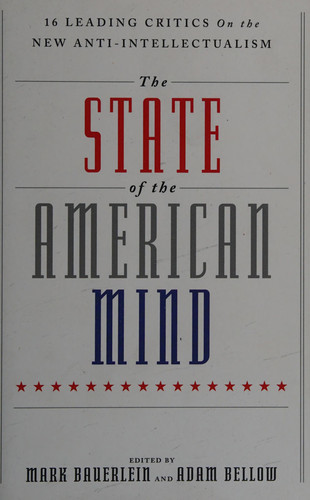
The state of the American mind: 16 leading critics on the new anti-intellectualism

Mark Bauerlein,Adam Bellow
In 1987, Allan Bloom’s The Closing of the American Mind was published; a wildly popular book that drew attention to the shift in American culture away from the tenants that made America—and Americans—unique. Bloom focused on a breakdown in the American curriculum, but many sensed that the issue affected more than education. The very essence of what it meant to be an American was disappearing. That was over twenty years ago. Since then, the United States has experienced unprecedented wealth, more youth enrolling in higher education than ever before, and technology advancements far beyond what many in the 1980s dreamed possible. And yet, the state of the American mind seems to have deteriorated further. Benjamin Franklin’s “self-made man” has become a man dependent on the state. Independence has turned into self-absorption. Liberty has been curtailed in the defense of multiculturalism. In order to fully grasp the underpinnings of this shift away from the self-reliant, well-informed American, editors Mark Bauerlein and Adam Bellow have brought together a group of cultural and educational experts to discuss the root causes of the decline of the American mind. The writers of these fifteen original essays include E. D. Hirsch, Nicholas Eberstadt, and Dennis Prager, as well as Daniel Dreisbach, Gerald Graff, Richard Arum, Robert Whitaker, David T. Z. Mindich, Maggie Jackson, Jean Twenge, Jonathan Kay, Ilya Somin, Steve Wasserman, Greg Lukianoff, and R. R. Reno. Their essays are compiled into three main categories: States of Mind: Indicators of Intellectual and Cognitive Decline These essays broach specific mental deficiencies among the population, including lagging cultural IQ, low Biblical literacy, poor writing skills, and over-medication. Personal and Cognitive Habits/Interests These essays turn to specific mental behaviors and interests, including avoidance of the news, short attention spans, narcissism, and conspiracy obsessions. National Consequences These essays examine broader trends affecting populations and institutions, including rates of entitlement claims, voting habits, and a low-performing higher education system. The State of the American Mind is both an assessment of our current state as well as a warning, foretelling what we may yet become. For anyone interested in the intellectual fate of America, The State of the American Mind offers an accessible and critical look at life in America and how our collective mind is faring.
Templeton Press 2015-06-16 260 pages

Acting in the night: Macbeth and the places of the Civil War

Nemerov, Alexander
"Alexander Nemerov is one of the greatest readers of American visual culture. This book has the revelatory power that only wide-ranging curiosity and true independence of mind can achieve." Richard H. Brodhead President of Duke University and author of Cultures of Letters: Scenes of Reading and Writing in Nineteenth-Century America ; "A benchmark in the writing of art history and in studies of the Civil War, Acting in the Night occupies a category unto itself. It uniquely immerses the reader in a holistic experience of the Civil War and shows Nemerov as a cosummate stylist in the field of American art history."Kathleen Pyne author of Modernism and the Feminine Voice ; "This is a work of criticism that borders on poetry, a brilliant and extremely original book that invites us to rethink to the artistic world we study."Julia Reinhard Lupton author of Thinking with Shakespeare: Essays on Politics and Life ; What can the performance of a single play on one night tell us about the world this event inhabited so briefly? Alexander Nemerov takes a performance of Macbeth in Washington, D.C., on October 17, 1863--with Abraham Lincoln in attendance--to explore this question and illuminate American art, politics, technology, and life as it was being lived. Nemerov's inspiration is Wallace Stevens and his poem "Anecdote of the Jar,"in which a single object organizes the wilderness around it. For Nemerov, that evening's performance of Macbeth reached across the tragedy of civil war to acknowledge the horrors and emptiness of a world it tried and ultimately failed to change. --Book Jacket
University of California Press 2010-09-01 299 pages

The American dream in the information age

Newman, Otto
This book explores the changing nature of the American Dream in the context of current and impending developments. Effective as they have been, traditional values need to be reassessed. Trends such as the informatics revolution, globalization, and changing patterns of work and free time ought to be taken into account. While the main focus is on the United States, the content is equally relevant to other major industrial societies experiencing similar forms of change. These changes have profound implications within the political, economic, and social realms. Particular attention is given to the rising incidence and significance of advance technology, which is capable of transforming not only the workplace but equally social relationships, family life, and individual development in a positive way.
St. Martin's Press 1999-07-30 229 pages

Cultural revolution in Iran: contemporary popular culture in the Islamic Republic

Annabelle Sreberny,Massoumeh Torfeh
The Islamic Republic of Iran has entered its fourth decade, and the values and legacy of the Revolution it was founded upon continue to have profound and contradictory consequences for Iranian life. Despite the repressive power of the current regime the immense creativity of popular cultural practices, that negotiate and resist a repressive system, is a potent and dynamic force. This book draws on the expertise and experience of Iranian and international academics and activists to address diverse areas of social and cultural innovation that are driving change and progress. While religious conservatism remains the creed of the establishment, this volume uncovers an underground world of new technology, media and entertainment that speaks to women seeking a greater public role and a restless younger generation that organises and engages with global trends online.
I.B. Tauris 2016 296 pages