
3 results for "Technology History"

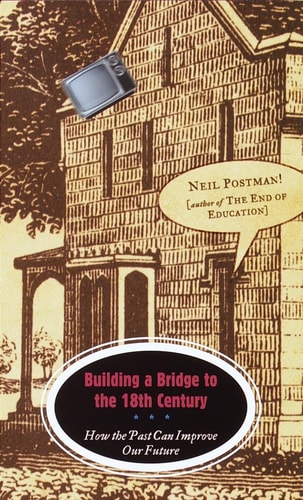
Building a bridge to the 18th century: how the past can improve our future

Postman, Neil
In Building a Bridge to the 18th Century , acclaimed cultural critic Neil Postman offers a cure for the hysteria and hazy values of the postmodern world. Postman shows us how to reclaim that balance between mind and machine in a dazzling celebration of the accomplishments of the Enlightenment-from Jefferson's representative democracy to Locke's deductive reasoning to Rousseau's demand that the care and edification of children be considered an investment in our collective future. Here, too, is the bold assertion that Truth is invulnerable to fashion or the passing of time. Provocative and brilliantly argued, Building a Bridge to the 18th Century illuminates a navigable path through the Information Age-a byway whose signposts, it turns out, were there all along.
Knopf 2000-10-10 213 pages

A history of the twentieth century

Gilbert, Martin
Martin Gilbert brings readers up to date in this rich historical narrative of the contradictory events of the last fifty years. Volume II ended in 1951, as the world recovered from World War II, and the nuclear threat increased. In this volume, Gilbert recalls the Cold War and communism--including McCarthyism, the Soviet and Warsaw Pact, the Berlin Wall--and the wars, from Korea to Vietnam to Bosnia. He moves from Poland's Solidarity Movement to Ireland's Bloody Sunday, from Pol Pot and his killing fields to the dissolution of the Soviet Union. Mao began a cultural revolution, Martin Luther King, Jr. and John F. Kennedy were assassinated, and Beijing's Tiananamen Square shocked the world. Technology and medicine advanced in leaps and bounds as the society struggled to catch up. Art, literature, and music, as well as epidemics and natural disasters, all have their place here. Many of the events are described through the words of those who were present. As in the previous two volumes, Gi
W. Morrow 1997 1088 pages

A short history of the twentieth century

Lukacs, John
"The historian John Lukacs offers a concise history of the twentieth century--its two world wars and cold war, its nations and leaders. The great themes woven through this spirited narrative are inseparable from the author's own intellectual preoccupations: the fading of liberalism, the rise of populism and nationalism, the achievements and dangers of technology, and the continuing democratization of the globe. The historical twentieth century began with the First World War in 1914 and ended seventy-five years later with the collapse of the Soviet Empire in 1989. The short century saw the end of European dominance and the rise of American power and influence throughout the world. The twentieth century was an American century--perhaps the American century. Lukacs explores in detail the phenomenon of national socialism (national socialist parties, he reminds us, have outlived the century), Hitler's sole responsibility for the Second World War, and the crucial roles played by his determined opponents Churchill and Roosevelt. Between 1939 and 1942 Germany came closer to winning than many people suppose. Lukacs casts a hard eye at the consequences of the Second World War--the often misunderstood Soviet-American cold war--and at the shifting social and political developments in the Far and Middle East and elsewhere. In an eloquent closing meditation on the passing of the twentieth century, he reflects on the advance of democracy throughout the world and the limitations of human knowledge" -- Publisher website
The Belknap Press of Harvard University Press 2013-10-07 230 pages