22 results for "Technology History"

The Singularity is Near When Humans Transcend Biology

Ray Kurzweil
How Singular? How singular is the Singularity? Will it happen in an instant? Lets consider again the derivation of the word. In mathematics a singularity is a value that is beyond any limit - in essence, infinity. The Singularity as we have discussed it in this book, does not achieve infinite levels of computation, memory, as any other other measurable attribute. But it certainly achieves vast levels of all these qualities, including intelligence. With the reverse engineering of the human brain we will be able to apply the parallel, self-organizing, chaotic, algorithms of human intelligence to enormously powerful computational substrates. This intelligence will then be in a position to improve its own design, both hardware and software, in a rapidly accelerating iterative process.
Viking 2005 652 pages

Stealing fire: how Silicon Valley, the Navy SEALs, and maverick scientists are revolutionizing the way we live and work

Kotler, Steven,Wheal, Jamie
NATIONAL BESTSELLER CNBC and Strategy + Business Best Business Book of 2017 "Steven and Jamie have done a wonderful job of balancing the promises, perils, and how-to prescriptions of engineering peak states such as 'flow.'" —Tim Ferriss, #1 New York Times best-selling author of The 4-Hour Workweek It’s the biggest revolution you’ve never heard of, and it’s hiding in plain sight. Over the past decade, Silicon Valley executives like Eric Schmidt and Elon Musk, Special Operators like the Navy SEALs and the Green Berets, and maverick scientists like Sasha Shulgin and Amy Cuddy have turned everything we thought we knew about high performance upside down. Instead of grit, better habits, or 10,000 hours, these trailblazers have found a surprising short cut. They're harnessing rare and controversial states of consciousness to solve critical challenges and outperform the competition. New York Times bestselling author Steven Kotler and high performance expert Jamie Wheal spent four years investigating the leading edges of this revolution—from the home of SEAL Team Six to the Googleplex, the Burning Man festival, Richard Branson’s Necker Island, Red Bull’s training center, Nike’s innovation team, and the United Nations’ Headquarters. And what they learned was stunning: In their own ways, with differing languages, techniques, and applications, every one of these groups has been quietly seeking the same thing: the boost in information and inspiration that altered states provide. Today, this revolution is spreading to the mainstream, fueling a trillion dollar underground economy and forcing us to rethink how we can all lead richer, more productive, more satisfying lives. Driven by four accelerating forces—psychology, neurobiology, technology and pharmacology—we are gaining access to and insights about some of the most contested and misunderstood terrain in history. Stealing Fire is a provocative examination of what’s actually possible; a guidebook for anyone who wants to radically upgrade their life.
Dey St. 2018-05-08 293 pages

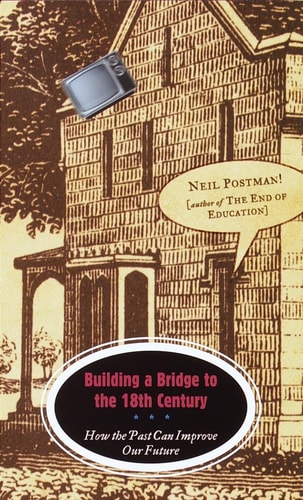
Building a bridge to the 18th century: how the past can improve our future

Postman, Neil
In Building a Bridge to the 18th Century , acclaimed cultural critic Neil Postman offers a cure for the hysteria and hazy values of the postmodern world. Postman shows us how to reclaim that balance between mind and machine in a dazzling celebration of the accomplishments of the Enlightenment-from Jefferson's representative democracy to Locke's deductive reasoning to Rousseau's demand that the care and edification of children be considered an investment in our collective future. Here, too, is the bold assertion that Truth is invulnerable to fashion or the passing of time. Provocative and brilliantly argued, Building a Bridge to the 18th Century illuminates a navigable path through the Information Age-a byway whose signposts, it turns out, were there all along.
Knopf 2000-10-10 213 pages

Mind change: how digital technologies are leaving their mark on our brains

Greenfield, Susan
"Google. Facebook. Twitter. Repeat. We live in a world unimaginable even a few decades ago, one like no other in human history. It's a parallel world where we can be on the move in the real world, yet always hooked into an alternative time and place. And although it's a two-dimensional world of sight and sound, it offers instant information, connected identities, and constant novelty. In this world, our screen technologies are increasingly where we work, where we unwind, where we relieve our boredom and where we learn. The subsequent transformation in how we live and think is a vitally important issue, perhaps even the most important issue of our time. When toddlers are given iPads, and adults spend ten hours a day staring at a screen, can we afford to assume that our brave new screen technologies are harmless tools? Blending a wide range of scientific studies, news events, and cultural criticism with brio and verve, Mind Change presents an incisive snapshot of the global 'now.' Greenfield examines how the dawn of the Digital Age has already altered our cultural landscape, fueled an epidemic of oversharing, and transformed how we learn, remember and spread information -- and how these innovations are changing our physical brains. A warning cry, a shot across the bow, and a call to action, Mind Change explores the social, cultural and physiological ramifications of our new digital lifestyle"--
Random House 2015-02-10 348 pages

The human use of human beings: cybernetics and society

Wiener, Norbert
"In 1950, mathematician-philosopher Norbert Wiener ended this classic book on the place of machines in society with a warning: "We shall never receive the right answers to our questions unless we ask the right questions.... The hour is very late, and the choice of good and evil knocks at our door." Wiener, the founder of the science of cybernetics--the study of the relationship between computers and the human nervous system--was widely mislabeled as an advocate for the automation of human life. As The Human Use for Human Beings reveals, his vision was much more complex and interesting, and is more relevant in today's world of AI than anyone could have anticipated. In his new introduction, Brian Christian aptly calls Wiener the "progenitor of contemporary AI-safety discourse." Wiener hoped that machines would release people from relentless and repetitive drudgery to achieve more creative pursuits, yet he anticipated the danger of dehumanizing and displacement. His pioneering views on the human-machine relationship as a "communicative process" are only more crucial now, as we carry in our pockets AI devices that we can literally speak to. His prescient warnings illuminate our contemporary relationships with language, art, and even social media. The Human Use of Human Beings examines the implications of cybernetics for education, law, language, science, technology, as Wiener anticipates the enormous impact--in effect, a third industrial revolution--that the computer has had on our lives."-- Provided by publisher
Mariner Classics 2025-08-12 240 pages

World Without Mind

Franklin Foer
Over the past few decades there has been a revolution in terms of who controls knowledge and information. This rapid change has imperilled the way we think. Without pausing to consider the cost, the world has rushed to embrace the products and services of four titanic corporations. We shop with Amazon; socialise on Facebook; turn to Apple for entertainment; and rely on Google for information. These firms sell their efficiency and purport to make the world a better place, but what they have done instead is to enable an intoxicating level of daily convenience. As these companies have expanded, marketing themselves as champions of individuality and pluralism, their algorithms have pressed us into conformity and laid waste to privacy. They have produced an unstable and narrow culture of misinformation, and put us on a path to a world without private contemplation, autonomous thought, or solitary introspection - a world without mind. In order to restore our inner lives, we must avoid being co-opted by these gigantic companies, and understand the ideas that underpin their success. Elegantly tracing the intellectual history of computer science - from the Descartes and the enlightenment to Alan Turing to Stuart Brand and the hippie origins of today's Silicon Valley - Foer exposes the dark underpinnings of our most idealistic dreams for technology. The corporate ambitions of Google, Facebook, Apple, and Amazon, he argues, are trampling longstanding liberal values, especially intellectual property and privacy. This is a nascent stage in the total automation and homogenization of social, political, and intellectual life. By reclaiming our private authority over how we intellectually engage with the world, we have the power to stem the tide. At stake is nothing less than who we are, and what we will become. There have been monopolists in the past but today's corporate giants have far more nefarious aims. They're monopolists who want access to every facet of our identities and influence over every corner of our decision-making. Until now few have grasped the sheer scale of the threat. Foer explains not just the looming existential crisis but the imperative of resistance.
Jonathan Cape Ltd 2017-09-28 272 pages

Which side of history? how technology is reshaping democracy and our lives

James P. Steyer
"A collection of 20-25 essays from prominent voices that brings forward creative, bold opinions that will examine the current state and impact of technology on our society and will highlight solutions for constructive change. Sample topics may include: 1 the impact of technology on elections and global democratic institutions; 2 the evisceration of longstanding privacy norms and standards; 3 the impact of technology on kids and teenagers; 4 the rise of cyberbullying and hate speech and how to address these challenges; and, 5 the libertarian ethos that often prizes a "move fast and break things" mentality and its relationship to the Silicon Valley culture bubble"--
Chronicle Prism 2020 327 pages

Bad Ideas? An Arresting History of Our Inventions

Robert Winston,Robert M. L. Winston
We are born with the instinct to create and invent. Indeed our ability to do so is what separates we humans from the rest of the animal world. The moment man first converted a stone to a useful tool set him on a relentless path toward greater control and power over his environment. But have our creative ideas always produced desirable results in line with their original good intention? How many ill-effects and dangers have they brought about along the way? And have they really served us well? Bad Ideas? traces the fascinating history of our attempts at self-improvement but also questions their value. The dubious consequences of the development of weaponry, for example, is self-evident from the primitive but lethal sling to the devastating nuclear bomb. But what of apparently more innocuous inventions such as farming, writing or medicine? All were initiated for the greater good but have nonetheless produced unforeseen fallout that continues to this day. What are their undesirable side-effects, how did they emerge over the years and where will they take us in the future? Written against a huge historical canvas, we join Robert Winston on a thrilling and inspiring journey from our earliest days to the present. We learn about the history of modern science, engineering, IT and much more, following the unexpected twists and turns of their progress. We meet the individuals who played a key role in their development, and share quirky anecdotes about their lives and brainwaves. Inspiring, unusual, and at times controversial, Bad Ideas? enables us by appreciating the past to look forward to the technological opportunities and ethical challenges of the future. In so doing it celebrates man's extraordinary capacity for achievement whilst warning us that his good intentions can sometimes end up as thoroughly bad ideas.
Bantam 2010 417 pages

Present shock: when everything happens now

Rushkoff, Douglas
"An award-winning author explores how the world works in our age of "continuous now" Back in the 1970s, futurism was all the rage. But looking forward is becoming a thing of the past. According to Douglas Rushkoff, "presentism" is the new ethos of a society that's always on, in real time, updating live. Guided by neither history nor long term goals, we navigate a sea of media that blend the past and future into a mash-up of instantaneous experience. Rushkoff shows how this trend is both disorienting and exhilarating. Without linear narrative we get both the humiliations of reality TV and the associative brilliance of The Simpsons. With no time for long term investing, we invent dangerously compressed derivatives yet also revive sustainable local businesses. In politics, presentism drives both the Tea Party and the Occupy movement. In many ways, this was the goal of digital technology--outsourcing our memory was supposed to free us up to focus on the present. But we are in danger of squandering this cognitive surplus on trivia. Rushkoff shows how we can instead ground ourselves in the reality of the present tense. "--
Penguin Books 2014-02-25 296 pages

Work mate marry love: how machines shape our human destiny

Spar, Debora L.
A crucial guide to life before—and after—Tinder, IVF, and robots. What will happen to our notions of marriage and parenthood as reproductive technologies increasingly allow for newfangled ways of creating babies? What will happen to our understanding of gender as medical advances enable individuals to transition from one set of sexual characteristics to another, or to remain happily perched in between? What will happen to love and sex and romance as our relationships migrate from the real world to the Internet? Can people fall in love with robots? Will they? In short, what will happen to our most basic notions of humanity as we entangle our lives and emotions with the machines we have created? In Work Mate Marry Love , Harvard Business School professor and former Barnard College president Debora L. Spar offers an incisive and provocative account of how technology has transformed our intimate lives in the past, and how it will do so again in the future. Surveying the course of history, she shows how marriage as we understand it resulted from the rise of agriculture, and that the nuclear family emerged with the industrial revolution. In their day, the street light, the car, and later the pill all upended courtship and sex. Now, as we enter an era of artificial intelligence and robots, how will our deepest feelings and attachments evolve? In the past, the prevailing modes of production produced a world dominated by heterosexual, mostly-monogamous, two-parent families. In the future, however, these patterns are almost certain to be reshaped, creating entirely new norms for sex and romance, and for the construction of families and the raising of children. Steering clear of both techno-euphoria and alarmism, Spar offers a bold and inclusive vision of how our lives might be changed for the better.
Farrar, Straus and Giroux 2021-08-17 384 pages

Simulation and its discontents

Turkle, Sherry
How the simulation and visualization technologies so pervasive in science, engineering, and design have changed our way of seeing the world. Over the past twenty years, the technologies of simulation and visualization have changed our ways of looking at the world. In Simulation and Its Discontents , Sherry Turkle examines the now dominant medium of our working lives and finds that simulation has become its own sensibility. We hear it in Turkle's description of architecture students who no longer design with a pencil, of science and engineering students who admit that computer models seem more “real” than experiments in physical laboratories. Echoing architect Louis Kahn's famous question, “What does a brick want?”, Turkle asks, “What does simulation want?” Simulations want, even demand, immersion, and the benefits are clear. Architects create buildings unimaginable before virtual design; scientists determine the structure of molecules by manipulating them in virtual space; physicians practice anatomy on digitized humans. But immersed in simulation, we are vulnerable. There are losses as well as gains. Older scientists describe a younger generation as “drunk with code.” Young scientists, engineers, and designers, full citizens of the virtual, scramble to capture their mentors' tacit knowledge of buildings and bodies. From both sides of a generational divide, there is anxiety that in simulation, something important is slipping away. Turkle's examination of simulation over the past twenty years is followed by four in-depth investigations of contemporary simulation culture: space exploration, oceanography, architecture, and biology.
The MIT Press 2009-04-17 217 pages

Forces of production: a social history of industrial automation

Noble, David F.
Focusing on the design and implementation of computer-based automatic machine tools, David F. Noble challenges the idea that technology has a life of its own. Technology has been both a convenient scapegoat and a universal solution, serving to disarm critics, divert attention, depoliticize debate, and dismiss discussion of the fundamental antagonisms and inequalities that continue to beset America. This provocative study of the postwar automation of the American metal-working industry—the heart of a modern industrial economy—explains how dominant institutions like the great corporations, the universities, and the military, along with the ideology of modern engineering shape, the development of technology. Noble shows how the system of "numerical control," perfected at the Massachusetts Institute of Technology (MIT) and put into general industrial use, was chosen over competing systems for reasons other than the technical and economic superiority typically advanced by its promoters. Numerical control took shape at an MIT laboratory rather than in a manufacturing setting, and a market for the new technology was created, not by cost-minded producers, but instead by the U. S. Air Force. Competing methods, equally promising, were rejected because they left control of production in the hands of skilled workers, rather than in those of management or programmers. Noble demonstrates that engineering design is influenced by political, economic, managerial, and sociological considerations, while the deployment of equipment—illustrated by a detailed case history of a large General Electric plant in Massachusetts—can become entangled with such matters as labor classification, shop organization, managerial responsibility, and patterns of authority. In its examination of technology as a human, social process, Forces of Production is a path-breaking contribution to the understanding of this phenomenon in American society.
Transaction Publishers 2011 409 pages

Ruling the waves: cycles of discovery, chaos, and wealth from the compass to the internet

Spar, Debora L.
Beginning with the development of the compass, Ruling the Waves examines a series of technological revolutions that promised, in their time, to transform the world's politics and business. With Debora Spar's gifted storytelling, each chapter reads like an adventure tale as she recounts the histories of the printing press and maps; of the telegraph, radio, and satellite television; of software, encryption, and the advent of digital music. At each of these junctures Spar suggests that invention led to both a wave of commerce and of chaos. Entrepreneurs such as Samuel Morse and Rupert Murdoch carved new markets from the emerging technology and proclaimed that the old rules no longer applied. And for a while, they were right. But eventually--and inevitably--even cowboys need rules: rules of property, rules of coordination, rules of competition. The erstwhile pioneers thus turn to government, lobbying for order and setting the stage for the next wave of discovery. A fascinating history of business, Ruling the Waves is also an original, thought-provoking analysis of the parallels between past innovations and inventions and our own tumultuous times.
Harcourt 2001 403 pages

Too big to know: rethinking knowledge now that the facts aren't the facts, experts are everywhere, and the smartest person in the room is the room

Weinberger, David
We used to know how to know. We got our answers from books or experts. We'd nail down the facts and move on. But in the Internet age, knowledge has moved onto networks. There's more knowledge than ever, of course, but it's different. Topics have no boundaries, and nobody agrees on anything. Yet this is the greatest time in history to be a knowledge seeker, if you know how. In Too Big to Know, Internet philosopher David Weinberger shows how business, science, education, and the government are learning to use networked knowledge to understand more than ever and to make smarter decisions than they could when they had to rely on mere books and experts. This groundbreaking book shakes the foundations of our concept of knowledge -- from the role of facts to the value of books and the authority of experts -- providing a compelling vision of the future of knowledge in a connected world. - Publisher.
Basic Books 2011 231 pages

The Social shaping of technology: how the refrigerator got its hum

Donald A. MacKenzie,Judy Wajcman
Technological change is often seen as something that follows its own logic – something about which we may protest, but which we are unable to alter fundamentally. This reader challenges that assumption. In it, a collection of distinguished authors demonstrate that technology is affected at a fundamental level by the social context in which it develops. The first section introduces the reader to general arguments about the relation of technology to society. In subsequent sections the editors examine three types of technology in particular: the technology of production, domestic technology and military (especially nuclear) technology. In each case a variety of examples is used to demonstrate how technologies reflect such features of the social and economic environment as the social relations of the workplace, gender divisions in society, or the dictates of the state. The editors argue that social scientists have devoted disproportionate attention to the effects of technology on society, and have tended to ignore the more fundamental question of what shapes technology in the first place. Drawing both on established work in the history of technology and on newer feminist and Marxist perspectives they show how important and fruitful it is to try to answer the deeper question.
Open University Press 1985 327 pages

America by design: science technology and the rise of corporate capitalism

Noble, David F.
Oxford University Press paperback. Includes bibliographical references and index. pt. 1: Technology as social production. The wedding of science to the useful arts--1: The rise of science-based industry. The wedding of science to the useful arts--2: The development of technical education. The wedding of science to the useful arts--3: The emergence of the professional engineer. Preservation through change: Corporate engineers and social reform -- pt. 2: Corporate reform as conscious social production. Laying the foundation: Scientific and industrial standardization. The corporation as inventor: Patent-law reform and patent monoply. Science for industry: The organization of industrial and university research. Technology as people: The industrial process of higher education --1. Technology as people: The industrial process of higher education--2. A technology of social production: Modern management and the expansion of engineering. * dss 20081210.
Oxford University Press 1979 384 pages

Acting in the night: Macbeth and the places of the Civil War

Nemerov, Alexander
"Alexander Nemerov is one of the greatest readers of American visual culture. This book has the revelatory power that only wide-ranging curiosity and true independence of mind can achieve." Richard H. Brodhead President of Duke University and author of Cultures of Letters: Scenes of Reading and Writing in Nineteenth-Century America ; "A benchmark in the writing of art history and in studies of the Civil War, Acting in the Night occupies a category unto itself. It uniquely immerses the reader in a holistic experience of the Civil War and shows Nemerov as a cosummate stylist in the field of American art history."Kathleen Pyne author of Modernism and the Feminine Voice ; "This is a work of criticism that borders on poetry, a brilliant and extremely original book that invites us to rethink to the artistic world we study."Julia Reinhard Lupton author of Thinking with Shakespeare: Essays on Politics and Life ; What can the performance of a single play on one night tell us about the world this event inhabited so briefly? Alexander Nemerov takes a performance of Macbeth in Washington, D.C., on October 17, 1863--with Abraham Lincoln in attendance--to explore this question and illuminate American art, politics, technology, and life as it was being lived. Nemerov's inspiration is Wallace Stevens and his poem "Anecdote of the Jar,"in which a single object organizes the wilderness around it. For Nemerov, that evening's performance of Macbeth reached across the tragedy of civil war to acknowledge the horrors and emptiness of a world it tried and ultimately failed to change. --Book Jacket
University of California Press 2010-09-01 299 pages

His and hers: gender, consumption, and technology

Roger Horowitz,Arwen Mohun
The pathbreaking essays in this collection explore the history of consumption by synthesizing discrete historical literatures on consumer culture, gender, and the history of technology. Luxury hotels and the chocolate industry are among the diverse array of topics these authors use to demonstrate that consumption is both a material and a cultural process. Production and consumption become equally inextricable under close analysis. Tools from both the history of technology and gender studies illuminate how these categories intersect. Although broad social and technological trends influence the outcome of these stories, the authors emphasize the agaency of particular groups, including consumers, workers, manufacturers, and the "mediators" who communicate between producers and consumers. This volume will be of interest to historians in a wide range of fields.
University Press of Virginia 1998 240 pages