34 results for "Technology History"

The Singularity is Near When Humans Transcend Biology

Ray Kurzweil
How Singular? How singular is the Singularity? Will it happen in an instant? Lets consider again the derivation of the word. In mathematics a singularity is a value that is beyond any limit - in essence, infinity. The Singularity as we have discussed it in this book, does not achieve infinite levels of computation, memory, as any other other measurable attribute. But it certainly achieves vast levels of all these qualities, including intelligence. With the reverse engineering of the human brain we will be able to apply the parallel, self-organizing, chaotic, algorithms of human intelligence to enormously powerful computational substrates. This intelligence will then be in a position to improve its own design, both hardware and software, in a rapidly accelerating iterative process.
Viking 2005 652 pages

A Picture Book of George Washington Carver

David A. Adler
Born a slave, he became a leading scientist. This is the inspiring story of the pioneering African-American teacher, scientist, and artist. Carver is perhaps best known for his scientific work with peanuts and sweet potatoes (and for inventing peanut butter!), but Time magazine also called him the "Black Leonardo" for his painting. Adler tells of Carver's work at the Tuskegee Institute with Booker T. Washington, his hard childhood, and his determination to learn despite many obstacles, A man of deep faith, Carver worked throughout his life to create scientific discoveries that would improve the lives of Southerners--especially African Americans. The colorful illustrations show Carver in all stages of his life and give children insight to Carver's world. For almost thirty years, David Adler’s Picture Book Biography series has profiled famous people who changed the world. Colorful, kid-friendly illustrations combine with Adler’s “expert mixtures of facts and personality” ( Booklist ) to introduce young readers to history through compelling biographies of presidents, heroes, inventors, explorers, and adventurers. These books are ideal for first and second graders interested in history, or who need reliable sources for school book reports.
Candlewick Press 2000-09-01 32 pages

A Picture Book of Louis Braille

David A. Adler
As a child, Louis Braille lost his sight in a tragic accident—but he was determined not to let that limit him. The young Frenchman sought every opportunity to learn, and by the time he was a teenager, began experimenting with a new form of writing. Today, his system of raised dots is used by people with visual difficulties across the world. Backmatter includes a timeline and author's note, as well as a page of letters and numerals in braille printing. For almost thirty years, David Adler’s Picture Book Biography series has profiled famous people who changed the world. Colorful, kid-friendly illustrations combine with Adler’s “expert mixtures of facts and personality” ( Booklist ) to introduce young readers to history through compelling biographies of presidents, heroes, inventors, explorers, and adventurers. These books are ideal for first and second graders interested in history, or who need reliable sources for school book reports.
Holiday House 2019-12-10 32 pages

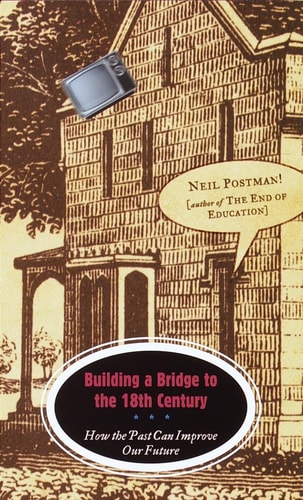
Building a bridge to the 18th century: how the past can improve our future

Postman, Neil
In Building a Bridge to the 18th Century , acclaimed cultural critic Neil Postman offers a cure for the hysteria and hazy values of the postmodern world. Postman shows us how to reclaim that balance between mind and machine in a dazzling celebration of the accomplishments of the Enlightenment-from Jefferson's representative democracy to Locke's deductive reasoning to Rousseau's demand that the care and edification of children be considered an investment in our collective future. Here, too, is the bold assertion that Truth is invulnerable to fashion or the passing of time. Provocative and brilliantly argued, Building a Bridge to the 18th Century illuminates a navigable path through the Information Age-a byway whose signposts, it turns out, were there all along.
Knopf 2000-10-10 213 pages

The human use of human beings: cybernetics and society

Wiener, Norbert
"In 1950, mathematician-philosopher Norbert Wiener ended this classic book on the place of machines in society with a warning: "We shall never receive the right answers to our questions unless we ask the right questions.... The hour is very late, and the choice of good and evil knocks at our door." Wiener, the founder of the science of cybernetics--the study of the relationship between computers and the human nervous system--was widely mislabeled as an advocate for the automation of human life. As The Human Use for Human Beings reveals, his vision was much more complex and interesting, and is more relevant in today's world of AI than anyone could have anticipated. In his new introduction, Brian Christian aptly calls Wiener the "progenitor of contemporary AI-safety discourse." Wiener hoped that machines would release people from relentless and repetitive drudgery to achieve more creative pursuits, yet he anticipated the danger of dehumanizing and displacement. His pioneering views on the human-machine relationship as a "communicative process" are only more crucial now, as we carry in our pockets AI devices that we can literally speak to. His prescient warnings illuminate our contemporary relationships with language, art, and even social media. The Human Use of Human Beings examines the implications of cybernetics for education, law, language, science, technology, as Wiener anticipates the enormous impact--in effect, a third industrial revolution--that the computer has had on our lives."-- Provided by publisher
Mariner Classics 2025-08-12 240 pages

Which side of history? how technology is reshaping democracy and our lives

James P. Steyer
"A collection of 20-25 essays from prominent voices that brings forward creative, bold opinions that will examine the current state and impact of technology on our society and will highlight solutions for constructive change. Sample topics may include: 1 the impact of technology on elections and global democratic institutions; 2 the evisceration of longstanding privacy norms and standards; 3 the impact of technology on kids and teenagers; 4 the rise of cyberbullying and hate speech and how to address these challenges; and, 5 the libertarian ethos that often prizes a "move fast and break things" mentality and its relationship to the Silicon Valley culture bubble"--
Chronicle Prism 2020 327 pages

Present shock: when everything happens now

Rushkoff, Douglas
"An award-winning author explores how the world works in our age of "continuous now" Back in the 1970s, futurism was all the rage. But looking forward is becoming a thing of the past. According to Douglas Rushkoff, "presentism" is the new ethos of a society that's always on, in real time, updating live. Guided by neither history nor long term goals, we navigate a sea of media that blend the past and future into a mash-up of instantaneous experience. Rushkoff shows how this trend is both disorienting and exhilarating. Without linear narrative we get both the humiliations of reality TV and the associative brilliance of The Simpsons. With no time for long term investing, we invent dangerously compressed derivatives yet also revive sustainable local businesses. In politics, presentism drives both the Tea Party and the Occupy movement. In many ways, this was the goal of digital technology--outsourcing our memory was supposed to free us up to focus on the present. But we are in danger of squandering this cognitive surplus on trivia. Rushkoff shows how we can instead ground ourselves in the reality of the present tense. "--
Penguin Books 2014-02-25 296 pages

Brooklyn Bridge: Fact and symbol

Trachtenberg, Alan
Fourteen of Walker Evans's evocative photographs of Brooklyn Bridge, most of which have never been published, appear in this edition of Alan Trachenberg's Brooklyn Bridge: Fact and Symbol. In the new afterword Trachenberg explores the history of Hart Crane's The Bridge, especially the poem's integral relationship with the powerful photography of Evans."[Brooklyn Bridge] is familiar in so many movies, in so many stage sets and, as Mr. Trachtenberg shows in this brilliant . . . book, it is at least as much a symbol as a reality. . . . Mr. Trachtenberg is always exciting and illuminating."—Times Literary Supplement "The book is a skillful and insightful synthesis of materials about Brooklyn Bridge from such diverse fields as history, engineering, literature and art. Essentially it asks the question of why Brooklyn Bridge achieved such great impact on the nineteenth century American imagination and why it has continued to have a significant impact on twentieth century art and literature. In addition to its exploration of the bridge's symbolic significance, which includes perceptive analyses of such particular works as Hart Crane's great poem cycle and the paintings of artists like Joseph Stella, the book also includes a solidly researched account of the conception, planning and construction of the bridge. Trachtenberg's account of the intellectual and cultural sources of the bridge is particularly fascinating in its demonstration of the convergence of many different philosophical and ideological currents of the time around this great engineering enterprise, illustrating as effectively as any discussion I know the complex interplay of ideas and material culture."—John G. Cawelti, University of Chicago"Alan Trachtenberg's Brooklyn Bridge is a fascinating story, the philosophic genesis of the idea in Europe, John Roebling's heroic effort to translate it into masonry and steel, and the meanings that Americans attached to the physical object as an emblem of their aspirations."—Leo Marx, Amherst College, author of The Machine in the Garden
Oxford University Press 1965 192 pages

The inner history of devices

Turkle,Sherry
"For more than two decades, in such landmark studies as The Second Self and Life on the Screen, Sherry Turkle has challenged our collective imagination with her insights about how technology enters our private worlds. In The Inner History of Devices, she describes her process, an approach that reveals how what we make is woven into our ways of seeing ourselves. She brings together three traditions of listening--that of the memoirist, the clinician, and the ethnographer. Each informs the others to compose an inner history of devices. We read about objects ranging from cell phones and video poker to prosthetic eyes, from Web sites and television to dialysis machines.
MIT Press 2008 208 pages

Simulation and its discontents

Turkle, Sherry
How the simulation and visualization technologies so pervasive in science, engineering, and design have changed our way of seeing the world. Over the past twenty years, the technologies of simulation and visualization have changed our ways of looking at the world. In Simulation and Its Discontents , Sherry Turkle examines the now dominant medium of our working lives and finds that simulation has become its own sensibility. We hear it in Turkle's description of architecture students who no longer design with a pencil, of science and engineering students who admit that computer models seem more “real” than experiments in physical laboratories. Echoing architect Louis Kahn's famous question, “What does a brick want?”, Turkle asks, “What does simulation want?” Simulations want, even demand, immersion, and the benefits are clear. Architects create buildings unimaginable before virtual design; scientists determine the structure of molecules by manipulating them in virtual space; physicians practice anatomy on digitized humans. But immersed in simulation, we are vulnerable. There are losses as well as gains. Older scientists describe a younger generation as “drunk with code.” Young scientists, engineers, and designers, full citizens of the virtual, scramble to capture their mentors' tacit knowledge of buildings and bodies. From both sides of a generational divide, there is anxiety that in simulation, something important is slipping away. Turkle's examination of simulation over the past twenty years is followed by four in-depth investigations of contemporary simulation culture: space exploration, oceanography, architecture, and biology.
The MIT Press 2009-04-17 217 pages

Favorites of fortune: technology, growth, and economic development since the Industrial Revolution

Patrice L. R. Higonnet,David S. Landes,Henry Rosovsky
A galaxy of distinguished international economists and historians pit economic history against the shaky assumptions of the classical economic theory of natural growth. Their explanations consider the factors of technology, entrepreneurialism, and paths to economic growth, but each reflects an ideological wave of explanation that has marked the last two hundred years.
Harvard University Press 1991-01 558 pages

Forces of production: a social history of industrial automation

Noble, David F.
Focusing on the design and implementation of computer-based automatic machine tools, David F. Noble challenges the idea that technology has a life of its own. Technology has been both a convenient scapegoat and a universal solution, serving to disarm critics, divert attention, depoliticize debate, and dismiss discussion of the fundamental antagonisms and inequalities that continue to beset America. This provocative study of the postwar automation of the American metal-working industry—the heart of a modern industrial economy—explains how dominant institutions like the great corporations, the universities, and the military, along with the ideology of modern engineering shape, the development of technology. Noble shows how the system of "numerical control," perfected at the Massachusetts Institute of Technology (MIT) and put into general industrial use, was chosen over competing systems for reasons other than the technical and economic superiority typically advanced by its promoters. Numerical control took shape at an MIT laboratory rather than in a manufacturing setting, and a market for the new technology was created, not by cost-minded producers, but instead by the U. S. Air Force. Competing methods, equally promising, were rejected because they left control of production in the hands of skilled workers, rather than in those of management or programmers. Noble demonstrates that engineering design is influenced by political, economic, managerial, and sociological considerations, while the deployment of equipment—illustrated by a detailed case history of a large General Electric plant in Massachusetts—can become entangled with such matters as labor classification, shop organization, managerial responsibility, and patterns of authority. In its examination of technology as a human, social process, Forces of Production is a path-breaking contribution to the understanding of this phenomenon in American society.
Transaction Publishers 2011 409 pages

The Social shaping of technology: how the refrigerator got its hum

Donald A. MacKenzie,Judy Wajcman
Technological change is often seen as something that follows its own logic – something about which we may protest, but which we are unable to alter fundamentally. This reader challenges that assumption. In it, a collection of distinguished authors demonstrate that technology is affected at a fundamental level by the social context in which it develops. The first section introduces the reader to general arguments about the relation of technology to society. In subsequent sections the editors examine three types of technology in particular: the technology of production, domestic technology and military (especially nuclear) technology. In each case a variety of examples is used to demonstrate how technologies reflect such features of the social and economic environment as the social relations of the workplace, gender divisions in society, or the dictates of the state. The editors argue that social scientists have devoted disproportionate attention to the effects of technology on society, and have tended to ignore the more fundamental question of what shapes technology in the first place. Drawing both on established work in the history of technology and on newer feminist and Marxist perspectives they show how important and fruitful it is to try to answer the deeper question.
Open University Press 1985 327 pages

America by design: science technology and the rise of corporate capitalism

Noble, David F.
Oxford University Press paperback. Includes bibliographical references and index. pt. 1: Technology as social production. The wedding of science to the useful arts--1: The rise of science-based industry. The wedding of science to the useful arts--2: The development of technical education. The wedding of science to the useful arts--3: The emergence of the professional engineer. Preservation through change: Corporate engineers and social reform -- pt. 2: Corporate reform as conscious social production. Laying the foundation: Scientific and industrial standardization. The corporation as inventor: Patent-law reform and patent monoply. Science for industry: The organization of industrial and university research. Technology as people: The industrial process of higher education --1. Technology as people: The industrial process of higher education--2. A technology of social production: Modern management and the expansion of engineering. * dss 20081210.
Oxford University Press 1979 384 pages

The American Presidency: an interpretation

Laski, Harold Joseph
The growth in recent years of Soviet political involvement and military presence in the Mediterranean/Middle East region poses a serious challenge to the security of NATO's southern flank. Among other aims, the Soviets hope to reduce Western, especially American, influence in the area; counter and/or neutralize the U.S. strategic posture; and bring to fruition the historic Russian drive for open access through the Turkish Straits. General Gurkan argues that Moscow's strategy is to shift pressure from the relatively stable central region of NATO to the flanks in a multiple pronged southern thrust.
Transaction Books 1980-01-15 67 pages