19 results for "Trade"

Arguing with zombies: economics, politics, and the fight for a better future

Krugman, Paul R.
"An accessible, compelling introduction to today's major policy issues from columnist, best-selling author, and Nobel Prize-winning economist Paul Krugman. There is no better guide than Paul Krugman to basic economics, the ideas that animate much of our public policy. Likewise, there is no better foe of zombie economics, the misunderstandings that just won't die. This delightful new book finds Krugman at his best, turning readers into intelligent consumers of the daily news with quick, vivid sketches of the key concepts behind taxes, health care, international trade, and more. Arguing with Zombies will put Krugman at the front of the debate in the 2020 election year. Building on and expanding his New York Times columns and other writings, it contains short, accessible chapters on topics including the fight for national health care in the United States, the housing bubble and financial meltdown of 2007- 2008, the European Union and Brexit, the attack on Social Security, and the fraudulent argument- the ultimate zombie- that tax cuts for the rich will benefit all"--
W. W. Norton & Company 2020-01-28 444 pages

The return of Marco Polo's world: war, strategy, and American interests in the twenty-first century

Kaplan, Robert D.
"A bracing assessment of U.S. foreign policy and world disorder over the past two decades, anchored by a major new Pentagon-commissioned essay about changing power dynamics among China, Eurasia, and America--from the renowned geopolitical analyst and bestselling author of The Revenge of Geography and The Coming Anarchy. In the late thirteenth century, Marco Polo began a decades-long trek from Venice to China. The strength of that Silk Road--the trade route between Europe and Asia--was a foundation of Kublai Khan's sprawling empire. Now, in the early twenty-first century, the Chinese regime has proposed a land-and-maritime Silk Road that duplicates exactly the route Marco Polo traveled. In the major lead essay, recently released by the Pentagon's Office of Net Assessment, Robert D. Kaplan lays out a blueprint of the world's changing power politics that recalls the late thirteenth century. As Europe fractures from changes in culture and migration, Eurasia coheres into a single conflict system. China is constructing a land bridge to Europe. Iran and India are trying to link the oil fields of Central Asia to the Indian Ocean. America's ability to influence the power balance in Eurasia is declining. This is Kaplan's first collection of essays since his classic The Coming Anarchy was published in 2000. Drawing on decades of firsthand experience as a foreign correspondent and military embed for The Atlantic, as well as encounters with preeminent realist thinkers, Kaplan outlines the timeless principles that should shape America's role in a turbulent world: a respect for the limits of Western-style democracy; a delineation between American interests and American values; an awareness of the psychological toll of warfare; a projection of power via a strong navy; and more. From Kaplan's immediate thoughts on President Trump ("On Foreign Policy, Donald Trump Is No Realist," 2016) to a frank examination of what will happen in the event of war with North Korea ("When North Korea Falls," 2006), The Return of Marco Polo's World is a vigorous and honest reckoning with the difficult choices the United States will face in the years ahead. "These essays constitute a truly pathbreaking, brilliant synthesis and analysis of geographic, political, technological, and economic trends with far-reaching consequences. The Return of Marco Polo's World is another work by Robert D. Kaplan that will be regarded as a classic."--General David Petraeus (U.S. Army, Ret.)"--
Random House 2018 280 pages

Sexual revolution: modern fascism and the feminist fightback

Penny, Laurie
'Captivating, emphatic and deeply inspiring, Sexual Revolution lifted me greatly by envisioning the possibilities of our moment' V (formerly Eve Ensler) 'Brilliant; vital; revolutionary' Kate Manne _________________ This is a story about how modern masculinity is killing the world, and how feminism can save it. It's a story about sex and power and trauma and resistance and persistence. Sex and gender are changing, and the world is changing with them. In this time of crisis, we are also witnessing a productive transformation: a revolutionary change in how we define gender, sex, consent and whose bodies matter.This sexual revolution is a threat to the social and economic order. It undermines the existing power structures and weakens the authority of institutions from the waged workplace to the nuclear family. No wonder the far right is fighting back so hard.Told with Laurie Penny's trademark urgency and candour, Sexual Revolution is a hand-grenade of a book: both a manifesto for social change and a story of how feminism can save us.
Bloomsbury Publishing 2022 297 pages

The populist explosion: how the great recession transformed American and European politics

Judis, John B.
Is the West witnessing a huge political upheaval? As if overnight, many Democrats revolted and passionately backed a socialist named Bernie Sanders; the United Kingdom voted to leave the European Union, in a stunning rebuke; the vituperative billionaire Donald Trump became the presidential nominee of the Republican Party; and a slew of rebellious parties continued to win election after election in countries like Switzerland, Norway, Italy, Austria, and Greece. John B. Judis tells us why we need to learn about the populist movement that began in the United States in the 1890s, the politics of which have recurred on both sides of the Atlantic ever since. Populism, on both the right and the left, champions the people against an establishment, based on issues -- globalization, free trade, immigration -- on which there has been a strong elite consensus, but also an even stronger mass discontent that is now breaking out in the open.
Columbia Global Reports 2016 182 pages

Meat market: female flesh under capitalism

Penny, Laurie
Modern culture is obsessed with controlling women's bodies. Our societies are saturated with images of unreal, idealised female beauty whilst real female bodies and the women who inhabit them are alienated from their own personal and political potential. Under modern capitalism, women are both consumers and consumed: Meat Market offers strategies for resisting this gory cycle of consumption, exposing how the trade in female flesh extends into every part of women's political selfhood.
Zero 2011-04-29 68 pages

Dark mirror: Edward Snowden and the American Surveillance State

Gellman, Barton
"Edward Snowden chose three journalists to tell the stories in his Top Secret trove of NSA documents: Barton Gellman of The Washington Post, Glenn Greenwald of The Guardian and filmmaker Laura Poitras, all of whom would share the Pulitzer Prize for Public Service. Poitras went on to direct the Oscar-winning Citizenfour. Greenwald wrote an instant memoir and cast himself as a pugilist on Snowden's behalf. Gellman took his own path. Snowden and his documents were the beginning, not the end, of a story he had prepared his whole life to tell. More than 20 years as a top investigative journalist armed him with deep sources in national security and high technology. New sources reached out from government and industry, making contact on the same kinds of secret, anonymous channels that Snowden had used. Gellman's reporting unlocked new puzzles in the NSA archive. And as Snowden's revelations faded somewhat from the public consciousness, the machinations he exposed continue still, with many policies unaltered despite societal outrage. Dark Mirror is a true-life spy tale that touches us all, told with authority and an inside view of extraordinary events. Within it is a chilling personal account of the obstacles facing the author, beginning with Gellman's discovery of his own name in Snowden's NSA document trove. Google notifies him that a foreign government is trying to compromise his account. A trusted technical adviser finds anomalies on his laptop. Sophisticated impostors approach Gellman with counterfeit documents, attempting to divert or discredit his work. Throughout Dark Mirror, the author wages an escalating battle against unknown digital adversaries who force him to mimic their tradecraft in self-defense. With the vivid and insightful style that marked Gellman's bestselling Angler, Dark Mirror is an inside account of the surveillance-industrial revolution and its discontents, fighting back against state and corporate intrusions into our most private spheres. Along the way, and with the benefit of hindsight, it tells the full story of a government leak unrivaled in drama since All the President's Men"--
Penguin Press 2020-05-19 426 pages

The long emergency: surviving the converging catastrophes of the twenty-first century

Kunstler, James Howard
With his classics of social commentary "The Geography of Nowhere and "Home from Nowhere, James Howard Kunstler has established himself as one of the great commentators on American space and place. Now, with "The Long Emergency, he offers a shocking vision of a post-oil future. The last two hundred years have seen the greatest explosion of progress and wealth in the history of mankind. But the oil age is at an end. The depletion of nonrenewable fossil fuels is about to radically change life as we know it, and much sooner than we think. As a result of artificially cheap fossil-fuel energy we have developed global models of industry, commerce, food production, and finance that will collapse. "The Long Emergency tells us just what to expect after we pass the tipping point of global peak oil production and the honeymoon of affordable energy is over, preparing us for economic, political, and social changes of an unimaginable scale. Are we laboring under a Jiminy Cricket syndrome when we tell ourselves that alternative means of energy are just a few years away? Even once they are developed, will they ever be able to sustain us in the way that fossil fuels once did? What will happen when our current plagues of global warming, epidemic disease, and overpopulation collide to exacerbate the end of the oil age? Will the new global economy be able to persevere, or will we be forced to revert to the more agrarian, localized economy we once knew? Could corporations like Wal-Mart and McDonald's, built on the premise of cheap transportation, become a thing of the past? Will the misguided experiment of suburbia--considered a birthright and a reality by millions of Americans--collapse when the car culturebecomes obsolete? Riveting and authoritative. "The Long Emergency is a devastating indictment that brings new urgency and accessibility to the critical issues that will shape our future, and that we can no longer afford to ignore. It is bound to become a classic of social science.
Atlantic Monthly Press 2005 307 pages

The nationalist revival: trade, immigration, and the revolt against globalization

Judis, John B.
"Why has nationalism come roaring back? Trump in America, Brexit in the U.K., anti-EU parties in Italy, Germany, France, the Netherlands, Austria, Poland, and Hungary, and nativist or authoritarian leaders in Turkey, Russia, India, and China -- why has nationalism suddenly returned with a vengeance? Is the world headed back to the fractious conflicts between nations that led to world wars and depression in the early 20th Century? Why are nationalists so angry about free trade and immigration? Why has globalization become a dirty word? Based on travels in America, Europe, and Asia, veteran political analyst John B. Judis found that almost all people share nationalist sentiments that can be the basis of vibrant democracies as well as repressive dictatorships. Today's outbreak of toxic "us vs. them" nationalism is an extreme reaction to utopian cosmopolitanism, which advocates open borders, free trade, rampant outsourcing, and has branded nationalist sentiments as bigotry. Can a new international order be created that doesn't dismiss what is constructive about nationalism? As he did for populism in The Populist Explosion, a runaway success after the 2016 election, Judis looks at nationalism from its modern origins in the 1800s to today to find answers"--Back cover.
Columbia Global Reports 2018 157 pages

Contemporary left antisemitism

Hirsh, David
Today's antisemitism is difficult to recognize because it does not come dressed in a Nazi uniform and it does not openly proclaim its hatred or fear of Jews. This book looks at the kind of antisemitism which is tolerated or which goes unacknowledged in apparently democratic spaces: trade unions, churches, left-wing and liberal politics, social gatherings of the chattering classes and the seminars and journals of radical intellectuals. It analyses how criticism of Israel can mushroom into antisemitism and it looks at struggles over how antisemitism is defined. It focuses on ways in which those who raise the issue of antisemitism are often accused of doing so in bad faith in an attempt to silence or smear. Hostility to Israel has become a signifier of identity, connected to opposition to imperialism, neo-liberalism and global capitalism; the 'community of the good' takes on toxic ways of imagining most living Jewish people.
Routledge 2017 314 pages

No end to war: terrorism in the twenty-first century

Laqueur, Walter
While the destruction of the World Trade Center and the strike against the Pentagon shocked the world at large, experts on terrorism like Walter Laqueur couldn't feign complete surprise. In No End to War, Laqueur, who has devoted three decades to the study of political violence, answers the most-often raised questions about terrorism in the light of 9/11 and the still unsolved Anthrax letters. First, what constitutes terrorism? What is new about the "new" terrorism? Why is the Muslim world the most potent breeding ground of this new terrorism? To what extent is religion itself a factor? Is there a clash of civilizations between the Muslim world and the largely Christian or post-Christian West? Is America at fault? Israel? Did European nations turn a blind eye to terrorists and their sympathizers in their midst? To what extent are poverty and oppression the causes of terrorism? What is the likelihood that terrorists will obtain weapons of mass destruction-chemical, biological, or nuclear? Why was the United States unprepared for 9/11? Why the intelligence failure? Are Islamic terrorists the only terrorists we need to fear? What about other terrorists from the right of the left, ecoterrorists or anti-globalization terrorists? And finally, what is the best defense against terrorism?>
Continuum 2003-05-01 288 pages

Getting to the heart of the matter: my 36 years in the Senate

Levin, Carl
"Representing Michigan for thirty-six years in the U.S. Senate, Carl Levin, the longest-serving senator in Michigan history, was known for his dogged pursuit of the truth, his commitment to holding government accountable, and his basic decency. Getting to the Heart of the Matter: My 36 Years in the Senate is his story - from his early days in Detroit as the son of a respected lawyer to the capstone of his career as chair of both the Senate Armed Services Committee and the Senate Permanent Subcommittee on Investigations. Levin's career placed him at the center of some of our nation's most critical points in modern times: from the aftermath of the 1967 Detroit riots, to the Clinton impeachment, through 9/11 and the wars in Iraq and Afghanistan, and the 2008 financial crisis. He met with numerous world leaders, including Egypt's Anwar Sadat and China's Jiang Zemin. Getting to the Heart of the Matter recounts Levin's experiences, thoughts, and actions during these historic moments. Consisting of seventeen chapters, the book takes the reader through Levin's early life in Detroit of the 1940s, 50s, and 60s where he met his wife, started a family, practiced law and served as the first General Counsel for the newly created Michigan Civil Rights Commission and the chief appellate defender for Detroit's Legal Aid Office. Elected to the Detroit City Council in 1969, where Levin served for eight years including four as Council president, the book describes how his fight against the Department of Housing and Urban Development's devastating housing practices in the neighborhoods of Detroit led him to run for the U.S. Senate with a pledge to make government work more effectively. Winning election six times, Levin had an illustrious career in the Senate where he challenged leaders in government and the private sector for the greater good of the nation. Levin describes how, as a Democrat, throughout his time in the Senate, he worked with Republican senators who often held different policy positions in order to find common ground to achieve national goals, and how he and his Senate staff searched for creative solutions to trade issues, support for the auto industry and manufacturing sector, U.S. military action in Iraq and Afghanistan, and efforts to protect the Great Lakes and the environment, among many other issues. Levin's hope in writing this memoir is that by sharing his deeply held beliefs about the responsibility of elected officials, the book will serve as a resource for people beginning a career in, or contemplating running for, public office. Readers with an interest in politics, history, facts, and perseverance will find kinship in this book" -- provided by the publisher
Wayne State University Press 2021 338 pages

Foreign Policy Breakthroughs: Cases in Successful Diplomacy

Robert L. Hutchings,Jeremi Suri
"Diplomacy is essential to the conduct of foreign policy and international business in the twenty-first century. Yet, few international actors are trained to understand or practice effective diplomacy. Poor diplomacy has contributed to repeated setbacks for the United States and other major powers in the last decade. Drawing on deep historical research, this book aims to 'reinvent' diplomacy for our current era. The original and comparative research provides a foundation for thinking about what successful outreach, negotiation, and relationship-building with foreign actors should look like. Instead of focusing only on failures, as most studies do, this one interrogates success. The book provides a framework for defining successful diplomacy and implementing it in diverse contexts. Chapters analyze the activities of diverse diplomats (including state and non-state actors) in enduring cases, including: post-WWII relief, the rise of the non-aligned movement, the Nuclear Non-Proliferation Treaty, the U.S. opening to China, the Camp David Accords, the reunification of Germany, the creation of the European Union, the completion of the North American Free Trade Agreement, and relief aid to pre-2001 Afghanistan. The cases are diverse and historical, but they are written with an eye toward contemporary challenges and opportunities. The book closes with systematic reflections on how current diplomats can improve their activities abroad. Foreign Policy Breakthroughs offers rigorous historical insights for present policy"--
Oxford University Press 2015 284 pages

Starting from zero: reconstructing downtown New York

Sorkin, Michael
Architect and social critic Michael Sorkin develops his own vision of the future lower Manhattan through a series of chronologically organized essays illustrated with full-color images of his own plans. Mixing his inimitable brand of social criticism with more personal reflections, Starting From Zero offers a striving challenge to the Ground Zero redevelopment plan recently chosen by New York's establishment insiders.
Routledge 2003 143 pages

Answer me this!

Zaltzman, Helen
Answer Me This! is a weekly interactive comedy podcast, presented by Helen Zaltzman and Olly Mann. In each show Helen and Olly answer listener-submitted questions, as diverse and fantastical as 'Why does golf bring out the worst in people?', 'Who invented the scotch egg?' and 'Why do all girls hate me?' In the Answer Me This! Question Compendium, Helen and Olly bring their trademark irreverence to the page for the first time in an inventive and witty spin on the classic Q & A format. Since its debut in January 2007, Answer Me This! has been chosen as an iTunes Podcast of the Year in 2008, and in 2009 became the first independently produced podcast to be nominated for a Sony Radio Academy Award. With listeners all over the world, and more than 1.5 million downloads per year, the show is now one of the most popular comedy podcasts in Britain.
Faber 2010 200 pages

Back back back: Celebrity row ; Outrage

Moses, Itamar
Itamar Moses has been hailed as one of America's most talented young playwrights since his critically acclaimed Bach at Leipzig debuted in 2005. In this anthology of three new plays, Moses blurs the line between fact and fiction, dramatizing today's most infamous news stories. In Back Back Back , the pressures of performance and reputation get the best of three professional baseball players when they are forced to reveal their not-so-natural secrets to winning the game. In Celebrity Row , Moses imagines what Timothy McVeigh, Ted Kaczynski, the 1993 World Trade Center bomber Ramzi Yousef, and the Latin Kings leader Luis Felipe would have philosophized about when they were inhabitants of the same maximum security prison in Colorado. Finally, in Outrage , the dangerous teacher-disciple relationship calls all of academia into question with the help of none other than Socrates and Bertolt Brecht.
Faber and Faber 2009-07-07 311 pages

Boris Johnson: the gambler

Bower, Tom
With his trademark access, insight and candour, Britain's leading investigative biographer tackles his most fascinating subject yet: Alexander Boris de Pfeffel Johnson, the UK's Prime Minister. As divisive as he is beguiling, as misunderstood as he is scrutinised, Boris Johnson is a singular figure. Many of us think we know his story well. His ruthless ambition was evident from his insistence, as a three-year-old, that he would one day be 'world king'. Eton and Oxford prepared him well for a frantic career straddling the dog-eat-dog worlds of journalism and politics. His transformation from bumbling stooge on Have I Got New for You to a triumphant Mayor of London was overshadowed only by his colourful personal life, brimming with affairs, scandals and transgressions. His ascent to Number 10 in the wake of the acrimonious, era-defining Brexit referendum would prove to be only the first act in an epic drama that saw him play both hero and villain - from proroguing parliament to his controversial leadership of the Covid-19 Crisis, all against the backdrop of divorce, marriage, the birth of his sixth child, revolts among Tory MPs and the countdown to Brexit. Yet despite his celebrity, decades of media scrutiny, the endless vitriol of his critics and the enduring adoration of his supporters, there is so much we've never understood about Boris - until now. Previous biographies have either dismissed him as a lazy, deceitful opportunist or been transfixed by his charm, wit and drive. Both approaches fall short, and so many questions about Boris remain unanswered. What seismic events of his childhood have evaded scrutiny? How has he so consistently defied the odds, proved his critics wrong, and got away with increasingly reckless gambles? What were his real achievements and failures as Mayor of London, what was really going on during his time as Foreign Secretary, and why did he write two articles for the Telegraph, one in favour of Leave and the other for Remain? How have the women in his life exerted more influence than any of us realise, and why is his story ultimately one overshadowed by family secrets? Based on a wealth of new interviews and research, this is the deepest, most rounded and most comprehensive portrait to date of the man, the mind, the politics, the affairs, the family - of a loner, a lover, a leader. Revelatory, unsettling and compulsively readable, it is the most timely and indispensable book yet from Britain's leading investigative biographer
WH Allen 2020 578 pages

Beginner's luck

Fanthorpe, U. A.
When she died, in 2009, Anthony Thwaite described U.A. Fanthorpe as a 'smiling subversive with a voice like bird-song'. An encouraging example to all late developers, this particular bird's voice took its time: she didn't become a poet until she was 45. But these examples of her very earliest work show the latent mastery and the rapid development of the craft that would bring her wide critical acclaim and an affectionate general readership. The mysteries of the trade gradually reveal themselves as rooted in a wide and uncensored range of subject-matter, a life-time's love of words, and an intuitive grasp of the mechanics of form and voice. Recognising her role so late, she was a woman in a hurry; there wasn't time for self-consciousness or grandiose notions of 'vocation'. 'A poet, ' she said, 'is a smuggler. He imports things clandestinely which are not supposed to have got through the customs.' Poetry 'happened to me', she would say. Her job? To listen, to pass it on.
Bloodaxe Books Ltd 2019 94 pages

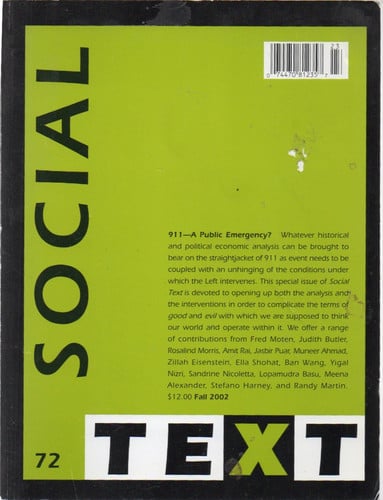
911 a Public Emergency?

Brent Hayes Edwards,Stefano Harney,Randy Martin,Ella Shohat,Timothy Mitchell,Fred Moten
Since September 11, public discourse has often been framed in terms of absolutes: an age of innocence gives way to a present under siege, while the United States and its allies face off against the Axis of Evil. This special issue of Social Text aims to move beyond these binaries toward thoughtful analysis. The editors argue that the challenge for the Left is to develop an antiterrorism stance that acknowledges the legacy of U.S. trade and foreign policy as well as the diversity of the Muslim faith and the dangers presented by fundamentalism of all kinds. Examining the strengths and shortcomings of area, race, and gender studies in the search for understanding, this issue considers cross-cultural feminism as a means of combating terrorism; racial profiling of Muslims in the context of other racist logics; and the homogenization of dissent. The issue includes poetry, photographic work, and an article by Judith Butler on the discursive space surrounding the attacks of September 11. This impressive range of contributions questions the meaning and implications of the events of September 11 and their aftermath. Contributors . Muneer Ahmad, Meena Alexander, Lopamudra Basu, Judith Butler, Zillah Eisenstein, Stefano Harney, Randy Martin, Rosalind C. Morris, Fred Moten, Sandrine Nicoletta, Yigal Nizri, Jasbir K. Puar, Amit S. Rai, Ella Shohat, Ban Wang
Duke University Press 2002-09-20 208 pages