8 results for "Trade"

Does America Need a Foreign Policy?

Dr Henry A Kissinger
In a timely, lucidly written, and highly accessible examination of America's position in the world today, Henry Kissinger delves into the traditional issues of U.S. relations with Russia, China, Europe, and other regions, as well as recently emerging concerns about globalization, free trade, U.S. military involvement abroad, and the endangered environment. Focusing on current and future policy choices, Kissinger presents an eye-opening perspective on the United States' role as the world's dominate power and outlines how it can be effectively reconciled with the urgent need to achieve a world order based on consensus in the twenty-first century. The new administration's approach to foreign policy has raised many questions about where the country is headed. In a proposal that is solidly grounded and brilliantly argued, Kissinger lays out a compelling and comprehensive vision of the direction America must take in the coming decades.
Turtleback Books 2002-09

Too Close to Call The Thirty-Six-Day Battle to Decide the 2000 Election

Jeffrey Toobin
From the best-selling author of A Vast Conspiracy and The Run of His Life comes Too Close to Call --the definitive story of the Bush-Gore presidential recount. A political and legal analyst of unparalleled journalistic skill, Jeffrey Toobin is the ideal writer to distill the events of the thirty-six anxiety-filled days that culminated in one of the most stunning Supreme Court decisions in history. Packed with news-making disclosures and written with the drive of a legal thriller, Too Close to Call takes us inside James Baker's private jet, through the locked gates to Al Gore's mansion, behind the covered-up windows of Katherine Harris's office, and even into the secret conference room of the United States Supreme Court. As the scene shifts from Washington to Austin and into the remote corners of the enduringly strange Sunshine State, Toobin's book will transform what you thought you knew about the most extraordinary political drama in American history. The Florida recount unfolded in a kaleidoscopic maze of bizarre concepts (chads, pregnant and otherwise), unfamiliar people in critically important positions (the Florida Supreme Court), and familiar people in surprising new places (the Miami relatives of Elián González, in a previously undisclosed role in this melodrama). With the rich characterization that is his trademark, Toobin portrays the prominent strategists who masterminded the campaigns--the Daleys and the Roves--and also the lesser-known but influential players who pulled the strings, as well as the judges and justices whose decisions determined the final outcome. Toobin gives both camps a treatment they have not yet received--remarkably evenhanded, nonpartisan, and entirely new. The post-election period posed a challenge to even the most zealous news junkie: how to keep up with what was happening and sort out the important from the trivial. Jeffrey Toobin has now done this--and then some. With clarity, insight, humor, and a deep understanding of the law, he deconstructs the events, the players, and the often Byzantine intricacies of our judicial system. A remarkable account of one of the most significant periods in our country's history, Too Close to Call is endlessly surprising, frequently poignant, and wholly addictive.
Random House Publishing Group 2002-10-08 320 pages

Sovereignty Under Challenge: How Governments Respond

Glazer, Nathan
Sovereignty-the authority of a state to wield ultimate power over its territory, its citizens, its institutions-is everywhere undergoing change as states respond in various ways to the challenges posed, from above and below. "Above" the state is the widening net of international institutions and treaties dealing with human rights, trade, investment, and monetary affairs; and "below" it are rising claims within states from long-resident groups discontented with the political order and from new migrants testing its authority. Sovereignty under Challenge deals with a range of such challenges and responses, analyzed in authoritative studies by leading scholars. The introductory chapter sets forth the theme that sovereignty is asserted clearly, but often unpredictably, when governments respond to challenge. It suggests ways of classifying these responses as variables that help explain the changing nature of sovereignty. Part 1, "The Citizen and the State," treats the rising tide of dual citizenship and the concerns this arouses in the United States; the work of national human rights commissions in Asia; and the challenge posed to the state by the Falungong movement in China. The two chapters in Part 2, "The Government as Decision-Maker," examine Japan's response to global warming and the problems of the World Health Organization in orchestrating collaboration among Southeast Asian states in implementing infectious disease control. Part 3, "Sovereignty and Culture," looks at conflicts engendered by outside change on indigenous economic, cultural, and legal institutions in India, Fiji, Indonesia, and Malaysia. The chapters in Part 4, "Sovereignty and the Economy," analyze the economic and cultural instability induced by Chinese migration to Russia's far east; the impact on state sovereignty brought about by transnational regulatory campaigns and social activism; the question of indigenous land rights in the Philippines; and the impact of transnational corporations on information technology in Asia. A concluding chapter offers a global assessment of the current status of state sovereignty.
[distributor] Taylor & Francis, c/o Bookpoint 2017-11-15 402 pages

Principles of Political Economy and Taxation

David Ricardo
David Ricardo's On the Principles of Political Economy and Taxation the implications of land rent increases along with population among other things. Ricardo argues for the acceptance of free trade and shows how it's both short and long term advantages. The arguments laid out in this book form the basis of modern trade theory and are, therefore, of interest in today's global economy.
CreateSpace Independent Publishing Platform 2010-09-24 220 pages

How to Make Peace in the Middle East in Six Months or Less Without Leaving Your Apartment

Gregory Levey
Gregory Levey’s modest goal is to solve the Middle East conflict—all by himself. After returning to North America following a stint in his midtwenties writing speeches for the Israeli government—first at the United Nations and then for the prime minister in Jerusalem—he thinks he is leaving the madness of the Middle East conflict behind. But nothing could be further from the truth. Levey soon discovers that everyone on this side of the Atlantic seems to think that they have the solution to the intractable conflict—and they all feel the need to tell him about it. Fatigued by the endless debate, the constant hostility, and the cacophony of shrill voices, he decides that the only way he is going to escape it all is if he solves the conflict himself, once and for all. So Levey sets out on a hilarious, quixotic, and surprisingly illuminating quest to broker a peace deal where a long line of world leaders have failed. Interacting with White House officials, DC lobbyists, congressmen, advisors to presidential candidates, high-profile journalists, secretive fundraisers, former Israeli spies now living in North America, and hundreds and hundreds of Jewish grandmothers, Levey tries to understand why the Middle East situation refuses to be resolved, and why so many people who live a world away are so obsessed with it. He combs through theories ranging from the eminently reasonable to the completely insane, engages in virtual peacemaking simulations, investigates an “online suicide bombing,” spends time with a former advisor to Yasser Arafat, undergoes training with a half-baked Jewish paramilitary group, goes undercover as an Evangelical Christian, and somehow ends up at a real-life castle owned by an eccentric, cape-wearing crusader for peace. In How to Make Peace in the Middle East in Six Months or Less Without Leaving Your Apartment, Levey brings his trademark brand of street-smart levity to a situation that many see as hopeless— and thereby reveals the very human and sometimes very silly side of a brutal, decades-old geopolitical conflict. Along the way, he meets a cast of characters that would be outright funny if the situation weren’t so dire. The result is a fast-paced, humorous, and insightful romp through U.S. policymaking in the Middle East.
Free Press 2013-05-04 288 pages

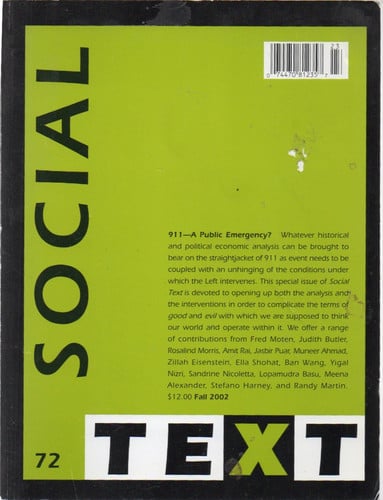
911 a Public Emergency?

Brent Hayes Edwards,Stefano Harney,Randy Martin,Ella Shohat,Timothy Mitchell,Fred Moten
Since September 11, public discourse has often been framed in terms of absolutes: an age of innocence gives way to a present under siege, while the United States and its allies face off against the Axis of Evil. This special issue of Social Text aims to move beyond these binaries toward thoughtful analysis. The editors argue that the challenge for the Left is to develop an antiterrorism stance that acknowledges the legacy of U.S. trade and foreign policy as well as the diversity of the Muslim faith and the dangers presented by fundamentalism of all kinds. Examining the strengths and shortcomings of area, race, and gender studies in the search for understanding, this issue considers cross-cultural feminism as a means of combating terrorism; racial profiling of Muslims in the context of other racist logics; and the homogenization of dissent. The issue includes poetry, photographic work, and an article by Judith Butler on the discursive space surrounding the attacks of September 11. This impressive range of contributions questions the meaning and implications of the events of September 11 and their aftermath. Contributors . Muneer Ahmad, Meena Alexander, Lopamudra Basu, Judith Butler, Zillah Eisenstein, Stefano Harney, Randy Martin, Rosalind C. Morris, Fred Moten, Sandrine Nicoletta, Yigal Nizri, Jasbir K. Puar, Amit S. Rai, Ella Shohat, Ban Wang
Duke University Press 2002-09-20 208 pages

What's Happened to Politics?

Bob Rae
Poised to capitalize on renewed political interest following the federal election, the trade paperback edition of What’s Happened to Politics? is sure to be necessary reading for every concerned Canadian citizen. Segmented electorates. Political leaders avoiding debate and dialogue in favour of an endless repetition of sound bites and vanity videos with little substance. Billions of dollars spent on lobbying. It’s clear that Canadian politics is in a sorry state. Through increasingly low voter turnouts and a general lack of engagement in the political process, Canadians have shown that they are dissatisfied and fed up with present-day politics. At a time when Canadians across the political spectrum are frustrated with political gamesmanship, it is more important than ever to find ways to re-engage with our communities, our leaders, and our political institutions. In Bob Rae, Canadians hear the voice of reason they need, and in What’s Happened to Politics? , they finally get an definitive account of the problems plaguing their national politics. Touching on everything from polling to issues of social justice to the way in which political parties package their candidates, Rae identifies the shortcomings of the current Canadian political framework, and what we, as citizens, can do to remedy that. With remarkable insight and startling accuracy, Rae envisions a political forum where citizens are inspired to participate, instead of feeling disenfranchised. Timely, filled with real-world examples, and told from the point of view of an experienced statesman, What’s Happened to Politics? is necessary reading for all Canadians, regardless of their political affiliation. Erudite, engaged, and keenly attuned to the frustrations expressed by Canadians across the political spectrum, Rae shows why he is the leading voice on Canadian politics.
Simon and Schuster 2016-05-03 192 pages

Government Risk-Sharing in Foreign Investment

Marina von Neumann Whitman
Since World War II six risk-sharing institutions to stimulate foreign investment have been established by the U.S. government and several international organizations. These are thoroughly studied. Originally published in 1965. The Princeton Legacy Library uses the latest print-on-demand technology to again make available previously out-of-print books from the distinguished backlist of Princeton University Press. These editions preserve the original texts of these important books while presenting them in durable paperback and hardcover editions. The goal of the Princeton Legacy Library is to vastly increase access to the rich scholarly heritage found in the thousands of books published by Princeton University Press since its founding in 1905.
Princeton University Press 2015-12-08 372 pages