44 results for "Trade"

The Shock Doctrine The Rise of Disaster Capitalism

Naomi Klein
Winner of the 2009 Warwick Prize for Writing In this groundbreaking alternative history of the most dominant ideology of our time, Milton Friedman's free-market economic revolution, Naomi Klein challenges the popular myth of this movement's peaceful global victory. From Chile in 1973 to Iraq today, Klein shows how Friedman and his followers have repeatedly harnessed terrible shocks and violence to implement their radical policies. As John Gray wrote in The Guardian, "There are very few books that really help us understand the present. The Shock Doctrine is one of those books."
National Geographic Books 2008-07-29 672 pages

Charged The New Movement to Transform American Prosecution and End Mass Incarceration

Emily Bazelon
NEW YORK TIMES BESTSELLER • A renowned journalist and legal commentator exposes the unchecked power of the prosecutor as a driving force in America’s mass incarceration crisis—and charts a way out. “An important, thoughtful, and thorough examination of criminal justice in America that speaks directly to how we reduce mass incarceration.”—Bryan Stevenson, author of Just Mercy “This harrowing, often enraging book is a hopeful one, as well, profiling innovative new approaches and the frontline advocates who champion them.”—Matthew Desmond, author of Evicted FINALIST FOR THE LOS ANGELES TIMES BOOK PRIZE • SHORTLISTED FOR THE J. ANTHONY LUKAS BOOK PRIZE • NAMED ONE OF THE BEST BOOKS OF THE YEAR BY NPR • The New York Public Library • Library Journal • Publishers Weekly • Kirkus Reviews The American criminal justice system is supposed to be a contest between two equal adversaries, the prosecution and the defense, with judges ensuring a fair fight. That image of the law does not match the reality in the courtroom, however. Much of the time, it is prosecutors more than judges who control the outcome of a case, from choosing the charge to setting bail to determining the plea bargain. They often decide who goes free and who goes to prison, even who lives and who dies. In Charged, Emily Bazelon reveals how this kind of unchecked power is the underreported cause of enormous injustice—and the missing piece in the mass incarceration puzzle. Charged follows the story of two young people caught up in the criminal justice system: Kevin, a twenty-year-old in Brooklyn who picked up his friend’s gun as the cops burst in and was charged with a serious violent felony, and Noura, a teenage girl in Memphis indicted for the murder of her mother. Bazelon tracks both cases—from arrest and charging to trial and sentencing—and, with her trademark blend of deeply reported narrative, legal analysis, and investigative journalism, illustrates just how criminal prosecutions can go wrong and, more important, why they don’t have to. Bazelon also details the second chances they prosecutors can extend, if they choose, to Kevin and Noura and so many others. She follows a wave of reform-minded D.A.s who have been elected in some of our biggest cities, as well as in rural areas in every region of the country, put in office to do nothing less than reinvent how their job is done. If they succeed, they can point the country toward a different and profoundly better future.
Random House Publishing Group 2020-05-05 448 pages

The Secret Knowledge On the Dismantling of American Culture

David Mamet
David Mamet has been a controversial, defining force in nearly every creative endeavor-now he turns his attention to politics. In recent years, David Mamet realized that the so-called mainstream media outlets he relied on were irredeemably biased, peddling a hypocritical and deeply flawed worldview. In 2008 Mamet wrote a hugely controversial op-ed for the Village Voice , "Why I Am No Longer a 'Brain-Dead Liberal'", in which he methodically attacked liberal beliefs, eviscerating them as efficiently as he did Method acting in his bestselling book True and False . Now Mamet employs his trademark intellectual force and vigor to take on all the key political issues of our times, from religion to political correctness to global warming. The legendary playwright, author, director, and filmmaker pulls no punches in his art or in his politics. And as a former liberal who woke up, Mamet will win over an entirely new audience of others who have grown irate over America's current direction.
Penguin Publishing Group 2012-08-28 256 pages

Building the New American Economy Smart, Fair, and Sustainable

Jeffrey D. Sachs
In this passionate and powerful book--part manifesto, part plan of action--the renowned economist Jeffrey D. Sachs offers a practical strategy to move America, seemingly more divided than ever, toward a new consensus: sustainable development. Sustainable development is a holistic approach that emphasizes economic, social, and environmental objectives in shaping policy. In focusing too much on economic growth, the United States has neglected rising economic inequality and dire environmental threats. Now, even growth is imperiled. Sachs explores issues that have captivated the nation and political debate, including infrastructure, trade deals, energy policy, the proper size and role of government, the national debt, and income inequality. Not only does he provide illuminating and accessible explanations of the forces at work in each case, but he also presents specific policy solutions. His argument rises above the pessimism born of political paralysis, economic stagnation, and partisanship to devise a brighter way forward, achievable both individually and collectively. In Building the New American Economy , Sachs shows how the United States can find a path to renewed economic progress that is fair and environmentally sustainable.
Columbia University Press 2018-03-20 130 pages

Original Meanings

Jack N. Rakove
From abortion to same-sex marriage, today's most urgent political debates will hinge on this two-part question: What did the United States Constitution originally mean and who now understands its meaning best? Rakove chronicles the Constitution from inception to ratification and, in doing so, traces its complex weave of ideology and interest, showing how this document has meant different things at different times to different groups of Americans. "From the Trade Paperback edition."
Random House Value Publishing 1998-05 439 pages

Three Days at Camp David How a Secret Meeting in 1971 Transformed the Global Economy

Jeffrey E. Garten
The former dean of the Yale School of Management and Undersecretary of Commerce in the Clinton administration chronicles the 1971 August meeting at Camp David, where President Nixon unilaterally ended the last vestiges of the gold standard--breaking the link between gold and the dollar--transforming the entire global monetary system. Over the course of three days--from August 13 to 15, 1971--at a secret meeting at Camp David, President Richard Nixon and his brain trust changed the course of history. Before that weekend, all national currencies were valued to the U.S. dollar, which was convertible to gold at a fixed rate. That system, established by the Bretton Woods Agreement at the end of World War II, was the foundation of the international monetary system that helped fuel the greatest expansion of middle-class prosperity the world has ever seen. In making his decision, Nixon shocked world leaders, bankers, investors, traders and everyone involved in global finance. Jeffrey E. Garten argues that many of the roots of America's dramatic retrenchment in world affairs began with that momentous event that was an admission that America could no longer afford to uphold the global monetary system. It opened the way for massive market instability and speculation that has plagued the world economy ever since, but at the same time it made possible the gigantic expansion of trade and investment across borders which created our modern era of once unimaginable progress. Based on extensive historical research and interviews with several participants at Camp David, and informed by Garten's own insights from positions in four presidential administrations and on Wall Street, Three Days at Camp David chronicles this critical turning point, analyzes its impact on the American economy and world markets, and explores its ramifications now and for the future.
Harper 2022 464 pages

Thank the Liberals For Saving America

Alan Colmes
Do you enjoy weekends? Vacation? Overtime? Are you happy that there's a safety net if you get laid off? Do you appreciate that there's no arsenic in your food? And what about the fact that you're protected from unjust imprisonment--do you like that? If your answer to these questions is an overwhelming yes, you can thank liberals. Since the founding of America, we have battled about the best way to move forward. In Thank the Liberals, political commentator and Fox News radio host Alan Colmes explains how those who fight for liberal ideals have consistently made our lives better. He tells us the real story about many of the programs and benefits we take for granted. With his trademark humor and wit, Colmes walks us through the liberal values on which our nation was established, showing how all Americans are actually liberal. Then he takes us through key pieces of legislation, constitutional amendments, Supreme Court decisions, and actions of grassroots organizations and individuals that have liberalized us even more, providing the equality and opportunity that have made America stand out as a beacon of freedom and democracy for the rest of the world. But the fight continues as the divide between conservatives and progressives increasingly widens. While "regressives," as Colmes calls them, would have us revert to bygone eras--revoking hard-won rights--liberals oppose this backward slide. From the relationship between church and state, to climate change, health care, immigration, caring for the poor, and making peace, not war, Colmes shows how liberals are leading the way. Thank the Liberals will open your eyes to some of our nation's current battles and set the story straight concerning who truly has fought--and continues to fight--for the freedom and justice that are essential to the American way of life.
Hay House, Inc 2013-09-17 221 pages

Does America Need a Foreign Policy?

Dr Henry A Kissinger
In a timely, lucidly written, and highly accessible examination of America's position in the world today, Henry Kissinger delves into the traditional issues of U.S. relations with Russia, China, Europe, and other regions, as well as recently emerging concerns about globalization, free trade, U.S. military involvement abroad, and the endangered environment. Focusing on current and future policy choices, Kissinger presents an eye-opening perspective on the United States' role as the world's dominate power and outlines how it can be effectively reconciled with the urgent need to achieve a world order based on consensus in the twenty-first century. The new administration's approach to foreign policy has raised many questions about where the country is headed. In a proposal that is solidly grounded and brilliantly argued, Kissinger lays out a compelling and comprehensive vision of the direction America must take in the coming decades.
Turtleback Books 2002-09

The Opposite of Hate A Field Guide to Repairing Our Humanity

Sally Kohn
“Brilliantly illustrates the immense and disarming power of changing course and driving not toward division, but toward civility and mutual respect.” -- Ms . magazine As a progressive commentator on Fox News and now CNN, Sally Kohn has made a career out of bridging intractable political differences. In this age of dangerous partisan resentment and rising bigotry, she decided to investigate hate itself--to better consider how we can stop it. With her trademark humor and humanity, Kohn introduces us to leading researchers and scientists who are exploring the evolutionary and cultural roots of hate. She travels to Rwanda, to the Middle East, and across the United States, talking with former terrorists and reformed white supremacists, and even sitting down with some of her own Twitter trolls. What she discovers is surprising: All of us harbor hate but the powerful acknowledgment that we are all in this together can lead us out of the wilderness. The opposite of hate is connection .
Algonquin Books 2019-03-26 272 pages

Too Close to Call The Thirty-Six-Day Battle to Decide the 2000 Election

Jeffrey Toobin
From the best-selling author of A Vast Conspiracy and The Run of His Life comes Too Close to Call --the definitive story of the Bush-Gore presidential recount. A political and legal analyst of unparalleled journalistic skill, Jeffrey Toobin is the ideal writer to distill the events of the thirty-six anxiety-filled days that culminated in one of the most stunning Supreme Court decisions in history. Packed with news-making disclosures and written with the drive of a legal thriller, Too Close to Call takes us inside James Baker's private jet, through the locked gates to Al Gore's mansion, behind the covered-up windows of Katherine Harris's office, and even into the secret conference room of the United States Supreme Court. As the scene shifts from Washington to Austin and into the remote corners of the enduringly strange Sunshine State, Toobin's book will transform what you thought you knew about the most extraordinary political drama in American history. The Florida recount unfolded in a kaleidoscopic maze of bizarre concepts (chads, pregnant and otherwise), unfamiliar people in critically important positions (the Florida Supreme Court), and familiar people in surprising new places (the Miami relatives of Elián González, in a previously undisclosed role in this melodrama). With the rich characterization that is his trademark, Toobin portrays the prominent strategists who masterminded the campaigns--the Daleys and the Roves--and also the lesser-known but influential players who pulled the strings, as well as the judges and justices whose decisions determined the final outcome. Toobin gives both camps a treatment they have not yet received--remarkably evenhanded, nonpartisan, and entirely new. The post-election period posed a challenge to even the most zealous news junkie: how to keep up with what was happening and sort out the important from the trivial. Jeffrey Toobin has now done this--and then some. With clarity, insight, humor, and a deep understanding of the law, he deconstructs the events, the players, and the often Byzantine intricacies of our judicial system. A remarkable account of one of the most significant periods in our country's history, Too Close to Call is endlessly surprising, frequently poignant, and wholly addictive.
Random House Publishing Group 2002-10-08 320 pages

Revolution for the Hell of It The Book That Earned Abbie Hoffman a 5 Year-Prison Term at the Chicago Conspiracy Trial

Abbie Hoffman
"If Steal This Book is Abbie Hoffman's guide to living outside the establishment, Revolution for the Hell of It is a chronicle of his radical escapades that still offers lessons for today's activists." "Hoffman pioneered the use of humor, theater, and surprise to change the world for the better. In Revolution for the Hell of It he gives firsthand accounts of his legendary adventures, from the activism that led up to the founding of the Youth International Party (or "Yippies!") to the 1968 Democratic National Convention protests ("a perfect mess"). Also chronicled is the mass antiwar demonstration he helped lead in which over 50,000 people levitated the Pentagon using psychic energy and the time he dropped handfuls of dollar bills onto the floor of the New York Stock Exchange and watched the traders scramble. With antiwar sentiment once again on the rise and an incendiary political climate not seen since the book's original printing, Abbie Hoffman's voice is more essential than ever."--BOOK JACKET.
Buccaneer Books, Incorporated 1994

Trade Is Not a Four-Letter Word How Six Everyday Products Make the Case for Trade

Fred P. Hochberg
“A sprightly and clear-eyed testimonial to the value of globalization” ( The Wall Street Journ al ) as seen through six surprising everyday goods—the taco salad, the Honda Odyssey, the banana, the iPhone, the college degree, and the blockbuster HBO series Game of Thrones. Trade allows us to sell what we produce at home and purchase what we don’t. It lowers prices and gives us greater variety and innovation. Yet understanding our place in the global trade network is rarely simple. Trade has become an easy excuse for struggling economies, a scapegoat for our failures to adapt to a changing world, and—for many Americans on both the right and the left—nothing short of a four-letter word. But as Fred P. Hochberg reminds us, trade is easier to understand than we commonly think. In Trade Is Not a Four-Letter Word , you’ll learn how NAFTA became a populist punching bag on both sides of the aisle. You’ll learn how Americans can avoid the grim specter of the $10 banana. And you’ll finally discover the truth about whether or not, as President Trump has famously tweeted, “trade wars are good and easy to win.” (Spoiler alert—they aren’t.) Hochberg debunks common trade myths by pulling back the curtain on six everyday products, each with a surprising story to tell: the taco salad, the Honda Odyssey, the banana, the iPhone, the college degree, and the smash hit HBO series Game of Thrones . Behind these six examples are stories that help explain not only how trade has shaped our lives so far but also how we can use trade to build a better future for our own families, for America, and for the world. Trade Is Not a Four-Letter Word is the antidote to today’s acronym-laden trade jargon pitched to voters with simple promises that rarely play out so one-dimensionally. Packed with colorful examples and highly digestible explanations, Trade Is Not a Four-Letter Word is “an accessible, necessary book that will increase our understanding of trade and economic policies and the ways in which they impact our daily lives” ( Library Journal , starred review).
Simon and Schuster 2021-01-26 336 pages

The nationalist revival: trade, immigration, and the revolt against globalization

Judis, John B.
"Why has nationalism come roaring back? Trump in America, Brexit in the U.K., anti-EU parties in Italy, Germany, France, the Netherlands, Austria, Poland, and Hungary, and nativist or authoritarian leaders in Turkey, Russia, India, and China -- why has nationalism suddenly returned with a vengeance? Is the world headed back to the fractious conflicts between nations that led to world wars and depression in the early 20th Century? Why are nationalists so angry about free trade and immigration? Why has globalization become a dirty word? Based on travels in America, Europe, and Asia, veteran political analyst John B. Judis found that almost all people share nationalist sentiments that can be the basis of vibrant democracies as well as repressive dictatorships. Today's outbreak of toxic "us vs. them" nationalism is an extreme reaction to utopian cosmopolitanism, which advocates open borders, free trade, rampant outsourcing, and has branded nationalist sentiments as bigotry. Can a new international order be created that doesn't dismiss what is constructive about nationalism? As he did for populism in The Populist Explosion, a runaway success after the 2016 election, Judis looks at nationalism from its modern origins in the 1800s to today to find answers"--Back cover.
Columbia Global Reports 2018 157 pages

The Shadow World Inside the Global Arms Trade

Andrew Feinstein
The Shadow World presents the behind-the-scenes tale of the global arms trade, exposing in forensic detail the deadly collusion that too often exists among senior politicians, weapons manufacturers, felonious arms dealers, and the military--a situation that compromises our security and undermines our democracy. Now a major PBS documentary "An authoritative guide to the business of war. Chilling, heartbreaking, and enraging."--Arundhati Roy Andrew Feinstein reveals the cover-ups behind a range of weapons deals, from the largest in history--between the British and Saudi governments---to the guns-for-diamonds deals in Africa and the current $60 billion U.S. weapons contract with Saudi Arabia. Based on pathbreaking reporting and unprecedented access to top-secret information, The Shadow World takes us into a clandestine realm that is as vitally important as it is shocking.
Macmillan 2012-11-27 696 pages

Sovereignty Under Challenge: How Governments Respond

Glazer, Nathan
Sovereignty-the authority of a state to wield ultimate power over its territory, its citizens, its institutions-is everywhere undergoing change as states respond in various ways to the challenges posed, from above and below. "Above" the state is the widening net of international institutions and treaties dealing with human rights, trade, investment, and monetary affairs; and "below" it are rising claims within states from long-resident groups discontented with the political order and from new migrants testing its authority. Sovereignty under Challenge deals with a range of such challenges and responses, analyzed in authoritative studies by leading scholars. The introductory chapter sets forth the theme that sovereignty is asserted clearly, but often unpredictably, when governments respond to challenge. It suggests ways of classifying these responses as variables that help explain the changing nature of sovereignty. Part 1, "The Citizen and the State," treats the rising tide of dual citizenship and the concerns this arouses in the United States; the work of national human rights commissions in Asia; and the challenge posed to the state by the Falungong movement in China. The two chapters in Part 2, "The Government as Decision-Maker," examine Japan's response to global warming and the problems of the World Health Organization in orchestrating collaboration among Southeast Asian states in implementing infectious disease control. Part 3, "Sovereignty and Culture," looks at conflicts engendered by outside change on indigenous economic, cultural, and legal institutions in India, Fiji, Indonesia, and Malaysia. The chapters in Part 4, "Sovereignty and the Economy," analyze the economic and cultural instability induced by Chinese migration to Russia's far east; the impact on state sovereignty brought about by transnational regulatory campaigns and social activism; the question of indigenous land rights in the Philippines; and the impact of transnational corporations on information technology in Asia. A concluding chapter offers a global assessment of the current status of state sovereignty.
[distributor] Taylor & Francis, c/o Bookpoint 2017-11-15 402 pages

Principles of Political Economy and Taxation

David Ricardo
David Ricardo's On the Principles of Political Economy and Taxation the implications of land rent increases along with population among other things. Ricardo argues for the acceptance of free trade and shows how it's both short and long term advantages. The arguments laid out in this book form the basis of modern trade theory and are, therefore, of interest in today's global economy.
CreateSpace Independent Publishing Platform 2010-09-24 220 pages

On the Principles of Political Economy and Taxation

David Ricardo
On the Principles of Political Economy and Taxation (19 April 1817) is a book by David Ricardo on economics. The book concludes that land rent grows as population increases. It also presents the theory of comparative advantage, the theory that free trade between two or more countries can be mutually beneficial, even when one country has an absolute advantage over the other countries in all areas of production.
CreateSpace Independent Publishing Platform 2018-08-19 244 pages

Transaction Man Traders, Disrupters, and the Dismantling of Middle-Class America

Nicholas Lemann
An Amazon Best History Book of 2019 "A splendid and beautifully written illustration of the tremendous importance public policy has for the daily lives of ordinary people." —Ryan Cooper, Washington Monthly Over the last generation, the United States has undergone seismic changes. Stable institutions have given way to frictionless transactions, which are celebrated no matter what collateral damage they generate. The concentration of great wealth has coincided with the fraying of social ties and the rise of inequality. How did all this come about? In Transaction Man , Nicholas Lemann explains the United States’—and the world’s—great transformation by examining three remarkable individuals who epitomized and helped create their eras. Adolf Berle, Franklin Delano Roosevelt’s chief theorist of the economy, imagined a society dominated by large corporations, which a newly powerful federal government had forced to become benign and stable institutions, contributing to the public good by offering stable employment and generous pensions. By the 1970s, the corporations’ large stockholders grew restive under this regime, and their chief theoretician, Harvard Business School’s Michael Jensen, insisted that firms should maximize shareholder value, whatever the consequences. Today, Silicon Valley titans such as the LinkedIn cofounder and venture capitalist Reid Hoffman hope “networks” can reknit our social fabric. Lemann interweaves these fresh and vivid profiles with a history of the Morgan Stanley investment bank from the 1930s through the financial crisis of 2008, while also tracking the rise and fall of a working-class Chicago neighborhood and the family-run car dealerships at its heart. Incisive and sweeping, Transaction Man is the definitive account of the reengineering of America and the enormous impact it has had on us all.
Picador 2020-11-10 320 pages

How to Make Peace in the Middle East in Six Months or Less Without Leaving Your Apartment

Gregory Levey
Gregory Levey’s modest goal is to solve the Middle East conflict—all by himself. After returning to North America following a stint in his midtwenties writing speeches for the Israeli government—first at the United Nations and then for the prime minister in Jerusalem—he thinks he is leaving the madness of the Middle East conflict behind. But nothing could be further from the truth. Levey soon discovers that everyone on this side of the Atlantic seems to think that they have the solution to the intractable conflict—and they all feel the need to tell him about it. Fatigued by the endless debate, the constant hostility, and the cacophony of shrill voices, he decides that the only way he is going to escape it all is if he solves the conflict himself, once and for all. So Levey sets out on a hilarious, quixotic, and surprisingly illuminating quest to broker a peace deal where a long line of world leaders have failed. Interacting with White House officials, DC lobbyists, congressmen, advisors to presidential candidates, high-profile journalists, secretive fundraisers, former Israeli spies now living in North America, and hundreds and hundreds of Jewish grandmothers, Levey tries to understand why the Middle East situation refuses to be resolved, and why so many people who live a world away are so obsessed with it. He combs through theories ranging from the eminently reasonable to the completely insane, engages in virtual peacemaking simulations, investigates an “online suicide bombing,” spends time with a former advisor to Yasser Arafat, undergoes training with a half-baked Jewish paramilitary group, goes undercover as an Evangelical Christian, and somehow ends up at a real-life castle owned by an eccentric, cape-wearing crusader for peace. In How to Make Peace in the Middle East in Six Months or Less Without Leaving Your Apartment, Levey brings his trademark brand of street-smart levity to a situation that many see as hopeless— and thereby reveals the very human and sometimes very silly side of a brutal, decades-old geopolitical conflict. Along the way, he meets a cast of characters that would be outright funny if the situation weren’t so dire. The result is a fast-paced, humorous, and insightful romp through U.S. policymaking in the Middle East.
Free Press 2013-05-04 288 pages

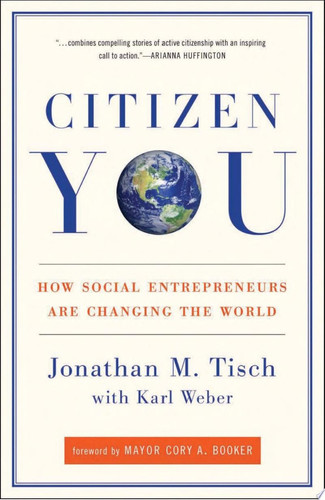
Citizen You How Social Entrepreneurs Are Changing the World

Jonathan Tisch,Karl Weber
Just when the world needs it most, a new style of social engagement is emerging: Active Citizenship. A key member of one of New York’s most civic-minded families—one that has supported many of America’s notable institutions and deserving programs—Jonathan Tisch has devoted a lifetime to “active citizenship.” It’s an idea that uses the power of practical creativity and grassroots participation to solve seemingly intractable problems. In Citizen You , Tisch challenges readers to join this movement and points the way toward making our world a better place, one person and one neighborhood at a time. Tisch has filled Citizen You with accounts of people who you’ll meet, such inspirational individuals as: Scott Harrison, who has used the networking and marketing skills he developed as a night club promoter to help over a million people in the developing world get access for the first time to clean, safe drinking water. Steffi Coplan, whose Broadway2Broadway project brought out the hidden musical talents of kids at an inner city school. Eric Schwarz, who decided to do something about America’s under-performing schools, and parlayed a single classroom mentoring project into the nationwide Citizens Schools movement. Chris Swan, who is training a new generation of “citizen engineers” to make sure that the projects they build aren’t just structurally sound but also environmentally and socially sustainable. Dave Nelson, who traded his role as an executive at IBM for a job at a struggling nonprofit that teaches kids about the power of entrepreneurship—and discovered a host of new challenges and rewards in the process. Through these and many other remarkable stories, you’ll learn how today’s active citizens are transforming thinking about social change. Rather than short-term fixes and hand-me-down charity, they’re striving to build sustainable, systemic solutions to our most challenging problems, building and empowering communities rather than fostering dependency. And they’re using a host of new tools, from online networking and private-public partnerships to corporate engagement and social entrepreneurship, to redefine how change can happen. Citizen You is a potent antidote to pessimism. At a time of unprecedented challenges on the national and world stage, when active citizenship is not a choice but a necessity, Citizen You dares us to reshape the social, political, and intellectual structures that have long confined us, and offers fresh thinking that redefines the very concept of activism. For more information and ideas about how to be an active citizen go to www.citizenyou.org
Crown 2011-05-03 288 pages