6 results for "Trade"

The secret servant

Silva, Daniel
A terrorist plot in London leads Israeli spy Gabriel Allon on a desperate search for a kidnapped woman in this thriller from #1 New York Times bestselling author Daniel Silva. While in Amsterdam, Israeli intelligence officer and master art restorer Gabriel Allon discovers a plot that is about to explode in the middle of London. The daughter of the American ambassador is to be brutally kidnapped. But Gabriel arrives too late to save her. And when he reveals his face to the plot’s masterminds, his fate is sealed as well. Drawn once more into the service of American intelligence, Gabriel desperately searches for the missing woman as the clock ticks steadily toward the hour of her execution. The search will thrust him into an unlikely alliance with a man who has lost everything because of his devotion to Islam. It will cause him to question the morality of the tactics of his trade. And it might very well cost him his life… A Publishers Weekly Best Book of the Year
Putnam 2007 385 pages

Preemption: a knife that cuts both ways

Dershowitz, Alan M.
Every so often, a startling book emerges that gives voice to a new of previously unexamined trend that is transforming society. In Preemption: A Knife That Cuts Both Ways, Alan M. Dershowitz, the renowned lawyer and educator, chronicles the world's fundamental shift in its approach to controlling dangerous and destructive human behavior. Dershowitz reveals that we are moving - whether in terms of fighting crime, profiling suspicious behavior, or combating terrorism - toward increasingly preventive and proactive measures and away from a traditional reliance on reactive responses. In showing the seismic shift that not only has profoundly altered foreign policy but also has affected matters as close to home as inoculation, Internet censorship, and stings, Dershowitz presents the reader with challenging dilemmas. For example, should one detain and interrogate a potential criminal solely on the basis of his profile, DNA, or predicted behavior? Should the Department of Homeland Security have the power to monitor law-abiding citizens just because they attend a certain mosque or church? Should a nation threatened by terrorism or nuclear attack be authorized to launch a preemptive attack or a preventive war? In presenting his finds, Dershowitz contrasts our approach to the Cold War - deterring a nuclear attack by threatening mutually assured destruction (MAD) - with our current approach to terrorism: kill them before they kill us. The tragic events of 9/11 have of course outwardly change the nature of American foreign policy, but Preemption convincingly demonstrated that the seeds were planted long before the collapse of the World Trade Towers and the deadly chain of al-Qaids bombings that have ripped through more than a dozen cities throughout the world. In tracing the emergence of a preemptive approach, particularly in this new century, Dershowitz examines the troubling implications not just for national security and foreign policy but for civil liberties and human rights as well. He calls for, and constructs, a new jurisprudence of preemption that seeks to balance security and freedom. With a remarkable flair for debate that has won him acclaim in the courtroom, Dershowitz brings his prodigious talen and firsthand expertise as lawyer to a topic of great philosophical and political import, The questions that he raises, both in his introduction and through the many lucid examples in Preemption, have already begun to define our age. In doing so, they will profoundly alter our fundamental understanding of how to confront crime, terrorism, and warfare. Indeed, the knife cuts both ways.
W. W. Norton 2007 348 pages

From empire to community: a new approach to international relations

Etzioni, Amitai
Whether one favors the U.S. global projection of force or is horrified by it, the question stands - where do we go from here? What ought to be the new global architecture? Amitai Etzioni follows a third way, drawing on both neoconservative and liberal ideas, in this bold new look at international relations. He argues that a "clash of civilizations" can be avoided and that the new world order need not look like America. Eastern values, including spirituality and moderate Islam, have a legitimate place in the evolving global public philosophy.Nation-states, Etzioni argues, can no longer attend to rising transnational problems, from SARS to trade in sex slaves to cybercrime. Global civil society does help, but without some kind of global authority, transnational problems will overwhelm us. The building blocks of this new order can be found in the war against terrorism, multilateral attempts at deproliferation, humanitarian interventions and new supranational institutions (e.g., the governance of the Internet). Basic safety, human rights, and global social issues, such as environmental protection, are best solved cooperatively, and Etzioni explores ways of creating global authorities robust enough to handle these issues as he outlines the journey from "empire to community."
Palgrave Macmillan 2004-05-14 258 pages

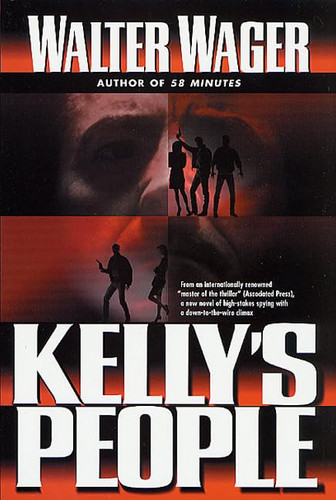
Kelly's people

Wager, Walter
The five ace intelligence agents gathered at the secret St. John Institute are the best of the best. The best at tradecraft. The best at weapons handling. The best at analyzing a volatile situation, getting in, getting what they came for, and getting out alive. They are all dead-their old identities perished when they were kidnapped by the secret masters of the institute. Now they have new names and new personal histories. More important, each has received a life-saving organ transplant. And something else-twice a day, each is given an injection of a mysterious golden serum. They are no longer ordinary human beings. Their minds are linked in a bond that grows stronger with time. Their leader is known as Denny Monroe. He doesn't trust anyone associated with the St. John Institute-especially not Charlotte Willson, who oversees the transplant project. Since the five agents are already dead, Monroe figures they're seen as expendable-and he's going to do whatever is necessary to protect himself and his four colleagues. Half a world away, a Russian general, desperate to escape his country's failing economy and crumbling military, sells five small atomic bombs-suitcase nukes-to an international terrorist. He's paid a staggering sum that allows him to ignore the death and destruction the bombs will inevitably cause. But General Temkov can't quite sleep peacefully at night. His best spy has vanished in the U.S. under suspicious circumstances. Kidnapping an Americana diplomat in Moscow, Temkov pressures the CIA to reveal the whereabouts of his missing man. But the CIA knows nothing. The first suitcase nuke destroys a small African city-a test of the equipment. Three more bombs are on their way to London, Jerusalem, and Washington, D.C. The CIA is convinced that the missing spy and the missing bombs are somehow connected. But to find out exactly what is going on, they need Denny Monroe and his band of extraordinary telepaths. Monroe has needs of his own-to determine the identity of the mysterious "Kelly's People." Are they his team, or does the St. John Institute guard even more secrets?
Tom Doherty Associates 2002-04-06 349 pages