9 results for "Trade"

The secret servant

Silva, Daniel
A terrorist plot in London leads Israeli spy Gabriel Allon on a desperate search for a kidnapped woman in this thriller from #1 New York Times bestselling author Daniel Silva. While in Amsterdam, Israeli intelligence officer and master art restorer Gabriel Allon discovers a plot that is about to explode in the middle of London. The daughter of the American ambassador is to be brutally kidnapped. But Gabriel arrives too late to save her. And when he reveals his face to the plot’s masterminds, his fate is sealed as well. Drawn once more into the service of American intelligence, Gabriel desperately searches for the missing woman as the clock ticks steadily toward the hour of her execution. The search will thrust him into an unlikely alliance with a man who has lost everything because of his devotion to Islam. It will cause him to question the morality of the tactics of his trade. And it might very well cost him his life… A Publishers Weekly Best Book of the Year
Putnam 2007 385 pages

Aftermath

Meyerowitz, Joel
This archive of pictures is the only existing photographic record of Ground Zero after the attacks on the World Trade Center on September 11th 2001. Fenced off and classified as a crime scene, the area was closed to all photographers, and only scant information was available about the activities in the guarded enclosure that became known as "the forbidden city." Through sheer persistence involving almost daily acts of resourcefulness and defiance, Joel Meyerowitz became the sole photographer to have continued access to the site and describe its transformation over the next nine months from a place of total devastation to cleared bedrock. Published to coincide with the fifth anniversary of the World Trade Center attacks, this book serves not only as an elegy to the thousands who lost their lives, but also celebrates the tireless effort and bravery of the thousands of police officers, fire fighters, construction workers, engineers, and volunteers who assisted in the clean-up process.
Phaidon Press 2006-08-21 349 pages

No end to war: terrorism in the twenty-first century

Laqueur, Walter
While the destruction of the World Trade Center and the strike against the Pentagon shocked the world at large, experts on terrorism like Walter Laqueur couldn't feign complete surprise. In No End to War, Laqueur, who has devoted three decades to the study of political violence, answers the most-often raised questions about terrorism in the light of 9/11 and the still unsolved Anthrax letters. First, what constitutes terrorism? What is new about the "new" terrorism? Why is the Muslim world the most potent breeding ground of this new terrorism? To what extent is religion itself a factor? Is there a clash of civilizations between the Muslim world and the largely Christian or post-Christian West? Is America at fault? Israel? Did European nations turn a blind eye to terrorists and their sympathizers in their midst? To what extent are poverty and oppression the causes of terrorism? What is the likelihood that terrorists will obtain weapons of mass destruction-chemical, biological, or nuclear? Why was the United States unprepared for 9/11? Why the intelligence failure? Are Islamic terrorists the only terrorists we need to fear? What about other terrorists from the right of the left, ecoterrorists or anti-globalization terrorists? And finally, what is the best defense against terrorism?>
Continuum 2003-05-01 288 pages

From empire to community: a new approach to international relations

Etzioni, Amitai
Whether one favors the U.S. global projection of force or is horrified by it, the question stands - where do we go from here? What ought to be the new global architecture? Amitai Etzioni follows a third way, drawing on both neoconservative and liberal ideas, in this bold new look at international relations. He argues that a "clash of civilizations" can be avoided and that the new world order need not look like America. Eastern values, including spirituality and moderate Islam, have a legitimate place in the evolving global public philosophy.Nation-states, Etzioni argues, can no longer attend to rising transnational problems, from SARS to trade in sex slaves to cybercrime. Global civil society does help, but without some kind of global authority, transnational problems will overwhelm us. The building blocks of this new order can be found in the war against terrorism, multilateral attempts at deproliferation, humanitarian interventions and new supranational institutions (e.g., the governance of the Internet). Basic safety, human rights, and global social issues, such as environmental protection, are best solved cooperatively, and Etzioni explores ways of creating global authorities robust enough to handle these issues as he outlines the journey from "empire to community."
Palgrave Macmillan 2004-05-14 258 pages

Usama bin Laden's al-Qaida: profile of a terrorist network

Alexander, Yonah
The al-Qaida informal and loose international network in over 50 countries has been responsible for spectacular terrorist operations such as the 1993 World Trade Center bombing in New York, the 1996 bombing of the Khobar Towers in Saudi Arabia, the 1998 U.S. embassy bombings in East Africa, and is apparently linked to the attack of the destroyer USS Cole in Aden, Yemen, in 2000 and the September 11th, 2001 events in New York City and Washington, DC. The purpose of this book is not to glorify bin Laden and al-Qaida. Rather, it is designed to provide an easily accessible reference for academics, policymakers, reporters and other interested individuals on one of the most notorious terrorist groups. The volume exposes much of al-Qaida's mystique and thereby places it in perspective as one of the many challenges facing the international community in the 21st Century. Published under the Transnational Publishers imprint
Transnational Publishers 2001 64 pages

The Border Canada, the US and Dispatches From the 49th Parallel

James Laxer
Insightful, prescient and often funny, The Border explores what it means to be Canadian and what Canada means to the giant to our south. If good fences make good neighbours, do we have the sort of fence that will allow us to maintain neighbourly relations with the world’s only superpower? In The Border , well-known political scientist and journalist James Laxer explores this question by taking the reader on a compelling 5000-mile journey into culture, politics, history, and the future of Canadian sovereignty. Long ignored (or celebrated) as “the world’s longest undefended border,” the line between us and the US is now a stress point. The attacks on the World Trade Center announced to the world that North America is no longer a quiet neighbourhood and made our relationship with the US one of the most pressing questions facing Canadians. The porousness of the border is sure to be more problematic as the world becomes more troubled. Canadian officials complain of American pornography, drugs, untaxed cigarettes and, especially, guns moving northwards. For their part, the FBI and US Customs Service blame Canada for the infiltration of Chinese gangs smuggling immigrants and, more urgently, third-world terrorist cells based north of the border. Drawing deeply from history and anecdote, Laxer shows that for all our neighbourly good will, the Canada-US border has been contentious since the American War of Independence. In the mid-1800s the Americans tried to seize the west coast up to the 54th parallel. On the other hand, until 1931 the Canadian Army’s “Defence Scheme Number One” was to launch a surprise attack on the US with Mexico and Japan as allies. But beyond the fraught politics of the border, Laxer discovers another legacy as well. Travelling the country from Campobello island in the east to Richmond BC in the west all the way up to the Alaska panhandle in the north, Laxer meets people who live within a stone’s throw of the foreigners on the other side, and who share with him tales of friendship and rivalry, smuggling and trade that have shaped the character of their communities.
National Geographic Books 2004-09-21 400 pages

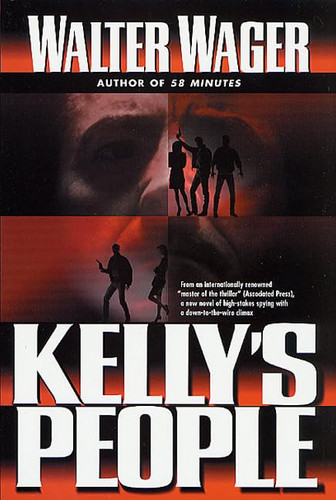
Kelly's people

Wager, Walter
The five ace intelligence agents gathered at the secret St. John Institute are the best of the best. The best at tradecraft. The best at weapons handling. The best at analyzing a volatile situation, getting in, getting what they came for, and getting out alive. They are all dead-their old identities perished when they were kidnapped by the secret masters of the institute. Now they have new names and new personal histories. More important, each has received a life-saving organ transplant. And something else-twice a day, each is given an injection of a mysterious golden serum. They are no longer ordinary human beings. Their minds are linked in a bond that grows stronger with time. Their leader is known as Denny Monroe. He doesn't trust anyone associated with the St. John Institute-especially not Charlotte Willson, who oversees the transplant project. Since the five agents are already dead, Monroe figures they're seen as expendable-and he's going to do whatever is necessary to protect himself and his four colleagues. Half a world away, a Russian general, desperate to escape his country's failing economy and crumbling military, sells five small atomic bombs-suitcase nukes-to an international terrorist. He's paid a staggering sum that allows him to ignore the death and destruction the bombs will inevitably cause. But General Temkov can't quite sleep peacefully at night. His best spy has vanished in the U.S. under suspicious circumstances. Kidnapping an Americana diplomat in Moscow, Temkov pressures the CIA to reveal the whereabouts of his missing man. But the CIA knows nothing. The first suitcase nuke destroys a small African city-a test of the equipment. Three more bombs are on their way to London, Jerusalem, and Washington, D.C. The CIA is convinced that the missing spy and the missing bombs are somehow connected. But to find out exactly what is going on, they need Denny Monroe and his band of extraordinary telepaths. Monroe has needs of his own-to determine the identity of the mysterious "Kelly's People." Are they his team, or does the St. John Institute guard even more secrets?
Tom Doherty Associates 2002-04-06 349 pages

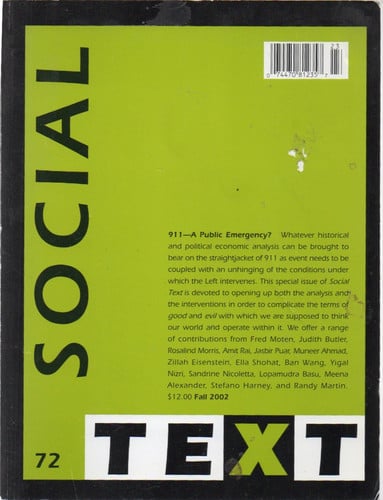
911 a Public Emergency?

Brent Hayes Edwards,Stefano Harney,Randy Martin,Ella Shohat,Timothy Mitchell,Fred Moten
Since September 11, public discourse has often been framed in terms of absolutes: an age of innocence gives way to a present under siege, while the United States and its allies face off against the Axis of Evil. This special issue of Social Text aims to move beyond these binaries toward thoughtful analysis. The editors argue that the challenge for the Left is to develop an antiterrorism stance that acknowledges the legacy of U.S. trade and foreign policy as well as the diversity of the Muslim faith and the dangers presented by fundamentalism of all kinds. Examining the strengths and shortcomings of area, race, and gender studies in the search for understanding, this issue considers cross-cultural feminism as a means of combating terrorism; racial profiling of Muslims in the context of other racist logics; and the homogenization of dissent. The issue includes poetry, photographic work, and an article by Judith Butler on the discursive space surrounding the attacks of September 11. This impressive range of contributions questions the meaning and implications of the events of September 11 and their aftermath. Contributors . Muneer Ahmad, Meena Alexander, Lopamudra Basu, Judith Butler, Zillah Eisenstein, Stefano Harney, Randy Martin, Rosalind C. Morris, Fred Moten, Sandrine Nicoletta, Yigal Nizri, Jasbir K. Puar, Amit S. Rai, Ella Shohat, Ban Wang
Duke University Press 2002-09-20 208 pages