6 results for "World History"

Traces of God: seeing God in Torah, history and everyday life

Gillman, Neil
A Probing and Powerful Look at the Role You Play in Shaping Your Relationship with God "No matter how hard we look, the God of Israel cannot be seen. Looking is not seeing, and seeing God is not like seeing an apple. It is much more like making a medical diagnosis on the basis of looking at a complex set of symptoms. Each of the symptoms is a dot. We can look at the dots and still miss the pattern." --from Part I The Torah is replete with references to hearing God but precious few references to seeing God. Seeing is complicated. What we look for and see are traces of God's presence in the world and in history, but not God. In order to identify those traces as reflections of divine presence, we need to re-examine how we see, what we see, and how we interpret that information. In this challenging and inspiring look at the dynamics of the religious experience, award-winning author and theologian Neil Gillman guides you into a new way of seeing the complex patterns in the Bible, history, and everyday experiences and helps you interpret what those patterns mean to you and your relationship with God. Examining faith and doubt, revelation and law, suffering and redemption, Gillman candidly deconstructs familiar biblical moments in order to help you develop and refine your own spiritual vision, so that you are able to discern the presence of God in unanticipated ways.
Jewish Lights Pub 2006 216 pages

The Biblical clock: the untold secrets linking the universe and humanity with God's plan

Friedmann, Daniel
Science and religion have two seemingly opposing views of the universe's biggest questions. But what if the real story told you they were both right? Vancouver, 2009. Physics engineer and CEO Daniel Friedmann loves solving problems. When the avid scientist dives deep into scripture, he's faced with questions he feels compelled to answer: Is it possible to harmonize the scientific timeline for the development of the universe with the biblical timeline described in Genesis 1? How do the evolution of human history and prophecies surrounding the End of Days fit in?His quest for answers takes him and his nephew Seb on an incredible journey through the ages, discovering the lives and works of mystics, prophets, sages, philosophers, scientists and biblical commentators.Follow Dan and Seb as they discover answers to some of the biggest questions in science and religion, including: -Does the six-day creation account actually link with science's 13.8 billion-year timeline?- How do world history, Genesis, and the End of Days fit within the context of God's Plan in heaven?- How can the appearance of life on Earth, as depicted by the fossil record, match the sequence and timing of life on Earth described in Genesis 1?- Do Genesis and the evolution of human history reveal the events and timing for the End of Days?- Are there texts predating modern science that describe the Big Bang and contain the scientifically calculated age of the universe?- And finally, is there a secret harmony resolving the creation-versus-evolution debate?The Biblical Clock is a fascinating and entertaining read, digging deep into the universe and solving its well-kept mysteries. Order your copy today
Daniel Friedmann and Dania Sheldon 2019-04-09 382 pages

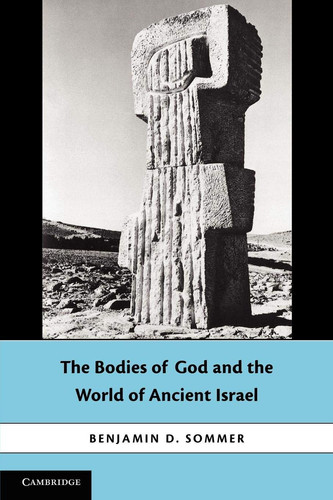
The bodies of God and the world of ancient Israel

Sommer, Benjamin D.
Sommer utilizes a lost ancient Near Eastern perception of divinity according to which a god has more than one body and fluid, unbounded selves. Though the dominant strains of biblical religion rejected it, a monotheistic version of this theological intuition is found in some biblical texts. Later Jewish and Christian thinkers inherited this ancient way of thinking; ideas such as the sefirot in Kabbalah and the trinity in Christianity represent a late version of this theology. This book forces us to rethink the distinction between monotheism and polytheism, as this notion of divine fluidity is found in both polytheistic cultures (Babylonia, Assyria, Canaan) and monotheistic ones (biblical religion, Jewish mysticism, Christianity), whereas it is absent in some polytheistic cultures (classical Greece). The Bodies of God and the World of Ancient Israel has important repercussions not only for biblical scholarship and comparative religion but for Jewish-Christian dialogue.
Cambridge University Press 2011-01-17 334 pages

Roadmap to the end of days: demystifying Biblical eschatology to explain the past, the secret to the apocalypse and the end of the world

Friedmann, Daniel
Is history a purposeful process with a beginning and an end, or is it a random series of events with neither purpose nor direction? If history is a guided process, are we near the end of the world? Have we almost completed preparations for the End of Days? What will happen next? When? Are we backseat passengers in this journey, or are we in the driver's seat?Daniel Friedmann takes you on a journey to discover what is really going on with Biblical eschatology and the end of the world, and to then glimpse the future and ponder the role you will play in it. History is a discipline that uses a narrative to examine and analyze a sequence of past events and to objectively postulate the patterns of cause and effect that determined them. Friedmann looks at history from the supernatural perspective. Every plan becomes suddenly evident when enough of it has played out. Have we reached the point in history where the Divine Plan of history is apparent? Read Roadmap to the End of Days and discover what is really going on, then glimpse the future and ponder the role you will play.In this book: -Friedmann places world history within the context of the Divine Plan, allowing listeners to understand recent past and what is in store for the future. -Learn about the Divine Plan structure in order to examine biblical history from a different perspective, with amazing accuracy. Why other experts who interpret the End of Days by deciphering prophecy alone may have it all wrong.-Put the End of Days into context by examining parallel periods of history that have already occurred. -Examining the revelations in scripture coherently and in sequence using the Divine Plan.-Learn how the cosmic placement of events, both historical and present, reveals a pattern of the future.-A bird's-eye view of where we have been and where we might go in order to bring us to a new level of understanding and a further questioning of our human origins, purpose, destiny, and ability to alter the path to the future."Friedmann has researched and composed another of his signature works deciphering the origins of the universe and decoding the unfolding apocalypse. With this seminal work, he achieves newfound heights unraveling riddles of the past and piercing the veil that obscures future events. Stellar in the stature of his reflections, supreme in the depth of his details, he has gloriously composed a mesmerizing manuscript that leaves you spellbound." -Pulitzer nominated author, David W. Menefee
Inspired Books 2017-02-06 180 pages

With all thine heart: love and the Bible

Stavans, Ilan
Is the Bible actually a love story between a deity and a people? And what does this love story have to do with the modern world? In With All Thine Heart distinguished cultural critic Ilan Stavans speaks to freelance writer Mordecai Drache about love in the Bible. Presented in an engaging, conversational format and touched with striking artwork, the textured dialogue between Stavans and Drache is meant to show how the Bible is a multidimensional text and one that, when considered over the course of history, still has the power to shape our world. The theme of love provides the connective tissue that binds this work. Addressing a wide range of topics, from biblical archaeology and fundamentalism to Hollywood movies, lexicography, and the act of praying, With All Thine Heart suggests that the Hebrew Bible is a novel worth decoding patiently, such as one does with classics like Don Quixote de la Mancha, In Search of Lost Time, and Anna Karenina. Similar to the protagonists in these tales, biblical characters, although not shaped with the artistic nuance of modern literature, allow for astonishing insight. This exploration of love through the pages of the Bible--organized chronologically from Genesis to Exodus and followed by insightful meditations on the Song of Songs and the Book of Job--is a delightful intellectual and spiritual treat . . . Shema Ysrael!
Rutgers University Press 2010 185 pages

Greed as idolatry: the origin and meaning of a Pauline metaphor

Rosner, Brian S.
What are the origin and meaning of the words "greed is idolatry" found in Ephesians 5:5 and Colossians 3:5? In what sense are the greedy guilty of idolatry? Many different answers have been given to this question throughout the history of interpretation. In fact, a consensus exists on only one score - that the expression serves to vilify greed. Brian Rosner takes on the challenge of interpretation by tackling the phrase as a metaphor, structuring his argument around an intriguing comparison to mountain climbing. From this vantage point, he offers a history of interpretation of the phrase, including a study of the origin of the concept of idolatrous greed in biblical and Jewish sources. Rosner concludes that the comparison of greed with idolatry teaches that to desire to acquire and keep for oneself more money and material things is an attack on God's exclusive right to human love, trust, and obedience. With this work comes an understanding of familiar terms - "greed," "idolatry," and even "God"--Challenging both the church as a whole and individual believers to consider the far-ranging implications of our materialistic world. --From publisher's description.
William B. Eerdmans Pub. Co 2007 214 pages