6 results for "World History"

This Is Your Mind on Plants

Michael Pollan
From number one New York Times bestselling author Michael Pollan, a radical challenge to how we think about drugs, and an exploration into the powerful human attraction to psychoactive plants--and the equally powerful taboos Of all the things humans rely on plants for--sustenance, beauty, medicine, fragrance, flavor, fiber--surely the most curious is our use of them to change consciousness: to stimulate or calm, fiddle with or completely alter, the qualities of our mental experience. Take coffee and tea: People around the world rely on caffeine to sharpen their minds. But we do not usually think of caffeine as a drug, or our daily use as an addiction, because it is legal and socially acceptable. So, then, what is a "drug"? And why, for example, is making tea from the leaves of a tea plant acceptable, but making tea from a seed head of an opium poppy a federal crime? In This Is Your Mind on Plants , Michael Pollan dives deep into three plant drugs--opium, caffeine, and mescaline--and throws the fundamental strangeness, and arbitrariness, of our thinking about them into sharp relief. Exploring and participating in the cultures that have grown up around these drugs while consuming (or, in the case of caffeine, trying not to consume) them, Pollan reckons with the powerful human attraction to psychoactive plants. Why do we go to such great lengths to seek these shifts in consciousness, and then why do we fence that universal desire with laws and customs and fraught feelings? In this unique blend of history, science, and memoir, as well as participatory journalism, Pollan examines and experiences these plants from several very different angles and contexts, and shines a fresh light on a subject that is all too often treated reductively--as a drug, whether licit or illicit. But that is one of the least interesting things you can say about these plants, Pollan shows, for when we take them into our bodies and let them change our minds, we are engaging with nature in one of the most profound ways we can. Based in part on an essay published almost twenty-five years ago, this groundbreaking and singular consideration of psychoactive plants, and our attraction to them through time, holds up a mirror to our fundamental human needs and aspirations, the operations of our minds, and our entanglement with the natural world.
National Geographic Books 2021-07-27 384 pages

Totem and Taboo

Sigmund Freud
"Totem and Taboo" is a collection of four essays by Sigmund Freud that were published together in German in 1913. Freud sought to apply his theories of psychoanalysis to the study of anthropology and early human history. The four essays cover a wide range of topics. In "The Horror of Incest", Freud examines the varied and common rules in primitive cultures that limit contact between members of the same family. In "Taboo and Emotional Ambivalence," Freud posits that primitive cultures and their attitudes about magical objects are similar to the behavior of people with neurotic psychological conditions in the modern world. In "Animism, Magic and the Omnipotence of Thought," Freud draws comparisons between the primitive belief in magic and magical animals to obsessive and compulsive disorders. Finally, in "The Return of Totemism in Childhood," Freud, influenced by one of Charles Darwin's theories about the male-dominated arrangement of early human societies, looks for parallels with his own Oedipus complex theory in the structure of primitive cultures. A classic and influential work of early psychoanalysis, "Totem and Taboo" is an important read for students of both psychology and social anthropology.
Lulu.com 2022-10-24 172 pages

Atlantis The Eighth Continent

Charles Berlitz
For thousands of years before the beginning of recorded history -- the legends tell us -- a powerful civilization flourished in the middle of the Atlantic Ocean. This breathtakingly advanced island continent boasted splendid cities, golden temples, crowded seaports from which the far-reaching influence of Atlantis spread to the rest of the world, until its destruction in an overwhelming cataclysm. Now, based on careful study of scientific undersea research, Charles Berlitz proves that Atlantis is not legend but fact -- and unravels a mystery even more startling than the Bermuda Triangle! * What message lies buried with the mighty stone structures deep beneath the Atlantic? * What profound revelations about Atlantis have come to us from beyond the Earth? * Was Atlantis destroyed in an ancient nuclear war? * What great centers of Atlantean culture yet await discovery? With dozens of never-before-seen photographs and over 50 drawings.
Random House Publishing Group 1985-04-12 256 pages

Built Before the Flood The Problem of the Tiahuanaco Ruins

H. S. Bellamy
The ancient site of Tiahuanaco in Bolivia is one of the greatest archaeological mysteries in the world. Some experts date it to 17,000 years ago, although no one has conclusively determined its age. Located at the southern end of Lake Titicaca at about 13,000 feet above sea level, one can find oceanic seashells in the area and ruins of extensive docks on an earlier shoreline. How could this be? This book takes a radical approach by presenting evidence, found at Tiahuanaco, for Earth having had a different moon in the remote past. According to the author, the gravitational pull of this moon caused higher water levels in the area. It also caused a different rotational spin of our planet that is accurately documented in the ancient calendar, found and interpreted by the author and others, that appears on the face of Tiahuanaco's most iconic landmark, the Gate of the Sun. This well researched book contains many notes, charts, and diagrams to support the author's claims, as well as an Index and Bibliography for further reference.
Book Tree 2019-10-12 208 pages

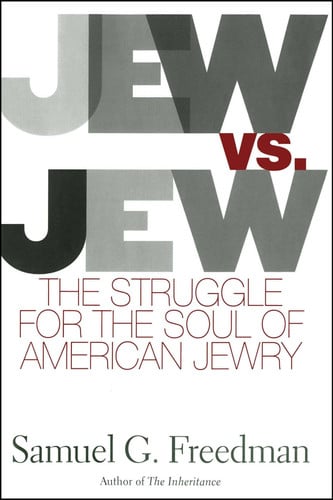
Jew Vs Jew The Struggle For The Soul Of American Jewry

Samuel G. Freedman
At a time when American Jews should feel more secure and cohesive than ever, civil war is tearing apart their community. Congregations, neighborhoods, even families are taking sides in battles about Jewish identity and Jewish authenticity. The conflict pits fundamentalist against secularist, denomination against denomination, even liberal against conservative within each branch of Jewry. Jew vs. Jew tells the story of how American Jewry has increasingly -- and perhaps terminally -- broken apart in the last forty years. Jew vs. Jew stretches in time from 1960 to 2000. It travels the country from Florida to New England, from Los Angeles to the Catskills in New York, from Cleveland to Denver, and it also crosses the ocean to Israel to show how tensions within the Jewish state inflame those among American Jews. The flash-points range from conversion standards to the role of women, from the peace process in Israel to the sexual climate on an Ivy League campus. But behind them all, as Samuel Freedman writes, lie common causes. First, far from unifying American Jews, Israel now divides them on both political and religious grounds. Second, neither America nor the larger world presents Jews with a single enemy against whom to coalesce. Third, and most important, nothing in the Jewish history of persecution, oppression, and exile prepared the Chosen People for the challenge posed by America, the challenge of being absorbed into a tolerant and diverse nation, being accepted so thoroughly that the intermarriage rate tops 50 percent. Jew vs. Jew introduces readers to memorable places and characters. Freedman describes one of the final summers at a Labor Zionist camp in the Catskills whose brand of secular Jewishness is becoming obsolete because Zionism succeeded in creating Israel. He tells the story of Orthodox and Reform Jews in a Cleveland suburb who are fighting about the construction of several synagogues -- and, on a deeper level, about whether unity or pluralism ought to be the goal of Jewish life. He portrays a Florida Jew so violently opposed to the Oslo peace accords that he planted a bomb in a synagogue where Shimon Peres was speaking. He tells about a Los Angeles congregation that spent three years debating whether or not to honor the Biblical matriarchs in its liturgy.We come to know the Long Island neighbors who cannot tolerate sharing even a property line because their versions of Jewish identity are so irreconcilably different. Jew vs. Jew is a work of vigorous reporting, lucid writing, and intellectual curiosity. And even as it chronicles an embittered and polarized community, it refuses to take sides or pass judgment. Instead, with compassion and acuity, Jew vs. Jew bears witness.
Simon & Schuster 2007-09-21 400 pages

The Other Side of Death

Chapman Cohen
In "The Other Side of Death," Chapman Cohen critically examines the widespread belief in a future life, offering a skeptical perspective rooted in rational thought. This meticulously researched study delves into the historical and philosophical underpinnings of spiritualism, dissecting its claims and assessing its validity through rigorous analysis. Published in 1922, Cohen's work challenges conventional religious views and invites readers to question the evidence supporting life after death. This book is a valuable resource for those interested in the history of spiritualism, philosophical debates surrounding mortality, and the enduring human fascination with what lies beyond. This work has been selected by scholars as being culturally important, and is part of the knowledge base of civilization as we know it. This work was reproduced from the original artifact, and remains as true to the original work as possible. Therefore, you will see the original copyright references, library stamps (as most of these works have been housed in our most important libraries around the world), and other notations in the work. This work is in the public domain in the United States of America, and possibly other nations. Within the United States, you may freely copy and distribute this work, as no entity (individual or corporate) has a copyright on the body of the work. As a reproduction of a historical artifact, this work may contain missing or blurred pages, poor pictures, errant marks, etc. Scholars believe, and we concur, that this work is important enough to be preserved, reproduced, and made generally available to the public. We appreciate your support of the preservation process, and thank you for being an important part of keeping this knowledge alive and relevant.
Creative Media Partners, LLC 2025-05-22 162 pages