18 results for "World History"

The noonday demon: an atlas of depression

Solomon, Andrew
With uncommon humanity, candor, wit, and erudition, award-winning author Andrew Solomon takes the reader on a journey of incomparable range and resonance into the most pervasive of family secrets. His contribution to our understanding not only of mental illness but also of the human condition is truly stunning. The Noonday Demon examines depression in personal, cultural, and scientific terms. Drawing on his own struggles with the illness and interviews with fellow sufferers, doctors and scientists, policymakers and politicians, drug designers and philosophers, Solomon reveals the subtle complexities and sheer agony of the disease. He confronts the challenge of defining the illness and describes the vast range of available medications, the efficacy of alternative treatments, and the impact the malady has had on various demographic populations around the world and throughout history. He also explores the thorny patch of moral and ethical questions posed by emerging biological explanations for mental illness. The depth of human experience Solomon chronicles, the range of his intelligence, and his boundless curiosity and compassion will change the reader's view of the world.
Scribner 2001-06-12 571 pages

Accidental presidents: eight men who changed America

Cohen, Jared
"The strength and prestige of the American presidency has waxed and waned since George Washington. Accidental Presidents looks at eight men who came to the office without being elected to it. It demonstrates how the character of the man in that powerful seat affects the nation and world. Eight men have succeeded to the presidency when the incumbent died in office. In one way or another they vastly changed our history. Only Theodore Roosevelt would have been elected in his own right. Only TR, Truman, and LBJ were re-elected. John Tyler succeeded William Henry Harrison who died 30 days into his term. He was kicked out of his party and became the first president threatened with impeachment. Millard Fillmore succeeded esteemed General Zachary Taylor. He immediately sacked the entire cabinet and delayed an inevitable Civil War by standing with Henry Clay's compromise of 1850. Chester Arthur, the embodiment of the spoils system, was so reviled as James Garfield's successor that he had to defend himself against plotting Garfield's assassination; but he reformed the civil service. Andrew Johnson, who succeeded our greatest president, sided with remnants of the Confederacy in Reconstruction. Theodore Roosevelt broke up the trusts. Calvin Coolidge silently cooled down the Harding scandals and preserved the White House for the Republican Herbert Hoover and the Great Depression. Truman surprised everybody when he succeeded the great FDR and proved an able and accomplished president. Lyndon B. Johnson was named to deliver Texas electorally. He led the nation forward on Civil Rights but failed on Vietnam. Accidental Presidents adds immeasurably to our understanding of the power and limits of the American presidency in critical times"--
Simon & Schuster 2019 509 pages

The Holocaust and new world slavery: a comparative history

Katz, Steven T.
This volume offers the first, in-depth comparison of the Holocaust and new world slavery. Providing a reliable view of the relevant issues, and based on a broad and comprehensive set of data and evidence, Steven Katz analyzes the fundamental differences between the two systems and re-evaluates our understanding of the Nazi agenda. Among the subjects he examines are: the use of black slaves as workers compared to the Nazi use of Jewish labor; the causes of slave demographic decline and growth in different New World locations; the main features of Jewish life during the Holocaust relative to slave life with regard to such topics as diet, physical punishment, medical care, and the role of religion; the treatment of slave women and children as compared to the treatment of Jewish women and children in the Holocaust. Katz shows that slave women were valued as workers, as reproducers of future slaves, and as sexual objects, and that slave children were valued as commodities. For these reasons, neither slave women nor children were intentionally murdered. By comparison, Jewish slave women and children were viewed as the ultimate racial enemy and therefore had to be exterminated. These and other findings conclusively demonstrate the uniqueness of the Holocaust compared with other historical instances of slavery
Cambridge University Press 2019 852 pages

The minds of Billy Milligan

Keyes, Daniel
The inspiration for the streaming series The Crowded Room , starring Tom Holland • From the acclaimed author of Flowers for Algernon comes the shocking true story of a man battling multiple personality disorder. “An absorbing, often heart-rending exploration of the human mind.”— Cosmopolitan Billy Milligan can be anyone he wants to be . . . except himself. Billy Milligan was a man tormented by twenty-four distinct personalities battling for supremacy over his body—a battle that culminated when he awoke in jail, arrested for the kidnap and rape of three women. In a landmark trial, Billy was acquitted of his crimes by reason of insanity caused by multiple personality—the first such court decision in history—bringing to public light the most remarkable and harrowing case of multiple personality ever recorded. Twenty-four people live inside Billy Milligan. Philip, a petty criminal; Kevin, who dealt drugs and masterminded a drugstore robbery; April, whose only ambition was to kill Billy's stepfather; Adalana, the shy, lonely, affection-starved lesbian who “used” Billy's body in the rapes that led to his arrest; David, the eight-year-old “keeper of pain”; and all of the others, including men, women, several children, both boys and girls, and the Teacher, the only one who can put them all together. You will meet each in this often shocking true story. And you will be drawn deeply into the mind of this tortured young man and his splintered, terrifying world.
Bantam Books 1995-01-01 426 pages

Sex on the moon

Mezrich, Ben
Thad Roberts, a fellow in a prestigious NASA programme had an idea - a romantic, albeit crazy, idea. He wanted to give his girlfriend the moon. Literally. Thad convinced his girlfriend and another female accomplice, both NASA interns, to break into an impenetrable laboratory at NASA's headquarters - past security checkpoints, and electronically locked door with cipher security codes and camera-lined hallways - and help him steal the most precious objects in the world- Apollo moon rocks from every moon landing in history. Was Thad Roberts - undeniably gifted, picked for one of the most competitive scientific posts imaginable - really what he seemed? And what does one do with an item so valuable that it's illegal even to own? Based on meticulous research into thousands of pages of court records, FBI transcripts and documents, and scores of interviews with the people involved, Mezrich - with his signature high-velocity swagger - has reconstructed the madcap story of genius, love, and duplicity all centred on a heist that reads like a Hollywood thrill ride.
Arrow 2012 306 pages

Bush country: how Dubya became a great president while driving liberals insane

Podhoretz, John
In this rousing, persuasive, and hugely entertaining book, John Podhoretz says that George W. Bush has earned a place in the pantheon of great American chief executives---and shows in one amazing detail after another how Bush's success has driven some of his critics into a pathological frenzy. Podhoretz is the first to acknowledge that the odds were stacked against Dubya, the inexperienced Texas governor who took up residence in the White House lacking an electoral majority, dogged by widely publicized verbal mishaps, and widely viewed by the American elite as a lightweight. But to the delight of his friends and the teeth-gnashing frustration of liberals, George W. Bush has proven himself an immensely effective president. Throughout his three years in the White House, as Podhoretz explains, Dubya has outsmarted, out-maneuvered, out-articulated, and outshone adversaries and critics. Steeled by the tragedy of September 11, the new president took a nation more obsessed with reality television than with the reality of international terrorism and girded it for the long struggle that lay ahead. He has presided over two major military campaigns to stunning success, initiated tax cuts whose dimensions have awed critics and fans alike, and brought his party into the twenty-first century. He has been resourceful, disciplined, and independent-minded---so much so that he was able to reject his own father's governing style as president to find his own voice and his own place in history. Bush hasn't hoarded his political capital, but has used it in bold and unexpected ways. Instead of bowing to conventional wisdom and carving out a centrist position, he has remained true to his ideological roots. Instead of deferring to established Beltway thinking, he has done what he thinks is best for America and the world. As Bush has grown more presidential, the criticisms of him have grown more intense---and, in Podhoretz's view, crazier and crazier. In a series of short chapters, Podhoretz takes a rhetorical scalpel to eight of the wildest caricatures of Bush and leaves them in hilarious shreds. In a season of broadsides being fired from both sides of the aisle, here is a book that distinguishes itself by the force of its arguments and the ringing clarity of its thought. Impassioned, insightful, and convincing, Bush Country is an analysis of a presidency gone right and a celebration of a 0man who has already earned his place in history.
St. Martin's Press 2004-02-23 276 pages

The diversity myth: multiculturalism and the political intolerance on campus

Sacks, David O.
This is a powerful exploration of the debilitating impact that politically-correct “multiculturalism” has had upon higher education and academic freedom in the United States. In the name of diversity, many leading academic and cultural institutions are working to silence dissent and stifle intellectual life. This book exposes the real impact of multiculturalism on the institution most closely identified with the politically correct decline of higher education—Stanford University. Authored by two Stanford graduates, this book is a compelling insider’s tour of a world of speech codes, “dumbed-down” admissions standards and curricula, campus witch hunts, and anti-Western zealotry that masquerades as legitimate scholarly inquiry. Sacks and Thiel use numerous primary sources—the Stanford Daily, class readings, official university publications—to reveal a pattern of politicized classes, housing, budget priorities, and more. They trace the connections between such disparate trends as political correctness, the gender wars, Generation X nihilism, and culture wars, showing how these have played a role in shaping multiculturalism at institutions like Stanford. The authors convincingly show that multiculturalism is not about learning more; it is actually about learning less. They end their comprehensive study by detailing the changes necessary to reverse the tragic disintegration of American universities and restore true academic excellence.
Independent Institute 1998 285 pages

Great catastrophe: Armenians and Turks in the shadow of genocide

De Waal, Thomas
The destruction of the Armenians of the Ottoman Empire in 1915-16 was the greatest atrocity of World War I. Around one million Armenians were killed, and the survivors were scattered across the world. Although it is now a century old, the issue of what most of the world calls the Armenian Genocide of 1915 is still a live and divisive issue that mobilizes Armenians across the world, shapes the identity and politics of modern Turkey, and has consumed the attention of U.S. politicians for years. In Great Catastrophe, the eminent scholar and reporter Thomas de Waal looks at the aftermath and politics of the Armenian Genocide and tells the story of recent efforts by courageous Armenians, Kurds, and Turks to come to terms with the disaster as Turkey enters a new post-Kemalist era. The story of what happened to the Armenians in 1915-16 is well-known. Here we are told the "history of the history" and the lesser-known story of what happened to Armenians, Kurds, and Turks in the century that followed. De Waal relates how different generations tackled the issue of the "Great Catastrophe" from the 1920s until the failure of the Protocols signed by independent Armenia and Turkey in 2010. Quarrels between diaspora Armenians supporting and opposing the Soviet Union broke into violence and culminated with the murder of an archbishop in 1933. The devising of the word "genocide," the growth of modern identity politics, and the 50th anniversary of the massacres re-energized a new generation of Armenians. In Turkey the issue was initially forgotten, only to return to the political agenda in the context of the Cold War and an outbreak of Armenian terrorism. More recently, Turkey has started to confront its taboos. In an astonishing revival of oral history, the descendants of tens of thousands of "Islamized Armenians," who have been in the shadows since 1915, have begun to reemerge and reclaim their identities. Drawing on archival sources, reportage and moving personal stories, de Waal tells the full story of Armenian-Turkish relations since the Genocide in all its extraordinary twists and turns. He looks behind the propaganda to examine the realities of a terrible historical crime and the divisive "politics of genocide" it produced. The book throws light not only on our understanding of Armenian-Turkish relations but also of how mass atrocities and historical tragedies shape contemporary politics.
Oxford University Press 2015 298 pages

The four little dragons: the spread of industrialization in East Asia

Vogel, Ezra Felvel
"Japan and the four little dragons—Taiwan, South Korea, Hong Kong, and Singapore—constitute less than 1 percent of the world’s land mass and less than 4 percent of the world’s population. Yet in the last four decades they have become, with Europe and North America, one of the three great pillars of the modern industrial world order. How did they achieve such a rapid industrial transformation? Why did the four little dragons, dots on the East Asian periphery, gain such Promethean energy at this particular time in history? Ezra F. Vogel, one of the most widely read scholars on Asian affairs, provides a comprehensive explanation of East Asia’s industrial breakthrough. While others have attributed this success to tradition or to national economic policy, Vogel’s penetrating analysis illuminates how cultural background interacted with politics, strategy, and situational factors to ignite the greatest burst of sustained economic growth the world has yet seen. Vogel describes how each of the four little dragons acquired the political stability needed to take advantage of the special opportunities available to would-be industrializers after World War II. He traces how each little dragon devised a structure and a strategy to hasten industrialization and how firms acquired the entrepreneurial skill, capital, and technology to produce internationally competitive goods. Vogel brings masterly insight to the underlying question of why Japan and the little dragons have been so extraordinarily successful in industrializing while other developing countries have not. No other work has pinpointed with such clarity how institutions and cultural practices rooted in the Confucian tradition were adapted to the needs of an industrial society, enabling East Asia to use its special situational advantages to respond to global opportunities."
Harvard University Press 1991 138 pages

Foreign Policy Breakthroughs: Cases in Successful Diplomacy

Robert L. Hutchings,Jeremi Suri
"Diplomacy is essential to the conduct of foreign policy and international business in the twenty-first century. Yet, few international actors are trained to understand or practice effective diplomacy. Poor diplomacy has contributed to repeated setbacks for the United States and other major powers in the last decade. Drawing on deep historical research, this book aims to 'reinvent' diplomacy for our current era. The original and comparative research provides a foundation for thinking about what successful outreach, negotiation, and relationship-building with foreign actors should look like. Instead of focusing only on failures, as most studies do, this one interrogates success. The book provides a framework for defining successful diplomacy and implementing it in diverse contexts. Chapters analyze the activities of diverse diplomats (including state and non-state actors) in enduring cases, including: post-WWII relief, the rise of the non-aligned movement, the Nuclear Non-Proliferation Treaty, the U.S. opening to China, the Camp David Accords, the reunification of Germany, the creation of the European Union, the completion of the North American Free Trade Agreement, and relief aid to pre-2001 Afghanistan. The cases are diverse and historical, but they are written with an eye toward contemporary challenges and opportunities. The book closes with systematic reflections on how current diplomats can improve their activities abroad. Foreign Policy Breakthroughs offers rigorous historical insights for present policy"--
Oxford University Press 2015 284 pages

A legacy of liberation: Thabo Mbeki and the future of the South African dream

Gevisser, Mark
In this gripping social history of South Africa, award-winning journalist Mark Gevisser follows the family of former South African President Thabo Mbeki to make sense of his legacy and understand the future of the country under new President Jacob Zuma. With unparalleled access to Mbeki and Zuma, as well as other key players in the ANC, Gevisser presents an intimate yet accessible account of South Africa's past, present and future. With his stunning account of the Mbeki family's history as a backdrop, Gevisser fleshes out a monumental period in world history that will continue to shape African politics for years to come.
Palgrave Macmillan 2010-06-08 376 pages

George Kennan: a study of character

Lukacs, John
A profoundly moving biographical study of George Kennan by the fine historian John Lukacs A man of impressive mental powers, of extraordinary intellectual range, and--last but not least--of exceptional integrity, George Frost Kennan (1904-2005) was an adviser to presidents and secretaries of state, with a decisive role in the history of this country (and of the entire world) for a few crucial years in the 1940s, after which he was made to retire; but then he became a scholar who wrote seventeen books, scores of essays and articles, and a Pulitzer Prize-winning memoir. He also wrote remarkable public lectures and many thousands of incisive letters, laying down his pen only in the hundredth year of his life. Having risen within the American Foreign Service and been posted to various European capitals, and twice to Moscow, Kennan was called back to Washington in 1946, where he helped to inspire the Truman Doctrine and draft the Marshall Plan. Among other things, he wrote the "X" or "Containment" article for which he became, and still is, world famous (an article which he regarded as not very important and liable to misreading). John Lukacs describes the development and the essence of Kennan's thinking; the--perhaps unavoidable--misinterpretations of his advocacies; his self-imposed task as a leading realist critic during the Cold War; and the importance of his work as a historian during the second half of his long life.
Yale University Press 2009 207 pages

Linked labor histories: New England, Colombia, and the making of a global working class

Chomsky, Aviva
Exploring globalization from a labor history perspective, Aviva Chomsky provides historically grounded analyses of migration, labor-management collaboration, and the mobility of capital. She illuminates the dynamics of these movements through case studies set mostly in New England and Colombia. Taken together, the case studies offer an intricate portrait of two regions, their industries and workers, and the myriad links between them over the long twentieth century, as well as a new way to conceptualize globalization as a long-term process. Chomsky examines labor and management at two early-twentieth-century Massachusetts factories: one that transformed the global textile industry by exporting looms around the world, and another that was the site of a model program of labor-management collaboration in the 1920s. She follows the path of the textile industry from New England, first to the U.S. South, and then to Puerto Rico, Japan, Mexico, Central America, the Caribbean, and Colombia. She considers how towns in Rhode Island and Massachusetts began to import Colombian workers as they struggled to keep their remaining textile factories going. Most of the workers eventually landed in service jobs: cleaning houses, caring for elders, washing dishes. Focusing on Colombia between the 1960s and the present, Chomsky looks at the Urabá banana export region, where violence against organized labor has been particularly acute, and, through a discussion of the AFL-CIO’s activities in Colombia, she explores the thorny question of U.S. union involvement in foreign policy. In the 1980s, two U.S. coal mining companies began to shift their operations to Colombia, where they opened two of the largest open-pit coal mines in the world. Chomsky assesses how different groups, especially labor unions in both countries, were affected. Linked Labor Histories suggests that economic integration among regions often exacerbates regional inequalities rather than ameliorating them.
Duke University Press 2008-04 397 pages

Love in black and white: a memoir of race, religion, and romance

Cohen, William S.
Streaming Video on Love In Black & White now available at Expandedbooks.com Most Americans regard the World War II period as belonging to the "greatest generation," but it was also a time when religious intolerance and racial violence flourished. Shamefully, it was commonplace to see signs that read "Whites Only" or "Jews Not Allowed." It is within this world that this compelling memoir is set. William Cohen, born in Bangor, Maine, was the eldest son of a Jewish father and a Protestant Irish mother. Janet Langhart, an African-American, was raised in Indianapolis, Indiana by her single parent mother, a Southern Baptist. The book draws fascinating parallels between the histories of two people from different regions, races, and religions, as both are witnesses to and targets of the social tensions of the day. Throughout Love in Black and White, readers accompany Bill and Janet in their struggle to overcome to the barriers of ethnic and racial bigotry and hatred. The stories are rich and profound. At times they are amusing. Other times, harrowing. Against impossible odds, Bill would be elected to serve his country as a U.S. Congressman and Senator, and Janet would become a prominent television personality, activist, and highly respected businesswoman and author. Opposites in so many ways―in color, faith and culture―seemingly a bundle of contradictions, they meet in 1974, become friends, and eventually fall in love. They decide to marry on Valentine's Day 1996 in the very place that once harbored some of the nation's most prominent racists-the U.S. Capitol. They receive the surprise of a lifetime when Bill is asked by President Bill Clinton to serve as the nation's 20th Secretary of Defense. It is a calling that proves to be life transforming for both him and Janet, as they lead, inspire and bring comfort to the men and women who defend our nation. It is at the Pentagon where they witness just how powerful our nation ca
Rowman & Littlefield Publishers 2007 373 pages

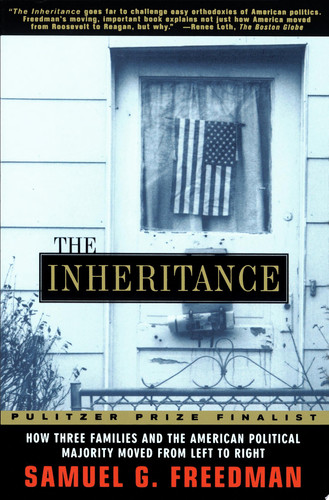
The inheritance: how three families and America moved from Roosevelt to Reagan and beyond

Freedman, Samuel G.
Orphan in the new world (Silvio Burigo) -- Liverpool on the Hudson (Lizzie Sanford Garrett) -- The dreamer and his son (Joseph Obrycki) -- The sewing room (Lizzie Garrett) -- The physics of cynicism (Joseph Obrycki) -- Worth two (Silvio Burigo) -- Voices from downstairs (Richie Garrett) -- Recessive genes (Silvio Burigo/Lorraine and Frank Trotta) -- Address as destiny (Vilma and Jack Maeby) -- Fence and basement (Silvio Burigo/Lorraine and Frank Trotta) -- Senator Clearwater (Richie Garrett) -- Uncle Paulie's Porch (Frank Trotta Jr.) -- The State Street Gang (Leslie Maeby) -- Poor snob (Tim Carey) -- Enchantment and its opposite (Frank Trotta Jr.) -- Incumbent protection (Leslie Maeby) -- Red suspenders (Tim Carey).
Simon & Schuster 1996 464 pages

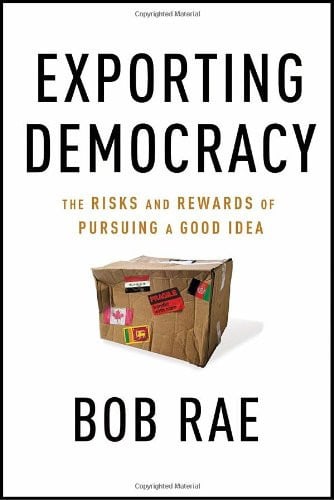
Exporting democracy: the risks and rewards of pursuing a good idea

Rae, Bob
The way most Western politicians talk, democracy is the pinnacle of civilization, the best political system there is. Many think it's the system the rest of the world ought to adopt. Bob Rae is not one of them. He is too well informed about the difficulties and dangers of implanting democracy in foreign lands. Exporting Democracy is an eloquently argued book in which Rae brings his lively, nuanced understanding to bear on the history and current fortunes of this powerful idea. He shows how it and the related ideas of freedom, human rights, and federalism have been pushed to centre stage by the collapse of Soviet communism and by ongoing wars to topple secular and religious dictatorships in the Middle East. He's also witnessed attempts to implant democracy in three countries riven by tribal and ethnic divisions, Iraq, Afghanistan, and Sri Lanka, and offers readers a cool appraisal of the effort.
McClelland & Stewart 2010 275 pages

Insulin murders: true life cases

Marks, Vincent
The first book ever to describe real life cases of murder, and purported murder, using insulin as a weapon. Covers cases from the USA, UK, Europe, Japan and New Zealand, including the well known Claus von Bulow case, the first criminal trial to be broadcast in its entirety on US TV (later the subject of a Hollywood movie, Reversal of Fortune). Written by Vincent Marks, coauthor of the critically acclaimed book Panic Nation: Exposing the Lies We're Told About Food and Health (John Blake Publishing) and a world authority on insulin, and Caroline Richmond, a medical journalist and writer, this gripping account is intended for doctors and laypeople alike, especially those with an interest in forensic medicine or true life crime.
Royal Socety of Medicine Press 2007 189 pages