17 results for "World History"

Balkan ghosts: a journey through history

Kaplan, Robert D.
From the assassination that triggered World War I to the ethnic warfare in Serbia, Bosnia, and Croatia, the Balkans have been the crucible of the twentieth century, the place where terrorism and genocide first became tools of policy. Chosen as one of the Best Books of the Year by The New York Times , and greeted with critical acclaim as "the most insightful and timely work on the Balkans to date" ( The Boston Globe ), Kaplan's prescient, enthralling, and often chilling political travelogue is already a modern classic. This new edition of the Balkan Ghosts includes six opinion pieces written by Robert Kaplan about the Balkans between 1996 and 2000 beginning just after the implementation of the Dayton Peace Accords and ending after the conclusion of the Kosovo war, with the removal of Slobodan Milosevic from power.
Picador 2005-05 307 pages

The Brooklyn nobody knows: an urban walking guide

Helmreich, William B.
Bill Helmreich walked every block of New York City—6,000 miles in all—to write the award-winning The New York Nobody Knows . Now he has re-walked Brooklyn—some 816 miles—to write this one-of-a-kind walking guide to the city's hottest borough. Drawing on hundreds of conversations he had with residents during his block-by-block journeys, The Brooklyn Nobody Knows captures the heart and soul of a diverse, booming, and constantly changing borough that defines cool around the world. The guide covers every one of Brooklyn’s forty-four neighborhoods, from Greenpoint to Coney Island, providing a colorful portrait of each section’s most interesting, unusual, and unknown people, places, and things. Along the way you will learn about a Greenpoint park devoted to plants and trees that produce materials used in industry; a hornsmith who practices his craft in Prospect-Lefferts Gardens; a collection of 1,140 stuffed animals hanging from a tree in Bergen Beach; a five-story Brownsville mural that depicts Zionist leader Theodor Herzl—and that was the brainchild of black teenagers; Brooklyn’s most private—yet public—beach in Manhattan Beach; and much, much more. An unforgettably vivid chronicle of today’s Brooklyn, the book can also be enjoyed without ever leaving home—but it’s almost guaranteed to inspire you to get out and explore one of the most fascinating urban areas anywhere. Covers every one of Brooklyn’s 44 neighborhoods, providing a colorful portrait of their most interesting, unusual, and unknown people, places, and things Each neighborhood section features a brief overview and history; a detailed, user-friendly map keyed to the text; and a lively guided walking tour Draws on the author’s 816-mile walk through every Brooklyn neighborhood Includes insights from conversations with hundreds of residents
Princeton University Press 2016-10-04 404 pages

An empire wilderness: travels into America's future

Kaplan, Robert D.
Having reported on some of the world's most violent, least understood regions in his bestsellers Balkan Ghosts and The Ends of the Earth, Robert Kaplan now returns to his native land, the United States of America. Traveling, like Tocqueville and John Gunther before him, through a political and cultural landscape in transition, Kaplan reveals a nation shedding a familiar identity as it assumes a radically new one. An Empire Wilderness opens in Fort Leavenworth, Kansas, where the first white settlers moved into Indian country and where Manifest Destiny was born. In a world whose future conflicts can barely be imagined, it is also the place where the army trains its men to fight the next war. "A nostalgic view of the United States is deliberately cultivated here," Kaplan writes, "as if to bind the uncertain future to a reliable past." From Fort Leavenworth, Kaplan travels west to the great cities of the heartland--to St. Louis, once a glorious shipping center expected to outshine imperial Rome and now touted, with its desolate inner city and miles of suburban gated communities, as "the most average American city." Kaplan continues west to Omaha; down through California; north from Mexico, across Arizona, New Mexico, and Texas; up to Montana and Canada, and back through Oregon. He visits Mexican border settlements and dust-blown county sheriffs' offices, Indian reservations and nuclear bomb plants, cattle ranches in the Oklahoma Panhandle, glacier-mantled forests in the Pacific Northwest, swanky postsuburban sprawls and grim bus terminals, and comes, at last, to the great battlefield at Vicksburg, Mississippi, where an earlier generation of Americans gave their lives for their vision of an American future. But what, if anything, he asks, will today's Americans fight and die for? At Vicksburg Kaplan contemplates the new America through which he has just traveled--an America of sharply polarized communities that draws its population from pools of talent far beyond its borders; an America where the distance between winners and losers grows exponentially as corporations assume gov-ernment functions and the wealthy find themselves more closely linked to their business associates in India and China than to their poorer neighbors a few miles away; an America where old loyalties and allegiances are vanishing and new ones are only beginning to emerge. The new America he found is in the pages of this book. Kaplan gives a precise and chilling vision of how the most successful nation the world has ever known is entering the final, and highly uncertain, phase of its history.
Random House 1998-08-18 393 pages

Eastward to Tartary

Kaplan, Robert D.
Eastward to Tartary , Robert Kaplan's first book to focus on a single region since his bestselling Balkan Ghosts , introduces readers to an explosive and little-known part of the world destined to become a tinderbox of the future. Kaplan takes us on a spellbinding journey into the heart of a volatile region, stretching from Hungary and Romania to the far shores of the oil-rich Caspian Sea. Through dramatic stories of unforgettable characters, Kaplan illuminates the tragic history of this unstable area that he describes as the new fault line between East and West. He ventures from Turkey, Syria, and Israel to the turbulent countries of the Caucasus, from the newly rich city of Baku to the deserts of Turkmenistan and the killing fields of Armenia. The result is must reading for anyone concerned about the state of our world in the decades to come.
Vintage Books 2001-10-23 364 pages

In Europe's shadow: two cold wars and a thirty-year journey through Romania and beyond

Kaplan, Robert D.
“Sweeping and replete with alluring detail . . . [a] haunting yet ultimately optimistic examination of the human condition as found in Romania.”—Alison Smale, The New York Times Book Review From the New York Times bestselling author Robert D. Kaplan, named one of the world’s Top 100 Global Thinkers by Foreign Policy magazine, comes a riveting journey through one of Europe’s frontier countries—and a potent examination of the forces that will determine Europe’s fate in the postmodern age. Robert Kaplan first visited Romania in the 1970s, when he was a young journalist and the country was a bleak Communist backwater. It was one of the darkest corners of Europe, but few Westerners were paying attention. What ensued was a lifelong obsession with a critical, often overlooked country—a country that, today, is key to understanding the current threat that Russia poses to Europe. In Europe’s Shadow is a vivid blend of memoir, travelogue, journalism, and history, a masterly work thirty years in the making—the story of a journalist coming of age, and a country struggling to do the same. Through the lens of one country, Kaplan examines larger questions of geography, imperialism, the role of fate in international relations, the Cold War, the Holocaust, and more. Here Kaplan illuminates the fusion of the Latin West and the Greek East that created Romania, the country that gave rise to Ion Antonescu, Hitler’s chief foreign accomplice during World War II, and the country that was home to the most brutal strain of Communism under Nicolae Ceaușescu. Romania past and present are rendered in cinematic prose: the ashen faces of citizens waiting in bread lines in Cold War–era Bucharest; the Bărăgan Steppe, laid bare by centuries of foreign invasion; the grim labor camps of the Black Sea Canal; the majestic Gothic church spires of Transylvania and Maramureş. Kaplan finds himself in dialogue with the great thinkers of the past, and with the Romanians of today, the philosophers, priests, and politicians—those who struggle to keep the flame of humanism alive in the era of a resurgent Russia. Upon his return to Romania in 2013 and 2014, Kaplan found the country transformed yet again—now a traveler’s destination shaped by Western tastes, yet still emerging from the long shadows of Hitler and Stalin. In Europe’s Shadow is the story of an ideological and geographic frontier—and the book you must read in order to truly understand the crisis Europe faces, from Russia and from within.
Random House 2016-11-01 287 pages

If only they didn't speak English: notes from Trump's America

Sopel, Jon
'You see, if only they didn't speak English in America, then we'd treat it as a foreign country - and probably understand it a lot better' 'the sanest man in America' - Bill Bryson 'Jon Sopel nails it' - Emily Maitlis **With a brand new chapter, charting Trump's first year in power** As the BBC's North America Editor, Jon Sopel has had a pretty busy time of it lately. In the time it's taken for a reality star to go from laughing stock to leader of the free world, Jon has travelled the length and breadth of the United States, experiencing it from a perspective that most of us could only dream of- he has flown aboard Air Force One, interviewed President Obama and has even been described as 'a beauty' by none other than Donald Trump. Through music, film, literature, TV and even through the food we eat and the clothes that we wear we all have a highly developed sense of what America is and through our shared, tangled history we claim a special relationship. But America today feels about as alien a country as you could imagine. It is fearful, angry and impatient for change. In this fascinating, insightful portrait of American life and politics, Jon Sopel sets out to answer our questions about a country that once stood for the grandest of dreams, but which is now mired in a storm of political extremism, racial division and increasingly perverse beliefs.
BBC Books 2018-05-31 380 pages

Marvelous possessions: the wonder of the New World : with a new preface

Greenblatt, Stephen
A masterwork of history and cultural studies, Marvelous Possessions is a brilliant meditation on the interconnected ways in which Europeans of the Age of Discovery represented non-European peoples and took possession of their lands, particularly in the New World. In a series of innovative readings of travel narratives, judicial documents, and official reports, Stephen Greenblatt shows that the experience of the marvelous, central to both art and philosophy, was manipulated by Columbus and others in the service of colonial appropriation. Much more than simply a collection of the odd and exotic, Marvelous Possessions is both a highly original extension of Greenblatt’s thinking on a subject that has permeated his career and a thrilling tale of wandering, kidnapping, and go-betweens—of daring improvisation, betrayal, and violence. Reaching back to the ancient Greeks, forward to the present, and, in his new preface, even to fantastical meetings between humans and aliens in movies like Close Encounters of the Third Kind , Greenblatt would have us ask: How is it possible, in a time of disorientation, hatred of the other, and possessiveness, to keep the capacity for wonder—for tolerant recognition of cultural difference—from being poisoned?
The University of Chicago Press 2017-10-20 202 pages

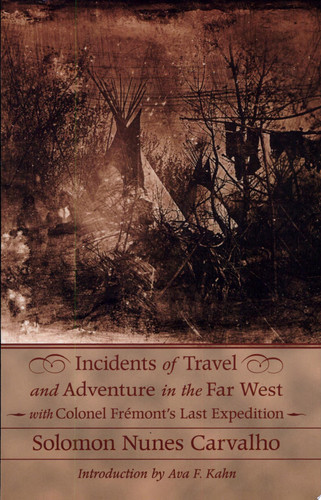
Incidents of travel and adventure in the Far West: with Colonel Fremont's last expedition across the Rocky Mountains, including three months' residence in Utah, and a perilous trip across the great American desert to the Pacific

Carvalho, Solomon Nunes
n August 1853, an American-born Sephardic Jew, Solomon Nunes Carvalho, accepted John Fremont's invitation to join his fifth expedition to find the best overland route to California. A Baltimore artist, inventor, and daguerreotypist, Carvalho was given the job of creating a photographic record of the lands and peoples along the way. Fremont's party left the Missouri on September 14, 1853, traveled up the Kansas River, overland to the Arkansas, upriver past Bent's Fort to the Huerfano, and traversed the Sandhill Pass into the Rocky Mountains. Beset by heavy snows and intense cold, they were reduced to eating their horses and mules and the occasional beaver or porcupine while making their way in midwinter across the Grand, Green, and Sevier Rivers. Suffering from frostbite, scurvy, and dysentery, Carvalho left the expedition in Utah; spent four months among the Mormons in Salt Lake City, where he observed with keen interest their system of spiritual wives; and reached California in 1854. Carvalho became the first Jewish writer to publish accounts of the Great American West and was also one of the first people to photograph the American West. Although only one of his plates is known to survive, others became the models for wood and steel engravings that broadcast the image of the West throughout the world. This Bison Books edition restores the discourses on Mormon doctrine omitted from previous twentieth-century editions. Ava F. Kahn is a visiting scholar at the California Studies Center, University of California, Berkeley. Her books include Jewish Voices of the California Gold Rush: A Documentary History, 1849-1880; Jewish Life in the American West: Perspectives on Migration, Settlement, and Community; and California Jews (coedited with Marc Dollinger).
University of Nebraska Press 2004-01-01 130 pages

A visit to Don Otavio

Bedford, Sybille
Before returning to the Old World after World War II, Sybille Bedford resolved to see something more of the New. "I had a great longing to move," she said, "to hear another language, eat new food, to be in a country with a long nasty history in the past and as little present history as possible." And so she set out for Mexico - and, incidentally, to write what Bruce Chatwin called the best travel book of the twentieth century, "a book of marvels, to be read again and again and again."
Eland 2002 312 pages

The golden dream: seekers of El Dorado

Silverberg, Robert
One of the most persistent legends in the annals of New World exploration is that of the Land of Gold. This mythical site was located over vast areas of South America (and later, North America); the search for it drove some men mad with greed and, as often as not, to their untimely deaths. In this history of quest and adventure, Robert Silverberg traces the fate of Old World explorers lured westward by the myth of El Dorado. From the German conquistadores licensed by the Spanish king to operate out of Venezuela, to the journeys of Gonzalo Pizarro in the Amazon basin, and to the nearly miraculous voyage of Francisco Orellana to the mouth of the Amazon River, encountering the warlike women who gave the river its name, violence and bloodshed accompanied the determined adventurers. Sir Walter Raleigh and a host of other explorers spent small fortunes and many lives trying to locate Manoa, a city that was rumored to be El Dorado—City of Gold. Celebrated science fiction author Robert Silverberg recreates these legendary quests in The Golden Dream: Seekers of El Dorado.
Ohio University Press 1996 437 pages

Engel's England: thirty-nine counties, one capital and one man

Engel, Matthew
England, says Matthew Engel, is the most complicated place in the world. And, as he travels through each of the historic English counties, he discovers that's just the start of it. Every county is fascinating, the product of a millennium or more of history: still a unique slice of a nation that has not quite lost its ancient diversity.He finds the well-dressers of Derbyshire and the pyromaniacs of Sussex; the Hindus and huntsmen of Leicestershire; the goddess-worshippers of Somerset. He tracks down the real Lancashire, hedonistic Essex, and the most mysterious house in Middlesex. In Durham he goes straight from choral evensong to the dog track. As he seeks out the essence of each county - from Yorkshire's broad acres to the microdot of Rutland - Engel always finds the unexpected .Engel's England is a totally original look at a confused country: a guidebook for people who don't think they need a guidebook. It is always quirky, sometimes poignant and often extremely funny.
Profile Books 2014 538 pages

Florence, a delicate case

Leavitt, David
David Leavitt brings the wonders and mysteries of Florence alive, illuminating why it is, and always has been, one of the most popular tourist destinations in the world. The third in the critically-acclaimed Writer and the City Series-in which some of the world's finest novelists reveal the secrets of the cities they know best- Florence is a lively account of expatriate life in the 'city of the lily'. Why has Florence always drawn so many English and American visitors? (At the turn of the century, the Anglo-American population numbered more than thirty thousand.) Why have men and women fleeing sex scandals traditionally settled here? What is it about Florence that has made it so fascinating-and so repellent-to artists and writers over the years? Moving fleetly between present and past and exploring characters both real and fictional, Leavitt's narrative limns the history of the foreign colony from its origins in the middle of the nineteenth century until its demise under Mussolini, and considers the appeal of Florence to figures as diverse as Tchaikovsky, E.M. Forster, Ronald Firbank, and Mary McCarthy. Lesser-known episodes in Florentine history-the moving of Michelangelo's David , and the construction of temporary bridges by black American soldiers in the wake of the Second World War-are contrasted with images of Florence today (its vast pizza parlors and tourist culture). Leavitt also examines the city's portrayal in such novels and films as A Room with a View , The Portrait of a Lady and Tea with Mussolini .
Bloomsbury 2002-06-01 176 pages

Farewell, Fred Voodoo: a letter from Haiti

Wilentz, Amy
A brilliant writer’s account of a long, painful, ecstatic—and unreciprocated—affair with a country that has long fascinated the world. The Rainy Season, Amy Wilentz’s award-winning 1989 portrait of Haiti after the fall of Jean-Claude Duvalier, was praised in the New York Times Book Review as “a remarkable account of a journalist’s transformation by her subject.” In her relationship with the country since then, Wilentz has witnessed more than one magical transformation. Now, with Farewell, Fred Voodoo , she gives us a vivid portrayal of the extraordinary people living in this stark place. Wilentz traces the country’s history from its slave plantations through its turbulent revolutionary history, its kick-up-the-dirt guerrilla movements, its totalitarian dynasty that ruled for decades, and its long and always troubled relationship with the United States. Yet through a history of hardship shines Haiti’s creative culture—its African traditions, its French inheritance, and its uncanny resilience, a strength that is often confused with resignation. Haiti emerged from the dust of the 2010 earthquake like a powerful spirit, and this stunning book describes the country’s day-to-day struggle and its relationship to outsiders who come to help out. There are human-rights reporters gone awry, movie stars turned aid workers, priests and musicians running for president, doctors turned diplomats. A former U.S. president works as a house builder and voodoo priests try to control elections. A foreign correspondent on a simple story becomes, over time and in the pages of this book, a lover of Haiti, pursuing the essence of this beautiful and confounding land into its darkest and brightest corners. Farewell, Fred Voodoo is a spiritual journey into the heart of the human soul, and Haiti has found in Amy Wilentz an author of astonishing wit, sympathy, and eloquence.
Simon & Schuster 2013-01-08 329 pages

How to travel without seeing

Neuman, Andrés
Lamenting not having more time to get to know each of the nineteen countries he visits after winning the prestigious Premio Alfaguara, Andrés Neuman begins to suspect that world travel consists mostly of "not seeing." But then he realizes that the fleeting nature of his trip provides him with a unique opportunity: touring and comparing every country of Latin America in a single stroke. Neuman writes on the move, generating a kinetic work that is at once puckish and poetic, aphoristic and brimming with curiosity. Even so-called non-places--airports, hotels, taxis--are turned into powerful symbols full of meaning. A dual Argentine-Spanish citizen, he incisively explores cultural identity and nationality, immigration and globalization, history and language, and turbulent current events. Above all, Neuman investigates the artistic lifeblood of Latin America, tackling with gusto not only literary heavyweights such as Bolaño, Vargas Llosa, Lorca, and Galeano, but also an emerging generation of authors and filmmakers whose impact is now making ripples worldwide.
Restless Books 2016-08-30 252 pages

Desert memories: journeys through the Chilean North

Dorfman, Ariel
El Norte Grande of Chile is the world's driest desert, a vast, barren expanse where a person can live an entire lifetime without ever feeling a single drop of rain, where rivers vanish into the sands and trees are all but unknown. But this forbidding landscape has many stories to tell an observant, inquisitive traveler. Someone like Ariel Dorfman. Renowned as a poet, essayist, novelist, and playwright, he combines eloquence, passion, and personal experience with a sure sense of place and a keen eye for the telling detail that brings history to life -- for this account of his journey through the desert is also a chronicle of modern Chile. Like an archaeologist, he sifts through shards of memory to recreate a world that no longer exists but still casts a long shadow over his native land. Ghosts are at the heart of his tale, from the ruined boomtowns where great nitrate fortunes were built to the seaside prison where Dorfman's old friend Freddy Taberna spent his last night before being executed in 1973 after the overthrow of Salvador Allende's government. In these pages, long-abandoned mining communities are summoned up in their glory days, when the mansions of mineral millionaires were built on the punishing labor of workers forever in hock to the company store. Nor are these the only ghosts. In this sweeping book, Dorfman also examines the oldest mummies in the world, visits an observatory at the top of the world that scans the light from long-dead stars, and sifts through the remains of indigenous villages buried under tons of sand. Skillfully interweaving present and past, memoir and meditation, fascinating history and colorful family lore, Desert Memories gazes across the seeming emptiness of el Norte Grande, finds a complete and compelling world, and conjures it up with the kind of elegant simplicity that only the most sophisticated of travelers can achieve.
National Geographic 2004 283 pages