
7 results for "World History"

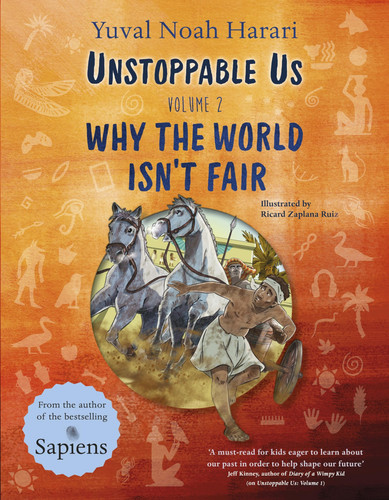
Unstoppable us: volume 2: why the world isn't fair

Harari, Yuval N.
Something really strange happened 10,000 years ago, and it changed everything. Why did millions of people agree to obey a few leaders? Where did kings and kingdoms come from? The answer to that is one of the strangest tales you'll ever hear. And it's a true story. Have you ever wondered how we got here? From gathering berries and hunting mammoths, to shopping at supermarkets and letting people tell us what to do? You might hear a lot of people say 'the world isn't fair'. But why isn't it? And how did it become so? In Unstoppable Us- Volume 1 , we learned how humans told stories to become rulers of the world - for good and bad. Now, in this next chapter of the incredible true tale of the Unstoppables, find out how humans learned to control animals like dogs, chicken and cows . . . And how a handful of humans learned to control everyone else. With full-colour illustrations showing the relentless rise and rise of the human race, this is history like you've never experienced it before.
Puffin Books 2024-03-07 187 pages

Ever since Darwin: reflections in natural history

Gould, Stephen Jay
More than any other modern scientists, Stephen Jay Gould has opened up to millions the wonders of evolutionary biology. His genius as an essayist lies in his unmatched ability to use his knowledge of the world, including popular culture, to illuminate the realm of science. Ever Since Darwin, Stephen Jay Gould's first book, has sold more than a quarter of a million copies. Like all succeeding collections by this unique writer, it brings the art of the scientific essay to unparalleled heights.
Norton 1979 285 pages

Dinosaurs at the Dinner Party How an Eccentric Group of Victorians Discovered Prehistoric Creatures and Accidentally Upended the World

Edward Dolnick
From the bestselling author of The Clockwork Universe and The Writing of the Gods , an “utterly delightful…hugely entertaining” ( Air Mail ) book about the eccentric Victorians who discovered dinosaur bones, leading to a whole new understanding of human history. In the early 1800s the natural world was a safe and cozy place, or so people believed. But then a twelve-year-old farm boy in Massachusetts stumbled on a row of fossilized three-toed footprints the size of dinner plates—the first dinosaur tracks ever found. Soon, in England, scientists unearthed enormous bones that reached as high as a man’s head. Outside of myths and fairy tales, no one had even imagined that creatures like three-toed giants had once lumbered across the land—nor dreamed that they could all have vanished, hundreds of millions years ago. In Dinosaurs at the Dinner Party , celebrated storyteller and historian Edward Dolnick leads us through a compelling true adventure as the paleontologists of the early 19th century puzzled their way through the fossil record to create the story of dinosaurs we know today. The tale begins with Mary Anning, a poor, uneducated woman who had a sixth sense for finding fossils buried deep inside cliffs; moves to William Buckland, an eccentric geologist who filled his home with specimens and famously pieced together a prehistoric scene from the fossil record inside a cave; and then on to the controversial Richard Owen, the era’s best-known scientist, and the one who coined the term “dinosaur.” “Exuberant” ( Kirkus Reviews ), entertaining, erudite, and featuring an unconventional cast of characters, Dinosaurs at the Dinner Party tells the story of how the accidental discovery of prehistoric creatures upended humanity’s understanding of the world and its own place within it.
Simon and Schuster 2025-08-12 352 pages

The Best American Science and Nature Writing 2004

Tim Folger,Steven Pinker
Since its inception in 1915, the Best American series has become the premier annual showcase for the country's finest short fiction and nonfiction. For each volume, a series editor reads pieces from hundreds of periodicals, then selects between fifty and a hundred outstanding works. That selection is pared down to the twenty or so very best pieces by a guest editor who is widely recognized as a leading writer in his or her field. This unique system has helped make the Best American series the most respected -- and most popular -- of its kind. The Best American Science and Nature Writing 2004, edited by Steven Pinker, is another "provocative and thoroughly enjoyable [collection] from start to finish" (Publishers Weekly). Here is the best and newest on science and nature: the psychology of suicide terrorism, desperate measures in surgery, the weird world of octopuses, Sex Week at Yale, the linguistics of click languages, the worst news about cloning, and much more.
Houghton Mifflin 2004 209 pages

Biology under the influence: dialectical essays on ecology, agriculture, and health

Lewontin, Richard C.
How do we understand the world? While some look to the heavens for intelligent design, others argue that it is determined by information encoded in DNA. Science serves as an important activity for uncovering the processes and operations of nature, but it is also immersed in a social context where ideology influences the questions we ask and how we approach the material world. Biology Under the Influence: Dialectical Essays on the Coevolution of Nature and Society breaks from the confirms of determinism, offering a dialectical analysis for comprehending a dynamic social and natural world. In Biology Under the Influence , Richard Lewontin and Richard Levins provide a devastating critique of genetic determinism and reductionism within science while exploring a broad range of issues including the nature of science, biology, evolution, the environment, pubic health, and dialectics, They dismantle the ideology that attempts to naturalize social inequalities, unveil the alienation of science and nature, and illustrate how a dialectical position serves as a basis for grappling with historical developments and a world characterized by change. Biology Under the Influence brings together the illuminating essays of two prominent scientists who work to demystify and empower the public's understanding of science and nature.
Monthly Review Press 2007-11-01 400 pages

Global Brain The Evolution of Mass Mind from the Big Bang to the 21st Century

Howard Bloom
"As someone who has spent forty years in psychology with a long-standing interest in evolution, I'll just assimilate Howard Bloom's accomplishment and my amazement." --DAVID SMILLIE, Visiting Professor of Zoology, Duke University In this extraordinary follow-up to the critically acclaimed The Lucifer Principle, Howard Bloom--one of today's preeminent thinkers--offers us a bold rewrite of the evolutionary saga. He shows how plants and animals (including humans) have evolved together as components of a worldwide learning machine. He describes the network of life on Earth as one that is, in fact, a "complex adaptive system," a global brain in which each of us plays a sometimes conscious, sometimes unknowing role, and he reveals that the World Wide Web is just the latest step in the development of this brain. These are theories as important as they are radical. Informed by twenty years of interdisciplinary research, Bloom takes us on a spellbinding journey back to the big bang to let us see how its fires forged primordial sociality. As he brings us back via surprising routes, we see how our earliest bacterial ancestors built multitrillion-member research and development teams a full 3.5 billion years ago. We watch him unravel the previously unrecognized strands of interconnectedness woven by crowds of trilobites, hunting packs of dinosaurs, feathered flying lizards gathered in flocks, troops of baboons making communal decisions, and adventurous tribes of protohumans spreading across continents but still linked by primitive forms of information networking. We soon find ourselves reconsidering our place in the world. Along the way, Bloom offers us exhilarating insights into the strange tricks of body and mind that have organized a variety of life forms: spiny lobsters, which, during the Paleozoic age, participated in communal marching rituals; and bees, which, during the age of dinosaurs, conducted collective brainwork. This fascinating tour continues on to the sometimes brutal subculture wars that have spurred the growth of human civilization since the Stone Age. Bloom shows us how culture shapes our infant brains, immersing us in a matrix of truth and mass delusion that we think of as reality. Global Brain is more than just a brilliantly original contribution to the ongoing debate on the inner workings of evolution. It is a "grand vision," says the eminent evolutionary biologist David Sloan Wilson, a work that transforms our very view of who we are and why.
Turner Publishing Company 2001-08 384 pages

Women after all: sex, evolution, and the end of male supremacy

Konner, Melvin
Overview: A lively, richly informed argument for the natural superiority of women from the acclaimed author of The Tangled Wing. There is a human genetic fluke that is surprisingly common, due to a change in a key pair of chromosomes. In the normal condition the two look the same, but in this disorder one is malformed and shrunken beyond recognition. The result is a shortened life span, higher mortality at all ages, an inability to reproduce, premature hair loss, and brain defects variously resulting in attention deficit, hyperactivity, conduct disorder, hypersexuality, and an enormous excess of both outward and self-directed aggression. It is called maleness. In Women After All, Melvin Konner traces the arc of evolution to explain the relationships between women and men. With patience and wit he explores the knotty question of whether men are necessary in the biological destiny of the human race. He draws on multiple, colorful examples from the natural world-such as the mating habits of the octopus, black widow, angler fish, and jacana-and argues that maleness in humans is hardly necessary to the survival of the species. In characteristically humorous and engaging prose, Konner sheds light on our biologically different identities, while noting the poignant exceptions that challenge the male/female divide. We meet hunter-gatherers such as those in Botswana, whose culture gave women a prominent place, invented the working mother, and respected women's voices around the fire. Recent human history has upset this balance, as a dense world of war fostered extreme male dominance. But our species has been recovering over the past two centuries, and an unstoppable move toward equality is afoot. It will not be the end of men, but it will be the end of male supremacy and a better, wiser world for women and men alike. Provocative and richly informed, Women After All is bound to be controversial across the sexes
W.W. Norton & Company 2015-02-24 404 pages