14 results for "World History"

The better angels of our nature: why violence has declined

Pinker, Steven
We've all asked, "What is the world coming to?" But we seldom ask, "How bad was the world in the past?" Cognitive scientist Steven Pinker shows that the past was much worse. Evidence of a bloody history has always been around us: genocides in the Old Testament, gory mutilations in Shakespeare and Grimm, monarchs who beheaded their relatives, and American founders who dueled with their rivals. The murder rate in medieval Europe was more than thirty times what it is today. Slavery, sadistic punishments, and frivolous executions were common features of life for millennia, then were suddenly abolished. How could this have happened, if human nature has not changed? Pinker argues that thanks to the spread of government, literacy, trade, and cosmopolitanism, we increasingly control our impulses, empathize with others, debunk toxic ideologies, and deploy our powers of reason to reduce the temptations of violence.
Viking 2011 802 pages

Mind change: how digital technologies are leaving their mark on our brains

Greenfield, Susan
"Google. Facebook. Twitter. Repeat. We live in a world unimaginable even a few decades ago, one like no other in human history. It's a parallel world where we can be on the move in the real world, yet always hooked into an alternative time and place. And although it's a two-dimensional world of sight and sound, it offers instant information, connected identities, and constant novelty. In this world, our screen technologies are increasingly where we work, where we unwind, where we relieve our boredom and where we learn. The subsequent transformation in how we live and think is a vitally important issue, perhaps even the most important issue of our time. When toddlers are given iPads, and adults spend ten hours a day staring at a screen, can we afford to assume that our brave new screen technologies are harmless tools? Blending a wide range of scientific studies, news events, and cultural criticism with brio and verve, Mind Change presents an incisive snapshot of the global 'now.' Greenfield examines how the dawn of the Digital Age has already altered our cultural landscape, fueled an epidemic of oversharing, and transformed how we learn, remember and spread information -- and how these innovations are changing our physical brains. A warning cry, a shot across the bow, and a call to action, Mind Change explores the social, cultural and physiological ramifications of our new digital lifestyle"--
Random House 2015-02-10 348 pages

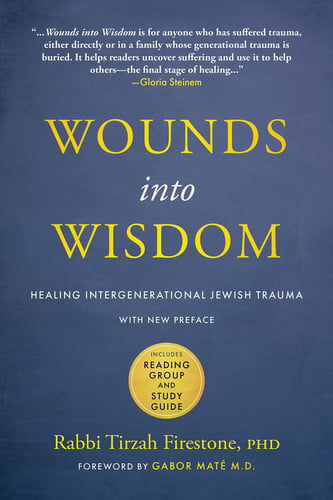
Wounds into wisdom: healing intergenerational Jewish trauma

Firestone, Tirzah
"Our past does not simply disappear. The painful history of our ancestors and their rich cultural wisdom intertwine within us to create the patterns of our future. Even when past trauma remains unspoken or has long been forgotten, it becomes part of us and our children-a legacy of both strength and woundedness that shapes our lives. In this book, Tirzah Firestone brings to life the profound impact of protracted historical trauma through the compelling narratives of those whose lives were marred by racial persecution and displacement. The tragic story of Firestone's own family lays the groundwork for these revealing testimonies of recovery, forgiveness, and moral leadership. Throughout, Firestone interweaves their voices with neuroscientific and psychological findings, as well as relevant and inspiring Jewish teachings. Seven principles emerge from these wise narratives-powerful prescriptive tools that speak to anyone dealing with the effects of past traumatic injury. At the broadest level, these principles are directives for staying morally awake in a world rife with terror"--
Monkfish Book Publishing Company 2022 258 pages

How magicians think: misdirection, deception, and why magic matters

Jay, Joshua
"Joshua Jay, one of the world's most accomplished magicians, not only opens that door but brings us inside to reveal the artistry and obsessiveness, esoteric history, and long-whispered-about traditions of a subject shrouded in mystery. In 52 short, compulsively readable essays, Jay describes how he does it, whether it's through the making of illusions, the psychology behind them, or the way technology influences the world of magic. He considers the aesthetics of performance, discusses contemporary masters, including David Copperfield, Penn & Teller, and David Blaine, and details how magicians hone their craft. And answers questions like: Can a magic trick be too good? How do you saw a person in half? Is there real magic in the universe? The answers, like so much in magic and life, depend on you."--Amazon.com.
Workman Publishing 2021 310 pages

Driven: a daughter's odyssey

Heldman, Julie
"In the mid-20th century, the Heldmans were tennis royalty. Julie was a volatile and gutsy tennis star, twice ranked number 5 in the world. Her mother Gladys was broadly admired for her unique magazine, World Tennis, and for engineering the women's tennis revolution. No one guessed that Gladys's hidden emotional abuse was the source of Julie's powerful drive. Driven is a highly readable insider's account of a pivotal time in women's tennis history; an in-depth look at Gladys's complex character; and the revealing story of Julie's interior journey, both on and off the court."--Page 4 of cover
Julie Heldman 2019 435 pages

The protean self: human resilience in an age of fragmentation

Lifton, Robert Jay
”Proteanism”—or the protean self—describes a psychological phenomenon integral to our times. We live in a world marked by breathtaking historical change and instantaneous global communication. Our lives seem utterly unpredictable: there are few absolutes. Rather than collapsing under these threats and pulls, Robert Jay Lifton tells us, the self turns out to be remarkably resilient. Like the Greek god Proteaus, who was able to change shape in response to crisis, we create new psychological combinations, immersing ourselves in fresh and surprising endeavors over our lifetimes.
BasicBooks 1993 262 pages

The Holocaust is over, we must rise from its ashes

Burg, Avraham
Modern-day Israel, and the Jewish community, are strongly influenced by the memory and horrors of Hitler and the Holocaust. Burg argues that the Jewish nation has been traumatized and has lost the ability to trust itself, its neighbors or the world around it. He shows that this is one of the causes for the growing nationalism and violence that are plaguing Israeli society and reverberating through Jewish communities worldwide. Burg uses his own family history--his parents were Holocaust survivors--to inform his innovative views on what the Jewish people need to do to move on and eventually live in peace with their Arab neighbors and feel comfortable in the world at large. Thought-provoking, compelling, and original, this book is bound to spark a heated debate around the world.
Palgrave Macmillan 2010 253 pages

Beyond Yahweh and Jesus: bringing death's wisdom to faith, spirituality, and psychoanalysis

Langs, Robert
The first in-depth psychoanalytic study of the Old and New Testaments, Beyond Yahweh and Jesus centers on God's role in enabling humans to cope with death and the anxieties it evokes. Yahweh is seen as tending to increase rather than diminish these death anxieties, while Christ offers near-perfect solutions to each type. Why, then, asks Dr. Langs, has Christ failed to bring peace to the world? Langs' answer is focused on what is, he argues, Western religion's lack of a deep understanding of human psychology-i.e., an absence of the psychological wisdom needed to supplement the spiritual wisdom of religion. This is a void bemoaned as early as the mid-1800s by the Archbishop Temple and by Carl Jung in the early 20th century. The journey on which Langs' study embarks leads through an examination of the related topics of knowledge acquisition and divine wisdom; the failure of psychoanalysis to provide religion with the psychology it needs to fulfill its mission; and a set of propositions that are intended to bring psychological wisdom to religion and thereby to initiate the third chapter in the history of God, in which a refashioned morality and fresh divine wisdom play notable roles. Simultaneously, the book offers a foundation for secular forms of spirituality and morality, as well as for human efforts to cope with death and its incumbent anxieties. The mission of this book is a lofty but necessary one: to reinvigorate religion with new dimensions and insights so as to empower it, at long last, to help bring peace to the world, both individually and collectively.
Jason Aronson 2008 201 pages

Going sane

Phillips, Adam
Volumes have been dedicated to madness, but sanity is rarely mentioned. We can define the mad, but how do we classify the sane? In Going Sane, psychoanalyst and writer Adam Phillips delves deep into history, philosophy, literature and his own experiences to address questions that we rarely ask about ourselves, taking us on an engrossing journey in which we learn many things - including some of what it takes to be happy in the modern world.
Hamish Hamilton 2005 244 pages

The abyss: bridging the divide between Israel and the Arab world

Avidar, Eli
"Eli Avidar looks into the abyss that divides Israel from its Arab neighbors, in order to understand the inherent flaws, prevailing misunderstandings, and tragic mistakes that characterize the relations and bloodletting, and how, if at all possible, to bridge the differences. In doing so, he offers a new perspective about the reality of the Middle East and all the clichés that have transformed the Hebrew-Arab lexicon into a complex and hopeless minefield. His analysis raises the question of whether the ongoing violent conflict between Israel and its neighbors might also be the result of a serious short circuit in communications. Is it possible that Israel, which has invested efforts and resources in knowing its adversaries, never even bothered to properly understand their language and their culture? Is it possible that Israeli leaders, who made their way to the top through the military and were privileged to know the most deeply hidden intelligence secrets, never learned to send messages of peace and reconciliation that the other side could respect and understand? Spanning six decades, the book explains why the main diplomatic initiatives have so far failed to solve the Israel-Palestinian conflict, and what needs to be done to break out of the vicious circle of ignorance and mutual suspicion that characterizes the conflict. Avidar uses his experience as diplomatic advisor to former foreign minister Ariel Sharon and as head of Israel's representative office in Qatar to reveal secret diplomatic meetings as well as the dynamics of the unique and complex diplomacy of the Middle East. He also tells about the activities of the 504 division of the Israel Defense Forces Intelligence Unit, in which he served as an operator of agents."--Publisher's description.
Rowman & Littlefield Publishing 2015-05-05 215 pages

Surviving the camps: unity in adversity during the Holocaust

Bartrop, Paul R.
Based on accounts by survivors, disputes Bruno Bettelheim's psychoanalytic, individual-oriented theory about prisoners' submission to Nazi values. Attributes survival in concentration camps to social activity, which served individual needs without harming others. Argues that group bonding was not appreciated by Bettelheim due to his approach and his selectivity of survivor accounts. Draws on a more authoritative, representative sample. Chs. 1-2 present a history of the camps and discuss how they were administered; ch. 3 uses survivor testimony to explain camp life; chs. 4-5 discuss the views of Bettelheim and his opponents; chs. 6-8 explore the concentration camp experience through the eyes of prisoners; ch. 9 presents conclusions about surviving in the camps.
University Press of America 2000-04-12 209 pages

Haunted in the New World: Jewish American culture from Cahan to The Goldbergs

Weber, Donald
Discusses Jewish identity in America as reflected in the culture of immigrants and descendants of immigrants. Self-hatred or, at least, ambivalence about oneself in the face of native American values is one theme. Ch. 5 (pp. 98-125), "To Make 'a Jew': Projecting Antisemitism in Post-War America", analyzes two novels - Arthur Miller's "Focus" and Saul Bellow's "The Victim" - that explore the psychosocial dimensions of postwar antisemitism. They raise the question whether possibilities of Jewish-Gentile relations might lead to personal and social renovation. In "Focus", a crypto-fascist antisemite who has internalized racist stereotypes finally identifies symbolically as a Jew. In "The Victim", both Jew and Gentile partially overcome their mutual stereotyping. The main Jewish protagonist also overcomes some negative aspects of his self-image.
Indiana University Press 2005-06-08 250 pages