40 results for "World History"

Iron Curtain The Crushing of Eastern Europe, 1944-1956

Anne Applebaum
At the end of WWII, the Soviet Union, to its surprise and delight, found itself in control of a huge swath of territory in Central Europe. It set out to convert a dozen radically different countries to a completely new political and moral system, Communism. Iron Curtain describes how the communist regimes of Eastern Europe were created, and what daily life was like once they were complete. Applebaum draws on newly opened European archives and personal accounts translated for the first time to portray in devestating detail millions of individuals trying to adjust to a way of life that challenged their every belief, rendered worthless their every qualification, and took everything away they had accumulated. Today the Soviet Block is a lost civilization, once whose cruelty, paranoia, bizarre morality and strange aethestics Applebaum captures in the electrifying pages of this book.
McClelland & Stewart 2012-10-30 608 pages

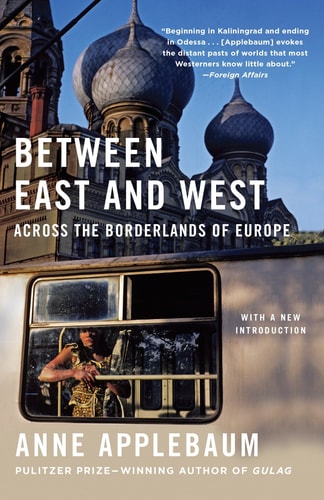
Between East and West Across the Borderlands of Europe

Anne Applebaum
In the summer and fall of 1991, Anne Applebaum, Pulitzer Prize-winning author of Gulag and Iron Curtain , took a three month road trip through the freshly independent borderlands of Eastern Europe. She deftly weaves the harrowing history of the region and captures the effects of political upheaval on a personal level. An extraordinary journey into the past and present of the lands east of Poland and west of Russia—an area defined throughout its history by colliding empires. Traveling from the former Soviet naval center of Kaliningrad on the Baltic to the Black Sea port of Odessa, Anne Applebaum encounters a rich range of competing cultures, religions, and national aspirations. In reasserting their heritage, the inhabitants of the borderlands attempt to build a future grounded in their fractured ancestral legacies. In the process, neighbors unearth old conflicts, devote themselves to recovering lost culture, and piece together competing legends to create a new tradition. Rich in surprising encounters and vivid characters, Between East and West brilliantly illuminates the soul of the borderlands and the shaping power of the past.
National Geographic Books 2017-06-13 336 pages

A people's tragedy: the Russian Revolution, 1891-1924

Figes, Orlando
On the brink of the 100th anniversary of the Russian Revolution, read the most vivid, moving, and comprehensive history of the events that changed the world It is history on an epic yet human scale. Vast in scope, exhaustive in original research, written with passion, narrative skill, and human sympathy, A People's Tragedy is a profound account of the Russian Revolution for a new generation. Many consider the Russian Revolution to be the most significant event of the twentieth century. Distinguished scholar Orlando Figes presents a panorama of Russian society on the eve of that revolution, and then narrates the story of how these social forces were violently erased. Within the broad stokes of war and revolution are miniature histories of individuals, in which Figes follows the main players' fortunes as they saw their hopes die and their world crash into ruins. Unlike previous accounts that trace the origins of the revolution to overreaching political forces and ideals, Figes argues that the failure of democracy in 1917 was deeply rooted in Russian culture and social history and that what had started as a people's revolution contained the seeds of its degeneration into violence and dictatorship. A People's Tragedy is a masterful and original synthesis by a mature scholar, presented in a compelling and accessibly human narrative.
Penguin Books 1998 923 pages

Return from Siberia

John Shallman
** Wall Street Journal , Publishers Weekly , and USA Today Bestseller!** In the lead-up to the Bolshevik Revolution, one young revolutionary is condemned to exile in Siberia; a hundred years later, his ancestors discover his story and learn just how much history has repeated itself. In the midst of running a long-shot political campaign, Democratic political consultant John Simon discovers a 100-year-old manuscript written by his grandfather Joseph—a brilliant young revolutionary whose exile to Siberia by the last czar of Russia is just the beginning of an extraordinary tale of survival, romance, and revolution. Return From Siberia chronicles not only the Simon family's relationship to each other and the past, but also the remarkable story of a young man who sacrificed everything for his political ideals. As Joseph's manuscript is translated, chapter-by-chapter, the Simon family is pulled deep into their ancestor’s story— in particular, the bitter rivalry between two brothers, whose competing visions of the American Dream are played out on the campaign trail and in their lives. Return from Siberia is a timely appraisal of modern politics and society juxtaposed with an inside look into the machinations of a young political mind 100 years ago. The true story documents an extraordinary time of political upheaval in Russia and Europe just prior to World War I while also drawing parallels to current day American politics and the current philosophical and ideological debates about immigration, Democratic Socialism, and Capitalism. Beyond the deep social, political, and philosophical themes, there is romance, adventure, betrayal, suspense, and the struggles of families today and in yesteryear. Return from Siberia illustrates how one modern family's connection to the past helps them resolve their future.
Skyhorse 2020-08-18 256 pages

The Lost A Search for Six of Six Million

Daniel Mendelsohn
A New York Times Notable Book * Winner of the National Jewish Book Award * Winner of the National Book Critics Circle Award * A Los Angeles Times Book Prize Finalist "A gripping detective story, a stirring epic, a tale of ghosts and dark marvels, a thrilling display of scholarship, a meditation on the unfathomable mystery of good and evil, a testimony to the enduring power of the ancient archetypes that haunt one Jewish family and the greater human family, The Lost is as complex and rich with meaning and story as the past it seeks to illuminate. A beautiful book, beautifully written."--Michael Chabon In this rich and riveting narrative, a writer's search for the truth behind his family's tragic past in World War II becomes a remarkably original epic--part memoir, part reportage, part mystery, and part scholarly detective work--that brilliantly explores the nature of time and memory, family and history. The Lost begins as the story of a boy who grew up in a family haunted by the disappearance of six relatives during the Holocaust--an unmentionable subject that gripped his imagination from earliest childhood. Decades later, spurred by the discovery of a cache of desperate letters written to his grandfather in 1939 and tantalized by fragmentary tales of a terrible betrayal, Daniel Mendelsohn sets out to find the remaining eyewitnesses to his relatives' fates. That quest eventually takes him to a dozen countries on four continents and forces him to confront the wrenching discrepancies between the histories we live and the stories we tell. And it leads him, finally, back to the small Ukrainian town where his family's story began, and where the solution to a decades-old mystery awaits him. Deftly moving between past and present, interweaving a world-wandering odyssey with childhood memories of a now-lost generation of immigrant Jews and provocative ruminations on biblical texts and Jewish history, The Lost transforms the story of one family into a profound, morally searching meditation on our fragile hold on the past. Deeply personal, grippingly suspenseful, and beautifully written, this literary tour de force illuminates all that is lost, and found, in the passage of time.
HarperCollins Publishers 2022-08-02 688 pages

Young Stalin

Sebag Montefiore,Simon Sebag Montefiore
Stalin, like Hitler, remains the very personification of evil but also one of the creators of today’s world. Now in an enthralling biography that reads like a thriller, Simon Sebag Montefiore unveils the shadowy, adventurous journey of the Georgian cobbler’s son who became the Red Tsar.What makes a Stalin? Was he illegitimate? Was his mother whore or saint? Was Stalin a Tsarist agent or Lenin’s chief gangster? Was his most notorious heist planned during his stay in London? Was he to blame for his wife’s death? If he really missed the 1917 Revolution, how did he emerge so powerful?Born in poverty, scarred by his upbringing, exceptional in his studies, this charismatic but dangerous boy was hailed as a romantic poet and trained as a priest but found his mission as fanatical revolutionary. He became the mastermind of bank robberies, protection-rackets, arson, piracy, and murder yet he was, uniquely part-intellectual, part-brigand. Surprisingly, he is also revealed as a scandalously prolific lover, leaving a trail of mistresses (varying from schoolgirls to noblewomen) and illegitimate children. Her is the arch-conspirator and escape-artist whose brutal ingenuity so impressed Lenin that he made Stalin (with Trotsky) his top henchman. The paranoid underworld of Joseph Conrad-style terrorism was Stalin’s natural habitat. Montefiore shows how murderous Caucasian banditry and political gangsterism, combined with pitiless ideology, qualified Stalin to demonstrate the Kremlin – and create the USSR in his flawed image. Based on massive research and astonishing new evidence in archives from Moscow to Georgia, YOUNG STALIN, companion and prequel to bestselling, prizewinning STALIN: THE COURT OF THE RED TSAR, is a chronicle of the Revolution, a pre-history of the USSR – and an intimate biography: this is how Stalin became Stalin.
McArthur 2007 397 pages

The Romanovs: 1613-1918

Sebag Montefiore, Simon
The Romanovs were the most successful dynasty of modern times, ruling a sixth of the world's surface for three centuries. How did one family turn a war-ruined principality into the world's greatest empire? And how did they lose it all? This is the intimate story of twenty tsars and tsarinas, some touched by genius, some by madness, but all inspired by holy autocracy and imperial ambition. Simon Sebag Montefiore's gripping chronicle reveals their secret world of unlimited power and ruthless empire-building, overshadowed by palace conspiracy, family rivalries, sexual decadence and wild extravagance, with a global cast of adventurers, courtesans, revolutionaries and poets, from Ivan the Terrible to Tolstoy and Pushkin, to Bismarck, Lincoln, Queen Victoria and Lenin. To rule Russia was both imperial-sacred mission and poisoned chalice: six of the last twelve tsars were murdered. Peter the Great tortured his own son to death while making Russia an empire, and dominated his court with a dining club notable for compulsory drunkenness, naked dwarfs and fancy dress. Catherine the Great overthrew her own husband (who was murdered soon afterward), enjoyed affairs with a series of young male favorites, conquered Ukraine and fascinated Europe. Paul I was strangled by courtiers backed by his own son, Alexander I, who in turn faced Napoleon's invasion and the burning of Moscow, then went on to take Paris. Alexander II liberated the serfs, survived five assassination attempts and wrote perhaps the most explicit love letters ever composed by a ruler. The Romanovs climaxes with a fresh, unforgettable portrayal of Nicholas II and Alexandra, the rise and murder of Rasputin, war and revolution--and the harrowing massacre of the entire family. Dazzlingly entertaining and beautifully written from start to finish, The Romanovs brings these monarchs--male and female, great and flawed, their families and courts--blazingly to life. Drawing on new archival research, Montefiore delivers an enthralling epic of triumph and tragedy, love and murder, encompassing the seminal years 1812, 1914 and 1917, that is both a universal study of power and a portrait of empire that helps define Russia today.
Alfred A. Knopf 2016 744 pages

Motherland: a feminist history of modern Russia, from revolution to autocracy

Ioffe, Julia
"Award-winning journalist Julia Ioffe tells the story of modern Russia through the history of its women, from revolution to utopia to autocracy. In 1990, seven-year-old Julia Ioffe and her family fled the Soviet Union. Nearly twenty years later, Ioffe returned to Moscow-only to discover just how much Russian society had changed while she had been living in America. The Soviet women she had known growing up-doctors, engineers, scientists-had seemingly been replaced with women desperate to marry rich and become stay-at-home moms. How had Russia gone from portraying itself as the vanguard of world feminism to the last bastion of conservative Christian values? In Motherland, Ioffe turns modern Russian history on its head, telling it exclusively through the stories of its women. From her own physician great-grandmothers to Lenin's lover, a feminist revolutionary; from the hundreds of thousands of Soviet girls who fought in World War II to the millions of single mothers who rebuilt and repopulated a devastated country; from the members of Pussy Riot to Yulia Navalnaya, wife of opposition leader Alexei Navalny, she chronicles one of the most audacious social experiments in history and how it failed the very women it was meant to liberate-and documents how that failure paved the way to the revanche of Vladimir Putin. Part memoir, part journalistic exploration, part history, Motherland paints a portrait of modern Russia through the women who shaped it. With deep emotion, Ioffe shows what it means to live through the cataclysms of revolution, war, idealism, and heartbreak-and reveals how the story of Russia today is inextricably tied to the history of its women"-- Provided by publisher.
Ecco, an imprint of Harper Collins Publishers 2025-10 489 pages

The Historical Figure of Jesus

Sanders, E. P.
Everyone has his own picture of Jesus - few historical figures have been so overlaid with centuries of mythmaking. But is it possible for us to discover what he was like from the historical evidence? Professor Sanders, author of Paul and Palestinian Judaism and Jesus and Judaism, has placed the study of the relationship between Judaism and early Christianity on a new one that is historical and descriptive rather than theological and antagonistic. In this book he uses a clear and logical approach, carefully distinguishing the 'certain' from the 'less certain' and the 'improbable' to present a fresh and dramatic account of Jesus as a person. Since scholars first began to analyse the gospels using the tools of critical study, Jesus has proved a tantalizing puzzle. There is enough evidence to offer the hope of a full explanation of who he was and what he did, but on examination it turns out to be difficult and sometimes contradictory. In the first part of this study Professor Sanders proposes that we can have excellent knowledge about Jesus on a general level where he fits into the history and religious movements of first-century Palestine, the main themes of his teaching, some of his principal activities, and the people who followed him. More specific questions, such as 'What precisely was he like?', 'What are the nuances of his teaching?' and 'What were his aims', can be answered with less certainty. The second part of the book identifies the range of possible answers and weighs the evidence in favour of each. Historical research into the life and career of Jesus cannot fully explain the emergence and phenomenal spread of the new religion of Christianity. The author discusses how the disciples decided to put together the reports of Jesus' life which we now have as the gospels, and their desire to present his person in the teachings of what became a powerful religion that spread from the Jews to the Gentiles and throughout the world. Although we must acknow
Allen Lane 1993

The Caucasus: an introduction

De Waal, Thomas
In this fascinating book, noted journalist Thomas de Waal—author of the highly acclaimed Black Garden—makes the case that while the Caucasus is often treated as a sub-plot in the history of Russia, or as a mere gateway to Asia. The five-day war in Georgia, which flared into a major international crisis in 2008, proves that this is still a combustible region, whose inner dynamics and history deserve a much more complex appreciation from the wider world. In The Caucasus, de Waal provides this richer, deeper, and much-needed appreciation, one that reveals that the South Caucasus—Armenia, Azerbaijan, and Georgia, and their many smaller regions, enclaves, and breakaway entities—is a fascinating and distinct world unto itself. Providing both historical background and an insightful analysis of the period after 1991, de Waal sheds light on how the region has been scarred by the tumultuous scramble for independence and the three major conflicts that broke out with the end of the Soviet Union—Nagorny Karabakh, Abkhazia, and South Ossetia. The book examines the region as a major energy producer and exporter; offers a compelling account of the Rose Revolution in Georgia, the rise of Mikheil Saakashvili, and the August 2008 war; and considers the failure of the South Caucasus, thus far, to become a single viable region. In addition, the book features a dozen or so "boxes" which provide brief snapshots of such fascinating side topics as the Kurds, Turkish-Armenian rapprochement, the promotion of the region as the "Soviet Florida," and the most famous of all Georgians, Stalin. The Caucasus delivers a vibrantly written and timely account of this turbulent region, one that will prove indispensable for all concerned with world politics. It is, as well, a stimulating read for armchair travelers and for anyone curious about far-flung corners of the world.
Oxford University Press 2010-10-07 259 pages

The History of the Russian Revolution

Leon Trotsky
The classic account of the social, economic, and political dynamics of the first socialist revolution as told by one of its central leaders. Trotsky describes how, under Lenin’s leadership, the Bolshevik Party led the working class, peasantry, and oppressed nationalities to overturn the monarchist regime of the landlords and capitalists and bring to power a government of the workers and peasants—one that set an example for toilers the world over. Nowhere are those world-shattering events explained with more clarity and insight than in this powerful account. Unabridged edition, 3 vols. in one. “Trotsky’s History is a monumental work”—Studies in East European Thought Chronology, glossary, lists of principal persons, parties, and political groups, index.
Pathfinder 1980 1564 pages

The Jews of silence

Wiesel, Elie
In the fall of 1965 the Israeli newspaper Haaretz sent a young journalist named Elie Wiesel to the Soviet Union to report on the lives of Jews trapped behind the Iron Curtain. “I would approach Jews who had never been placed in the Soviet show window by Soviet authorities,” wrote Wiesel. “They alone, in their anonymity, could describe the conditions under which they live; they alone could tell whether the reports I had heard were true or false—and whether their children and their grandchildren, despite everything, still wish to remain Jews. From them I would learn what we must do to help . . . or if they want our help at all.” What he discovered astonished him: Jewish men and women, young and old, in Moscow, Kiev, Leningrad, Vilna, Minsk, and Tbilisi, completely cut off from the outside world, overcoming their fear of the ever-present KGB to ask Wiesel about the lives of Jews in America, in Western Europe, and, most of all, in Israel. They have scant knowledge of Jewish history or current events; they celebrate Jewish holidays at considerable risk and with only the vaguest ideas of what these days commemorate. “Most of them come [to synagogue] not to pray,” Wiesel writes, “but out of a desire to identify with the Jewish people—about whom they know next to nothing.” Wiesel promises to bring the stories of these people to the outside world. And in the home of one dissident, he is given a gift—a Russian-language translation of Night, published illegally by the underground. “‘My God,’ I thought, ‘this man risked arrest and prison just to make my writing available to people here!’ I embraced him with tears in my eyes.”
Vallentine, Mitchell 1973 141 pages

History of the Russian Revolution

Trotsky, Leon
In History of the Russian Revolution , Leon Trotsky provided a vivid, truly original account of a transitional period in world history. Written with passion and keen insight, Trotsky—himself a central figure in the revolution—breaks down the complex issues that led to the fall of the Russian empire and the rise of the Soviet Union We were His work on history of analysis and political commentary stands as a reminder of the people’s struggle for change and the violent birth of a new nation
Independently published 2024-10-29 305 pages

A century of ambivalence: the Jews of Russia and the Soviet Union, 1881 to the present

Gitelman, Zvi Y.
A century ago, the Russian Empire contained the largest Jewish community in the world, numbering about five million people. Today, the Jewish population of the former Soviet Union has dwindled to half a million, but remains probably the third-largest Jewish community in the world. In the intervening century, the Jews of that area have been at the center of some of the most dramatic events of modern history - two world wars, revolutions, pogroms, political liberation, repression, and the collapse of the USSR. In startling photographs from the archives of the YIVO Institute for Jewish Research and with a lively and lucid narrative, 'A Century of Ambivalence' traces the historical experience of Jews in Russia from a period of creativity and repression in the second half of the nineteenth century through the paradoxes posed by the post-Soviet era.
Indiana University Press 2001 297 pages

A concise history of the Russian Revolution

Pipes, Richard
An authoritative history of the Russian Revolution and the "violent and disruptive acts" that created the first modern totalitarian regime, portraying the crisis at the heart of the tsarist empire "A deep and eloquent condemnation of the revolution and its aftermath." — The New York Times Drawing on archival materials released in Russia, Richard Pipes chronicles the upheaval that began as a conservative revolt but was soon captured by messianic intellectuals intent not merely on reforming Russia but on remaking the world. He provides fresh accounts of the revolution's personalities and policies, crises, and cruelties, from the murder of the royal family through civil war, famine, and state terror. Brilliantly and persuasively, Pipes shows us why the resulting system owes less to the theories of Marx than it did to the character of Lenin and Russia's long authoritarian tradition. What ensues is a path-clearing work that is indispensable to any understanding of the events of the century.
Vintage Books 1996-11-26 431 pages

Taking Risks A Jewish Youth in the Soviet Partisans and His Unlikely Life in California

Joseph Pell,Fred Rosenbaum
On the night the SS rounded up the Jews of his Ukrainian ghetto, eighteen-year-old Yosel Epelbaum crawled on his hands and knees to a nearby forest. There he joined a diverse band of pro-Soviet partisans, led by a kind of warlord in the wilderness, who created a "forest republic" behind enemy lines. With his courageous comrades, Epelbaum disrupted the German war effort for almost a year and a half and saved hundreds of civilans at the same time. After the liberation. the young survivor became caught up in Europe's roaring black market. With little money or formal education, an knowing no English, he immigrated to San Francisco in 1947 and within a year opened an ice cream shop in the city's outlying, foggy Sunset District. Only a decade later Joe Pell was well on his way to becoming one of the leading real estate developers in Northern California. Taking Risks, related in a taut and vivid style, is his story--one of loss and torment but also daring, ingenuity, and uncommon resilience.
Gatekeeper Press 2021-03-26 242 pages

Stalin's Generals

Harold Shukman
A star cast of distinguished contributors-- including Dmitri Volkogonov, John Erickson, Catherine Andreyev, David Glantz, and Oleg Rzheshevsky-- paint a crucial portrait of a defining period in world history. Unlike most military history, which usually deals with large-scale army movements and campaign strategy, this looks at the training, experience, and personalities of the generals themselves. The result is illuminating, revealing how 25 men succeeded in taking Stalin from the Volga to Berlin.
Diane Pub Co 2000-03 394 pages