41 results for "World History"

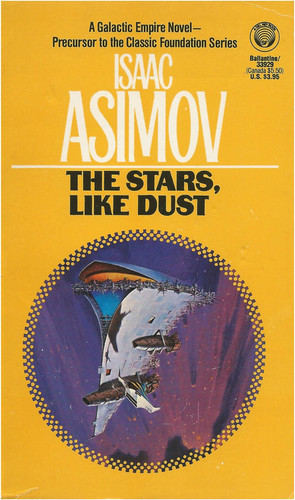
The Stars, Like Dust

Isaac Asimov
The first book in the Galactic Empire series, the spectacular precursor to the classic Foundation series, by one of history's most influential writers of science fiction, Isaac Asimov His name was Biron Farrill and he was a student at the University of Earth. A native of one of the helpless Nebular Kingdoms, he saw his home world conquered and controlled by the planet Tyrann--a ruthless, barbaric Empire that was building a dynasty of cruelty and domination among the stars. Farrill's own father had been executed for trying to resist the Tyrann dictatorship and now someone was trying to kill Biron. But why? His only hope for survival lay in fleeing Earth and joining the rebellion that was rumored to be forming somewhere in the Kingdoms. But once he cast his lot with the freedom fighters, he would find himself guarding against treachery on every side and facing the most difficult choice of all: to betray either the woman he loved or the revolution that was the last hope for the future.
Ballantine books 1986 231 pages

Pebble in the sky

Asimov, Isaac
Two minutes before he disappeared forever from the face of the Earth he knew, Joseph Schwartz was strolling down the pleasant streets of a Chicago suburb, thinking about his family, He was a simple man, a kind man, a practical man not given to wild flights of imagination. So when he saw the old Raggedy Ann doll lying in his path, he merely smiled and lifted his foot to step over it... That was the only thing he remembered. He did not know that it marked the last act of his life on this earth - and the beginning of a terrifying journey into a strange new world where the twentieth century was already ancient history.
Fawcett 1971 191 pages

Worldwar Striking the Balance

Harry Turtledove
WORLDWAR: BOOK 4 At the bloody height of World War II, the deadliest enemies in all of human history were forced to put aside their hatreds and unite against an even fiercer foe: a seemingly invincible power bent on world domination. With awesome technology, the aggressors swept across the planet, sowing destruction as Tokyo, Berlin, and Washington, D.C., were A-bombed into submission. Russia, Nazi Germany, Japan and the U.S. were not easily cowed, however. With cunning and incredible daring, they pressed every advantage against the invader's superior strength, and, led by Stalin, began to detonate their own atom bombs in retaliation. City after city explodes in radioactive firestorms, and fears grow as the worldwide resources disappear; will there be any world left for the invaders to conquer, or for the uneasy allies to defend? While Mao Tse-tung wages a desperate guerrilla war and Hitler drives his country toward self-destruction, United States forces frantically try to stop the enemy's push from coast to coast. Yet in this battle to stave off world domination, unless the once-great military powers take the risk of annihilating the human race, they'll risk losing the war. The fatal, final deadline arrives in Harry Turtledove's grand, smashing finale to the Worldwar series, as uneasy allies desperately seek a way out of a no-win, no-survival situation: a way to live free in a world that may soon be bombed into atomic oblivion. From the Hardcover edition.
Ballantine Books 1997 547 pages

Worldwar Upsetting the Balance

Harry Turtledove
Communist China, Japan, Nazi Germany, the United States: they began World War II as mortal enemies. But suddenly their only hope for survival--never mind victory--was to unite to stop a mighty foe--one whose frightening technology appeared invincible. Far worse beings than the Nazis were loose. From Warsaw to Moscow to China's enemy-occupied Forbidden City, the nations of the world had been forced into an uneasy alliance since humanity began its struggle against overwhelming odds. In Britain and Germany, where the banshee wail of hostile jets screamed across the land, caches of once-forbidden weapons were unearthed, and unthinkable tactics were employed against the enemy. Brilliantly innovative military strategists confronted challenges unprecedented in the history of warfare. Even as lack of fuel forced people back to horse and carriage, physicists worked feverishly to create the first atomic bombs--with horrifying results. City after city joined the radioactive pyre as the planet erupted in fiery ruins. Yet the crisis continued--on land, sea, and in the air--as humanity writhed in global combat. The tactics of daredevil guerrillas everywhere became increasingly ingenious against a superior foe whose desperate retaliation would grow ever more fearsome. No one had ever put the United States, or the world, in such deadly danger. But if the carnage and annihilation ever stopped, would there be any pieces to pick up?
Ballantine Books 1996 544 pages

In the Balance

Harry Turtledove
War seethed across the planet. Machines soared through the air, churned through the seas, crawled across the surface, pushing ever forward, carrying death. Earth was engaged in titanic struggle. Germany, Russia, France, China, Japan: the maps were changing day by day. The hostilities spread in ever-widening ripples of destruction: Britain, Italy, Africa...The fate of the world hung in the balance. Then the real enemy came. Out of the dark of night, out of the soft glow of dawn, out of the clear blue sky came an invasion force the likes of which Earth had never known - and worldwar was truly joined. The invaders were inhuman and they were unstoppable. Their technology was far beyond our reach, and their goal was simple. Fleetlord Atvar had arrived to claim Earth for the Empire. Never before had Earth's people been more divided. Never had the need for unity been greater. And grudgingly, inexpertly, humanity took up the challenge. In this epic novel of alternate history, Harry Turtledove takes us around the globe. We roll with German panzers; watch the coast of Britain with the RAF; and welcome alien-liberators to the Warsaw ghetto. In tiny planes we skim the vast Russian steppe, and we push the envelope of technology in secret labs at the University of Chicago. Turtledove's saga covers all the Earth, and beyond, as mankind - in all its folly and glory - faces the ultimate threat; and a turning point in history shows us a past that never was and a future that could yet come to be...
Random House Publishing Group 1997-10-04

The Best of Harry Turtledove

Harry Turtledove
For more than forty years, Harry Turtledove has been the acknowledged master of one of science fiction's most durable sub-genres: the tale of alternate history. In the course of an incredibly prolific career, Turtledove has created a host of brilliantly imagined revisionist histories on subjects ranging from the American Civil War to the Byzantine Empire to the Second World War (in which an alien invasion plays an unexpected role.) His work includes standalone novels and multi-volume epics, along with an impressive array of short fiction, the best of which has been gathered in this generous, irreplaceable volume. The Best of Harry Turtledove opens with "Peace is Better," the first of three stories featuring Bill Williamson, the nine-foot-tall Sasquatch who serves as governor of the fictional state of Jefferson, a place where "everyone gets along, regardless of race or size." Or species. "Bonehunters" posits a world in which the extinction event that ended the reign of the dinosaurs never took place. Two subsequent stories, "Junior & Me" and the Melville-inspired novella, "The Quest for the Great Gray Mossy," continue to develop this scenario. "The Eighth Grade History Class Visits the Hebrew Home for the Aging" imagines a world in which Anne Frank survived and emigrated to the United States, where she recounts her experiences to a visiting middle school class. "But It Does Move" is the account of a fictional confrontation between Galileo and a leader of the Holy Inquisition. These are only a few of the people, places, and historical epochs you will encounter in this magisterial collection. The twenty-four stories in The Best of Harry Turtledove constitute a master class both in the technique of alternate history and in the art of narrative itself. Longtime Turtledove readers will take this book to their hearts. Newcomers will find themselves searching for more of the author's inimitable--and highly addictive--fiction. They have a lot to look forward to.
Subterranean Press 2021-04-30 584 pages

Walk in hell

Turtledove, Harry
“Harry Turtledove [is] probably the best-known practitioner of alternate history working today.”— American Heritage The year is 1915, and the world is convulsing. Though the Confederacy has defeated its northern enemy twice, this time the United States has allied with the Kaiser. In the South, the freed slaves, fueled by Marxist rhetoric and the bitterness of a racist nation, take up the weapons of the Red rebellion. Despite these advantages, the United States remains pinned between Canada and the Confederate States of America, so the bloody conflict continues and grows. Both presidents—Theodore Roosevelt of the Union and staunch Confederate Woodrow Wilson—are stubbornly determined to lead their nations to victory, at any cost. . .
Del Rey Books 2000-07-05 606 pages

Fallout The Hot War

Harry Turtledove
“Turtledove is the standard-bearer for alternate history.”— USA Today The novels of Harry Turtledove show history balancing on single moments: One act of folly. One poor decision. One moment of rage. In this astounding new series, the unthinkable has come to pass. The Cold War turns hot—and the United States and the Soviet Union unleash their nuclear arsenals upon each other. Millions die. Millions more are displaced. Germans battle side by side with Americans, Polish freedom fighters next to Russian fascists. The genie is out of the bottle. And there’s no telling what fresh hell will come next. At the heart of Fallout are Harry Truman and Josef Stalin. Even as Joe McCarthy rises in power, the U.S. president is focused elsewhere, planning to cut off the head of the Soviet threat by taking out Stalin. It’s a daring gambit, but the Soviets have one of their own. Meanwhile, Europe’s weak sisters, France and Italy, seem poised to choose the winning side, while China threatens to overrun Korea. With Great Britain ravaged and swaths of America in ruins, leaders are running out of options. When the United States drops another series of bombs to slow the Russian advance in Europe, Stalin strikes back—with horrifying results. These staggering events unfold through the eyes of a sprawling cast of characters: a Holocaust survivor in a displaced persons camp in Washington; the wife of a bomber pilot and her five-year-old daughter starting a new existence; a savage Soviet fighter waging war by his own rules; a British pub owner falling in love with an American pilot. In the masterly hands of Harry Turtledove, this epic chronicle of war becomes a story of human struggle. As the armies of the world implode, the next chapter will be written by the survivors—those willing to rise up for an uncertain future. Praise for Fallout “Turtledove proves, yet again, that he is the best when it comes to rewriting history!” — Suspense Magazine “Turtledove, the master of alternate history, has done well again.” — Shelf Awareness “No one writes alternate-history novels quite like Turtledove. . . . Expect epic political stakes as well as personal and heartfelt stories of war.” —BookTrib
Random House Worlds 2017-05-30 400 pages

The Center Cannot Hold (American Empire, Book Two)

Harry Turtledove
In this spectacular, thought-provoking epic of alternate history, Harry Turtledove has created an unparalleled vision of social upheaval, war, and cutthroat politics in a world very much like our own—but with dramatic differences. It is 1924—a time of rebuilding, from the slow reconstruction of Washington’s most honored monuments to the reclamation of devastated cities in Europe and Canada. In the United States, the Socialist Party, led by Hosea Blackford, battles Calvin Coolidge to hold on to the Powell House in Philadelphia. And it seems as if the Socialists can do no wrong, for the stock market soars and America enjoys prosperity unknown in a half century. But as old names like Custer and Roosevelt fade into history, a new generation faces new uncertainties. The Confederate States, victorious in the War of Secession and in the Second Mexican War but at last tasting defeat in the Great War, suffer poverty and natural calamity. The Freedom Party promises new strength and pride. But if its chief seizes the reins of power, he may prove a dangerous enemy for the hated U.S.A. Yet the United States take little note. Sharing world domination with Germany, they consider events in the Confederacy of little consequence. As the 1920s end, calamity casts a pall across the continent. With civil war raging in Mexico, terrorist uprisings threatening U.S. control in Canada, and an explosion of violence in Utah, the United States are rocked by uncertainty. In a world of occupiers and the occupied, of simmering hatreds, shattered lives, and pent-up violence, the center can no longer hold. And for a powerful nation, the ultimate shock will come when a fleet of foreign aircraft rain death and destruction upon one of the great cities of the United States. . . .
National Geographic Books 2003-07-01 640 pages

Eastern Standard Tribe

CORY. DOCTOROW
Step into a world where time zones are tribes and loyalty is everything. "Eastern Standard Tribe" by Cory Doctorow, once lost to the sands of time, is now brilliantly restored and republished by Alpha Editions. This captivating novel, out of print for decades, is a collector's item and a cultural treasure, meticulously revived for today's and future generations. In a near-future society where global connectivity is both a blessing and a curse, protagonist Art struggles with the chaos of his dual life as a consultant and a secret agent for the Eastern Standard Tribe. Doctorow weaves a thrilling narrative that explores the complexities of trust, identity, and the relentless pursuit of happiness in a hyper-connected world. This edition is not just a reprint; it's a beautifully restored classic that promises to engage casual readers and collectors alike. With its unique blend of humor, insight, and suspense, "Eastern Standard Tribe" is a timeless exploration of the human condition in the digital age. Don't miss your chance to own a piece of literary history that challenges the boundaries of time and technology.
Alpha Edition 2025-04-15 150 pages

The Gladiator

Harry Turtledove
In Harry Turtledove's The Gladiator, the Soviet Union won the Cold War. The Russians were a little smarter than they were in our own world, and the United States was a little dumber and a lot less resolute. Now, more than a century later, the world's gone Communist, and capitalism is a bad word. For Gianfranco and his friend Annarita, a couple of teenagers growing up in Milan, life in a heavily regimented, surveillance-rich command economy is just plain dreary. The eventual withering-away of the state doesn't look like it's going to happen anytime soon. Annarita's a hard-working student and a member of the Young Socialists' League. Gianfranco is a lot less motivated--but on the other hand, his father's a Party apparatchik. The biggest excitement in their lives is a wargame shop called The Gladiator, which runs tournaments, and stocks marvelous complex games you can't find anywhere else. Then, abruptly, the shop is shut down. Someone's figured out that The Gladiator's games are teaching counterrevolutionary capitalist principles. The Security Police are searching high and low for the shop's proprietors, who've not only vanished into thin air, but have left behind sets of fingerprints that aren't in the records of any government on earth. Only one staffer is left: Gianfranco and Annarita's friend Eduardo. He's on the run, and he comes to them in secret with an astonishing story: he's a time trader from our own timeline, accidentally left behind when the store was evacuated. The only way Eduardo can get home to his own timeline is if Gianfranco and Annarita can help him reach one of the other time trader sites in this world--and the Security Police will be on their tails all the way there.
Macmillan 2008-09-30 288 pages

The Valley-Westside War

Harry Turtledove
Usually Crosstime Traffic concerns itself with trade. Our world owns the secret of travel between parallel continuums, and we mean to use it to trade for much-needed resources with the worlds next door. Preferably without letting them know about any of that parallel-worlds stuff. But there’s one parallel world that’s different. In it, the atomic war broke out in 1967, at the height of the Summer of Love. Now, Crosstime Traffic has been given a different sort of mission: find out what on earth, or on the many earths, went wrong.
Macmillan 2009-03-31 288 pages

Powerless

Harry Turtledove
In a society where lies are law, a simple act of honesty can become the ultimate rebellion. When does silent compliance with an oppressive regime become unbearable? For Charlie Simpkins, the manager of a small vegetable shop in Los Angeles' San Fernando Valley, part of the West Coast People's Democratic Republic, the breaking point comes when he is asked to display a meaningless propaganda poster in his shop window. It is a seemingly insignificant act in a lifetime of obedience. But Charlie just can't bring himself to doing it. This minor act of defiance, however, show too much independent thinking on Charlie's part, setting off a chain of escalating consequences for Charlie and his wife and two children. Powerless is a haunting dystopian tale of how even the smallest act of defiance can spiral into disaster in a society that demands total conformity. It serves as a chilling reminder of how easily standing up for one's principles can lead to crushing consequences, erringly echoing the challenges we face today for speaking our truth, even in societies that claim to uphold freedom. While the novel draws original inspiration from Alexander Dubček's 1968 vision of "socialism with a human face" in Czechoslovakia (the reformist movement sought to humanize authoritarian rule), it will resonate with many who fear that individual freedoms are under attack in many parts of the world. In Powerless, Charlie Simpkins' growing disillusionment mirrors the psychological toll experienced by many today as political stress and uncertainty become ever more pervasive. As Charlie seeks out others who share his dissatisfaction, his increasingly deliberate and risky actions symbolize the quiet acts of defiance that offer hope and resistance in a society where the powerful suppress dissent. Powerless serves as a poignant reminder of the consequences that can arise when standing up for one's principles in an environment that demands conformity.​
CAEZIK 2025-07-15 290 pages

Salamis

Harry Turtledove
"all will be impressed by Turtledove's immersive ancient world." − Publishers Weekly A new novel by one of the most acclaimed writers of alternate history in the world; a New York Times bestselling author who has been crowned as 'the Master of Alternate History' by Publisher Weekly and has won virtually every major award associated with the genre. Salamis is the fifth (standalone) novel in Harry Turtledove's critically acclaimed Hellenic Traders universe, detailing the adventures of two cousins, Menedemos and Sostratos, who work as seaborne traders following the death of Alexander the Great. This time the stage is one of the greatest sea battles ever fought in ancient times; the Battle of Salamis of 306 BC . The small, free, and independent polis of Rhodes is trying to stay neutral between the local great powers, each ruled by one of Alexander the Great's marshals: Asia Minor, controlled by one-eyed Antigonos, and Egypt, under the rule of Ptolemaios. As tensions between the great powers escalate, Menedemos and Sostratos are trying to resolve their own problems, oblivious to the fact that one of the greatest navel fleets in ancient history is about to set sail. Ptolemaios, needing shipping to carry weapons for the army he intends to land, coerces Menedemos into bringing their ship, the Aphrodite , along as part of his expeditionary force. And so, very much against their will, Menedemos and Sostratos become small parts of one of the ancient world's most significant naval battles.
CAEZIK 2020 268 pages

Owls to Athens

Harry Turtledove
"Owls to Athens demonstrates Turteltaub's excellent research skills ... an entertaining and intelligent story"-SF Site "Scholar and bestselling author [Turteltaub], encapsulates his vision of the ancient world through the eyes of these two engaging merchants."-Historical Novel Society After some long and perilous journeys, Menedemos and Sostratos finally head back to Athens just in time for the Dionysia, a bacchanalian festival of plays and celebrations. Like earlier installments in the series, Owls to Athens has the cousins going through various adventures, trade negotiations and sexual escapades, all set against a finely painted mosaic of Hellenic life in the fourth century BCE. However, this time, most of their time is spent in the City of Athens instead of sailing on the high seas. But even in the City, life can be treacherous, particularly when Menedemos decides to have an affair with one of the most influential and dangerous women in Athens.
Phoenix Pick 2015-03-27 348 pages

Walk to the End of the World

Suzy McKee Charnas
The men of the Holdfast had long treated with contempt the degenerated creatures known as "fems." To give themselves the drive to survive and reconquer the world, the men needed a common enemy. Superstitious belief had ascribed to the fems the guilt for the terrible Wasting that had destroyed the world. They were the ideal scapegoat. The truth was lost in death and decay and buried in history. It was going to be a long journey back...
Berkley Publishing Corporation 1978 246 pages

A God Named Smith & Worlds of the Imperium

Keith Laumer,Henry Slesar
Armchair Fiction presents extra large editions of classic science fiction double novels. The first novel, “A God Named Smith” is a brilliant essay of the future by renown sci-fi author, Henry Slesar. The kind of people that Smith wanted for his new world was simple: If you believe you have supe¬rior and/or mental capabili¬ties, and are interested in joining other men and women of your caliber in the most important enterprise of hu¬man history, you are invited to write for full details con¬cerning the establishment of a new planetary home for the human race. This is an un¬precedented opportunity to begin life anew on a better world: a world without fault and without end, where Nature is subservient to Man, and Man subservient to God; where beauty and perfection are more important than hate or lust; where Man can live in peace and harmony and eternal Truth. The only problem was that Smith turned out to be something less than a benevolent ruler. The second novel, “Worlds of the Imperium,” is by another great sci-fi veteran, Keith Laumer. It was high intrigue in an alternate universe. For Brion Bayard, the discovery of an alternate world to Earth, where history took a different turn in the road, was not a pleasant experience. When he was kidnapped kicking and screaming, it brought him some startling revelations. Here was a world in which there were identical double personages—¬including a dangerous and most hated dictator named…Brion Bayard! His assignment seemed simple enough. Dressed as the dictator’s double, Brion was to enter the enemy stronghold, kill the dictator, and take his place until law and order could be maintained. Unfortunately, assassination attempts are a mighty tricky deal and things do not always go as planned…
Armchair Fiction & Music 2012-04 218 pages

Tales of Majipoor

Robert Silverberg
Product Description Majipoor, an immense planet populated by a wide variety of exotic races, first appeared in Robert Silverberg's 1980 novel, Lord Valentine's Castle, a book that has since acquired the status of a modern classic. In subsequent decades, Silverberg has revisited Majipoor on numerous occasions, and it has become one of this gifted and prolific author's signature creations.The latest offering in the cycle, Tales of Majipoor, is both a superb literary accomplishment and a gift to Silverberg's legion of devoted fans. This generous volume contains seven long stories, each of which explores a different aspect of life on Majipoor. Together, they encompass several thousand years of colorful, dramatic history. The opening tale, 'The End of the Line,' tells the story of Lord Stiamot and his rise to the role of Coranol, a position second only to Pontifex in Majipoor's complex hierarchy. The final entry, 'The Seventh Shrine,' circles back to the very beginning of the series, giving us a murder mystery set during the reign of Lord Valentine. In between are stories that involve magic ('The Sorcerer s Apprentice'), religion ('The Way They Wove the Spells in Sippulgar'), and even poetry ('The Book of Changes'). Supplementing all this is a brief but crucial historical prologue and a series of detailed maps that add richness and depth to these singular--and endlessly absorbing--narratives. Beautifully written and thoroughly imagined on every level, Tales of Majipoor combines irresistible storytelling with the sort of meticulously detailed world building that only the finest imaginative literature can provide. It is a book that only Robert Silverberg, a true Grand Master, could have written. From the Inside Flap Majipoor, an immense planet populated by a wide variety of exotic races, first appeared in Robert Silverberg's 1980 novel, Lord Valentine's Castle, a book that has since acquired the status of a modern classic. In subsequent decades, Silverberg has revisited Majipoor on numerous occasions, and it has become one of this gifted and prolific author's signature creations.The latest offering in the cycle, Tales of Majipoor, is both a superb literary accomplishment and a gift to Silverberg's legion of devoted fans. This generous volume contains seven long stories, each of which explores a different aspect of life on Majipoor. Together, they encompass several thousand years of colorful, dramatic history. The opening tale, “The End of the Line,” tells the story of Lord Stiamot and his rise to the role of Coranol, a position second only to Pontifex in Majipoor's complex hierarchy. The final entry, “The Seventh Shrine,” circles back to the very beginning of the series, giving us a murder mystery set during the reign of Lord Valentine. In between are stories that involve magic (“The Sorcerer's Apprentice”), religion (“The Way They Wove the Spells in Sippulgar”), and even poetry (“The Book of Changes”). Supplementing all this is a brief but crucial historical prologue and a series of detailed maps that add richness and depth to these singular—and endlessly absorbing—narratives. Beautifully written and thoroughly imagined on every level, Tales of Majipoor combines irresistible storytelling with the sort of meticulously detailed world building that only the finest imaginative literature can provide. It is a book that only Robert Silverberg, a true Grand Master, could have written.
Subterranean Press 2013-09-30 372 pages

Homeward Bound

Harry Turtledove
The twentieth century was awash in war. World powers were pouring men and machines onto the killing fields of Europe. Then, in one dramatic stroke, a divided planet was changed forever. An alien race attacked Earth, and for every nation, every human being, new battle lines were drawn. . HOMEWARD BOUND With his epic novels of alternate history, Harry Turtledove shares a stunning vision of what might have been–and what might still be–if one moment in history were changed. In the WorldWar and Colonization series, an ancient, highly advanced alien species found itself locked in a bitter struggle with a distant, rebellious planet–Earth. For those defending the Earth, this all-out war for survival supercharged human technology, made friends of foes, and turned allies into bitter enemies. For the aliens known as the Race, the conflict has yielded dire consequences. Mankind has developed nuclear technology years ahead of schedule, forcing the invaders to accept an uneasy truce with nations that possess the technology to defend themselves. But it is the Americans, with their primitive inventiveness, who discover a way to launch themselves through distant space–and reach the Race’s home planet itself. Now–in the twenty-first century–a few daring men and women embark upon a journey no human has made before. Warriors, diplomats, traitors, and exiles–the humans who arrive in the place called Home find themselves genuine strangers on a strange world, and at the center of a flash point with terrifying potential. For their arrival on the alien home world may drive the enemy to make the ultimate decision–to annihilate an entire planet, rather than allow the human contagion to spread. It may be that nothing can deter them from this course. With its extraordinary cast of characters–human, nonhuman, and some in between– Homeward Bound is a fascinating contemplation of cultures, armies, and individuals in collision. From the novelist USA Today calls “the leading author of alternate history,” this is a novel of vision, adventure, and constant, astounding surprise.
Random House Worlds 2005-12-27 656 pages