74 results for "World History"

The better angels of our nature: why violence has declined

Pinker, Steven
We've all asked, "What is the world coming to?" But we seldom ask, "How bad was the world in the past?" Cognitive scientist Steven Pinker shows that the past was much worse. Evidence of a bloody history has always been around us: genocides in the Old Testament, gory mutilations in Shakespeare and Grimm, monarchs who beheaded their relatives, and American founders who dueled with their rivals. The murder rate in medieval Europe was more than thirty times what it is today. Slavery, sadistic punishments, and frivolous executions were common features of life for millennia, then were suddenly abolished. How could this have happened, if human nature has not changed? Pinker argues that thanks to the spread of government, literacy, trade, and cosmopolitanism, we increasingly control our impulses, empathize with others, debunk toxic ideologies, and deploy our powers of reason to reduce the temptations of violence.
Viking 2011 802 pages

The library book

Orlean, Susan
The author reopens the unsolved mystery of the most catastrophic library fire in American history. This book chronicles the Los Angeles Public Library (LAPL) fire, and its aftermath, to showcase the crucial role that libraries play in our lives. The author delves into the evolution of libraries around the world, from their humble beginnings to their status as a cornerstone of the community; brings the departments of the library to life through on-the-ground reporting; reflects on her own experiences in libraries; and reexamines the case of Harry Peak, the actor long suspected of setting fire to the LAPL. The fire was disastrous: it reached 2000 degrees and burned for more than seven hours. By the time it was extinguished, it had consumed four hundred thousand books and damaged seven hundred thousand more. Investigators descended on the scene, but more than thirty years later, the mystery remains: Did someone purposefully set fire to the library? In addition to examining the circumstances of the fire, the author delves into the history of the LAPL. The book introduces us to a cast of characters from libraries past and present - from Mary Foy; who in 1880 at eighteen years old was named the head of the LAPL at a time when men still dominated the role, to Dr. C.J.K. Jones, "The Human Encyclopedia," who roamed the library dispensing information. The book introduces readers to Charles Lummis, an eccentric journalist and adventurer who was determined to make the L.A. library one of the best in the world, and to the staff in the twenty-first century, who work every day to ensure that their institution remains a vital part of the city it serves.--adapted from publisher's description and end-papers.
Simon and Schuster 2018 317 pages

Cooked: a natural history of transformation

Pollan, Michael
"Fire, water, air, earth--our most trusted food expert recounts the story of his culinary education In Cooked, Michael Pollan explores the previously uncharted territory of his own kitchen. Here, he discovers the enduring power of the four classical elements--fire, water, air, and earth--to transform the stuff of nature into delicious things to eat and drink. Apprenticing himself to a succession of culinary masters, Pollan learns how to grill with fire, cook with liquid, bake bread, and ferment everything from cheese to beer. In the course of his journey, he discovers that the cook occupies a special place in the world, standing squarely between nature and culture. Both realms are transformed by cooking, and so, in the process, is the cook. Each section of Cooked tracks Pollan's effort to master a single classic recipe using one of the four elements. A North Carolina barbecue pit master tutors him in the primal magic of fire; a Chez Panisse-trained cook schools him in the art of braising; a celebrated baker teaches him how air transforms grain and water into a fragrant loaf of bread; and finally, several mad-genius "fermentos" (a tribe that includes brewers, cheese makers, and all kinds of picklers) reveal how fungi and bacteria can perform the most amazing alchemies of all. The reader learns alongside Pollan, but the lessons move beyond the practical to become an investigation of how cooking involves us in a web of social and ecological relationships: with plants and animals, the soil, farmers, our history and culture, and, of course, the people our cooking nourishes and delights. Cooking, above all, connects us. The effects of not cooking are similarly far reaching. Relying upon corporations to process our food means we consume huge quantities of fat, sugar, and salt; disrupt an essential link to the natural world; and weaken our relationships with family and friends. In fact, Cooked argues, taking back control of cooking may be the single most important step anyone can take to help make the American food system healthier and more sustainable. Reclaiming cooking as an act of enjoyment and self-reliance, learning to perform the magic of these everyday transformations, opens the door to a more nourishing life."--
Allen Lane 2013 468 pages

English as a global language

Crystal, David
David Crystal's informative account of the rise of English as a global language explores the history, current status and potential of English as the international language of communication. This new edition of his classic work includes additional sections on the future of English as a world language, English on the Internet, and the possibility of an English "family" of languages. Footnotes, new tables, and a comprehensive bibliography reflect the expanded scope of the revised edition. An internationally renowned scholar in the field of language and linguistics, David Crystal received an Order of the British Empire in 1995 for his services to the English language. He is the author of several books with Cambridge, including Language and the Internet (2001), Language Death (2000), English as a Global Language (1997), Cambridge Encyclopedia of Language (1997), and Cambridge Encyclopedia of the English Language (1995) as well as Words on Words (University of Chicago, 2000). First edition Hb (1997): 0-521-59247-X First edition Pb (1998): 0-521-62994-2
Cambridge University Press 2003-07-28 212 pages

Nothing is true and everything is possible: the surreal heart of the new Russia

Pomerantsev, Peter
A journey into the glittering, surreal heart of 21st century Russia: into the lives of Hells Angels convinced they are messiahs, professional killers with the souls of artists, bohemian theatre directors turned Kremlin puppet-masters, supermodel sects, post-modern dictators and oligarch revolutionaries. This is a world erupting with new money and new power, changing so fast it breaks all sense of reality, where life is seen as a whirling, glamorous masquerade where identities can be switched and all values are changeable. It is home to a new form of authoritarianism, far subtler than 20th century strains, and which is rapidly expanding to challenge the global order. An extraordinary book - one which is as powerful and entertaining as it is troubling - Nothing is True and Everything is Possible offers a wild ride into this political and ethical vacuum
PublicAffairs 2014 243 pages

Ethnic Americans: a history of immigration

Dinnerstein, Leonard
For more than three decades, Ethnic Americans has been hailed as a classic history of immigration to America. Leonard Dinnerstein and David M. Reimers begin with a brief overview of immigration during the colonial and early national eras (1492 to the 1820s), focusing primarily on the arrival of English Protestants, while at the same time stressing the diversity brought by Dutch, French, Spanish, and other small groups, including "free people of color" from the Caribbean. Next they follow large-scale European immigration from 1830 to the 1880s. Catholicism became a major force in America during this period, with immigrants—five million in the 1880s alone—creating a new mosaic in every state of the Union. This section also touches on the arrival, beginning in 1848, of Chinese immigrants and other groups who hoped to find gold and get rich. Subsequent chapters address eastern and southern European immigration from 1890 to 1940; newcomers from the Western Hemisphere and Asia who arrived from 1840 to 1940; immigration restriction from 1875 to World War II; and the postwar arrival and experiences of Asian, Mexican, Hungarian, and Cuban refugees. Taking the past fifteen years into account, the fifth edition of Ethnic Americans considers recent influxes of Asians and Hispanics, especially the surge in the Mexican population, and includes expanded coverage of nativist sentiment in American politics and thought. --
Columbia University Press 2009 236 pages

American midnight: the Great War, a violent peace, and democracy's forgotten crisis

Hochschild, Adam
National Bestseller * One of the year's most acclaimed works of nonfiction A BEST BOOK OF THE YEAR: New York Times, Washington Post, New Yorker, Chicago Tribune, Kirkus, New York Post, Fast Company From legendary historian Adam Hochschild, a "masterly" (New York Times) reassessment of the overlooked but startlingly resonant period between World War I and the Roaring Twenties, when the foundations of American democracy were threatened by war, pandemic, and violence fueled by battles over race, immigration, and the rights of labor The nation was on the brink. Mobs burned Black churches to the ground. Courts threw thousands of people into prison for opinions they voiced--in one notable case, only in private. Self-appointed vigilantes executed tens of thousands of citizens' arrests. Some seventy-five newspapers and magazines were banned from the mail and forced to close. When the government stepped in, it was often to fan the flames. This was America during and after the Great War: a brief but appalling era blighted by lynchings, censorship, and the sadistic, sometimes fatal abuse of conscientious objectors in military prisons--a time whose toxic currents of racism, nativism, red-baiting, and contempt for the rule of law then flowed directly through the intervening decades to poison our own. It was a tumultuous period defined by a diverse and colorful cast of characters, some of whom fueled the injustice while others fought against it: from the sphinxlike Woodrow Wilson, to the fiery antiwar advocates Kate Richards O'Hare and Emma Goldman, to labor champion Eugene Debs, to a little-known but ambitious bureaucrat named J. Edgar Hoover, and to an outspoken leftwing agitator--who was in fact Hoover's star undercover agent. It is a time that we have mostly forgotten about, until now. In American Midnight, award-winning historian Adam Hochschild brings alive the horrifying yet inspiring four years following the U.S. entry into the First World War, spotlighting forgotten repression while celebrating an unforgettable set of Americans who strove to fix their fractured country--and showing how their struggles still guide us today.
Mariner Books 2023-10-17 432 pages

The cruelty is the point: why Trump's America endures / Adam Serwer

Serwer, Adam
"To many, our most shocking political crises appear unprecedented--un-American, even. But they are not, writes The Atlantic's Adam Serwer in this prescient essay collection, which dissects the most devastating moments in recent memory to reveal deeply entrenched dynamics, patterns as old as the country itself. The January 6 insurrection, anti-immigrant sentiment, and American authoritarianism all have historic roots that explain their continued power with or without President Donald Trump--a fact borne out by what has happened since his departure from the White House. Serwer argues that Trump is not the cause, he is a symptom. Serwer's phrase "the cruelty is the point" became among the most-used descriptions of Trump's era, but as this book demonstrates, it resonates across centuries. The essays here combine revelatory reporting, searing analysis, and a clarity that's bracing. In this new, expanded version of his bestselling debut, Serwer elegantly dissects white supremacy's profound influence on our political system, looking at the persistence of the Lost Cause, the past and present of police unions, the mythology of migration, and the many faces of anti-Semitism. In so doing, he offers abundant proof that our past is present and demonstrates the devastating costs of continuing to pretend it's not. The Cruelty Is the Point dares us, the reader, to not look away."--
One World 2022-09-20 404 pages

Mind change: how digital technologies are leaving their mark on our brains

Greenfield, Susan
"Google. Facebook. Twitter. Repeat. We live in a world unimaginable even a few decades ago, one like no other in human history. It's a parallel world where we can be on the move in the real world, yet always hooked into an alternative time and place. And although it's a two-dimensional world of sight and sound, it offers instant information, connected identities, and constant novelty. In this world, our screen technologies are increasingly where we work, where we unwind, where we relieve our boredom and where we learn. The subsequent transformation in how we live and think is a vitally important issue, perhaps even the most important issue of our time. When toddlers are given iPads, and adults spend ten hours a day staring at a screen, can we afford to assume that our brave new screen technologies are harmless tools? Blending a wide range of scientific studies, news events, and cultural criticism with brio and verve, Mind Change presents an incisive snapshot of the global 'now.' Greenfield examines how the dawn of the Digital Age has already altered our cultural landscape, fueled an epidemic of oversharing, and transformed how we learn, remember and spread information -- and how these innovations are changing our physical brains. A warning cry, a shot across the bow, and a call to action, Mind Change explores the social, cultural and physiological ramifications of our new digital lifestyle"--
Random House 2015-02-10 348 pages

How free is free? the long death of Jim Crow

Litwack, Leon F.
In 1985, a black veteran of the civil rights movement offered a bleak vision of a long and troubled struggle. For more than a century, black southerners learned to live with betrayed expectations, diminishing prospects, and devastated aspirations. Their odyssey includes some of the most appalling examples of terrorism, violence, and dehumanization in the history of this nation. But, as Leon Litwack graphically demonstrates, it is at the same time an odyssey of resilience and resistance defined by day-to-day acts of protest: the fight for justice poignantly recorded in the stories, songs, images, and movements of a people trying to be heard. For black men and women, the question is: how free is free? Despite two major efforts to reconstruct race relations, injustices remain. From the height of Jim Crow to the early twenty-first century, struggles over racism persist despite court decisions and legislation. Few indignities were more pronounced than the World War II denial of basic rights and privileges to those responding to the call to make the world safe for democratic values—values that they themselves did not enjoy. And even the civil rights movement promise to redeem America was frustrated by change that was often more symbolic than real. Although a painful history to confront, Litwack’s book inspires as it probes the enduring story of racial inequality and the ongoing fight for freedom in black America with power and grace.
Harvard University Press 2009-02-27 187 pages

Beasts: what animals can teach us about the origins of good and evil

Masson, J. Moussaieff
"There are two supreme predators on the planet with the most complex brains in nature: humans and orcas. In the twentieth century alone, one of these animals killed 200 million members of its own species, the other has killed none. Jeffrey Masson's fascinating new book begins here: There is something different about us. In his previous bestsellers, Masson has showed that animals can teach us much about our own emotions--love (dogs), contentment (cats), grief (elephants), among others. But animals have much to teach us about negative emotions such as anger and aggression as well, and in unexpected ways. In Beasts he demonstrates that the violence we perceive in the "wild" is mostly a matter of projection. We link the basest human behavior to animals, to "beasts" ("he behaved no better than a beast"), and claim the high ground for our species. We are least human, we think, when we succumb to our primitive, animal ancestry. Nothing could be further from the truth. Animals, at least predators, kill to survive, but there is nothing in the annals of animal aggression remotely equivalent to the violence of mankind. Our burden is that humans, and in particular humans in our modern industrialized world, are the most violent animals to our own kind in existence, or possibly ever in existence on earth. We lack what all other animals have: a check on the aggression that would destroy the species rather than serve it. It is here, Masson says, that animals have something to teach us about our own history. In Beasts, he strips away our misconceptions of the creatures we fear, offering a powerful and compelling look at our uniquely human propensity toward aggression"--
Bloomsbury 2014 213 pages

The human use of human beings: cybernetics and society

Wiener, Norbert
"In 1950, mathematician-philosopher Norbert Wiener ended this classic book on the place of machines in society with a warning: "We shall never receive the right answers to our questions unless we ask the right questions.... The hour is very late, and the choice of good and evil knocks at our door." Wiener, the founder of the science of cybernetics--the study of the relationship between computers and the human nervous system--was widely mislabeled as an advocate for the automation of human life. As The Human Use for Human Beings reveals, his vision was much more complex and interesting, and is more relevant in today's world of AI than anyone could have anticipated. In his new introduction, Brian Christian aptly calls Wiener the "progenitor of contemporary AI-safety discourse." Wiener hoped that machines would release people from relentless and repetitive drudgery to achieve more creative pursuits, yet he anticipated the danger of dehumanizing and displacement. His pioneering views on the human-machine relationship as a "communicative process" are only more crucial now, as we carry in our pockets AI devices that we can literally speak to. His prescient warnings illuminate our contemporary relationships with language, art, and even social media. The Human Use of Human Beings examines the implications of cybernetics for education, law, language, science, technology, as Wiener anticipates the enormous impact--in effect, a third industrial revolution--that the computer has had on our lives."-- Provided by publisher
Mariner Classics 2025-08-12 240 pages

Liquid times: living in an age of uncertainty

Bauman, Zygmunt
The passage from ‘solid’ to ‘liquid’ modernity has created a new and unprecedented setting for individual life pursuits, confronting individuals with a series of challenges never before encountered. Social forms and institutions no longer have enough time to solidify and cannot serve as frames of reference for human actions and long-term life plans, so individuals have to find other ways to organise their lives. They have to splice together an unending series of short-term projects and episodes that don’t add up to the kind of sequence to which concepts like ‘career’ and ‘progress’ could meaningfully be applied. Such fragmented lives require individuals to be flexible and adaptable – to be constantly ready and willing to change tactics at short notice, to abandon commitments and loyalties without regret and to pursue opportunities according to their current availability. In liquid modernity the individual must act, plan actions and calculate the likely gains and losses of acting (or failing to act) under conditions of endemic uncertainty. Zygmunt Bauman’s brilliant writings on liquid modernity have altered the way we think about the contemporary world. In this short book he explores the sources of the endemic uncertainty which shapes our lives today and, in so doing, he provides the reader with a brief and accessible introduction to his highly original account, developed at greater length in his previous books, of life in our liquid modern times.
Polity Press 2007 115 pages

World Without Mind

Franklin Foer
Over the past few decades there has been a revolution in terms of who controls knowledge and information. This rapid change has imperilled the way we think. Without pausing to consider the cost, the world has rushed to embrace the products and services of four titanic corporations. We shop with Amazon; socialise on Facebook; turn to Apple for entertainment; and rely on Google for information. These firms sell their efficiency and purport to make the world a better place, but what they have done instead is to enable an intoxicating level of daily convenience. As these companies have expanded, marketing themselves as champions of individuality and pluralism, their algorithms have pressed us into conformity and laid waste to privacy. They have produced an unstable and narrow culture of misinformation, and put us on a path to a world without private contemplation, autonomous thought, or solitary introspection - a world without mind. In order to restore our inner lives, we must avoid being co-opted by these gigantic companies, and understand the ideas that underpin their success. Elegantly tracing the intellectual history of computer science - from the Descartes and the enlightenment to Alan Turing to Stuart Brand and the hippie origins of today's Silicon Valley - Foer exposes the dark underpinnings of our most idealistic dreams for technology. The corporate ambitions of Google, Facebook, Apple, and Amazon, he argues, are trampling longstanding liberal values, especially intellectual property and privacy. This is a nascent stage in the total automation and homogenization of social, political, and intellectual life. By reclaiming our private authority over how we intellectually engage with the world, we have the power to stem the tide. At stake is nothing less than who we are, and what we will become. There have been monopolists in the past but today's corporate giants have far more nefarious aims. They're monopolists who want access to every facet of our identities and influence over every corner of our decision-making. Until now few have grasped the sheer scale of the threat. Foer explains not just the looming existential crisis but the imperative of resistance.
Jonathan Cape Ltd 2017-09-28 272 pages

Raise a fist, take a knee: race and the illusion of progress in modern sports

Feinstein, John
"Commentators, coaches, and fans alike have long touted the diverse rosters of leagues like the NFL and MLB as sterling examples of a post-racial America. Yet decades after Tommie Smith and John Carlos raised their fists in a display of Black power and pride, and years after Colin Kaepernick shocked the world by kneeling for the national anthem, the role Black athletes and coaches are expected to perform--both on and off the field--still can be determined as much by stereotype and old-fashion ideology as ability and performance. Whether it's the pre-game moments of resistance, the lack of diversity among coaching and managerial staff, or the consistent undervaluation of Black quarterbacks, racial politics impact every aspect of every sport being played--yet the gigantic salaries and glitzy lifestyles of pro athletes often disguise the ugly truths of how minority players are treated and discarded by their White bosses. John Feinstein crisscrossed the country to secure personal interviews with quarterbacks, coaches, and more, revealing the stories none of us have heard (but all of us should know). Seventy-five years after Jackie Robinson broke baseball's color line, race is still a central and defining factor of America's professional sports leagues. With an encyclopedic knowledge of professional sports, and shrewd cultural criticism, bestselling and award-winning author John Feinstein uncovers not just why, but how, pro sports continue to perpetuate racial inequality."--
Little, Brown and Company 2021 366 pages

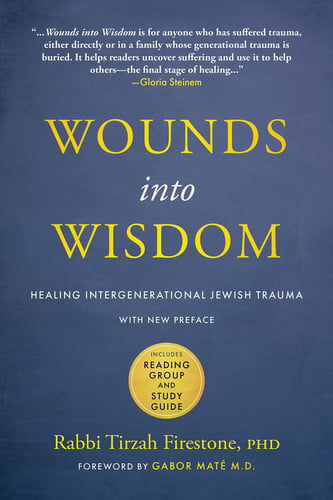
Wounds into wisdom: healing intergenerational Jewish trauma

Firestone, Tirzah
"Our past does not simply disappear. The painful history of our ancestors and their rich cultural wisdom intertwine within us to create the patterns of our future. Even when past trauma remains unspoken or has long been forgotten, it becomes part of us and our children-a legacy of both strength and woundedness that shapes our lives. In this book, Tirzah Firestone brings to life the profound impact of protracted historical trauma through the compelling narratives of those whose lives were marred by racial persecution and displacement. The tragic story of Firestone's own family lays the groundwork for these revealing testimonies of recovery, forgiveness, and moral leadership. Throughout, Firestone interweaves their voices with neuroscientific and psychological findings, as well as relevant and inspiring Jewish teachings. Seven principles emerge from these wise narratives-powerful prescriptive tools that speak to anyone dealing with the effects of past traumatic injury. At the broadest level, these principles are directives for staying morally awake in a world rife with terror"--
Monkfish Book Publishing Company 2022 258 pages

Offside: soccer and American exceptionalism

Markovits, Andrei S.
"Soccer is the world's favorite pastime, a passion for billions around the globe. In the United States, however, the sport is a distant also-ran behind football, baseball, basketball, and hockey. Why is America an exception? And why, despite America's leading role in popular culture, does most of the world ignore American sports in return? Offside is the first book to explain these peculiarities, taking us on a thoughtful and engaging tour of America's sports culture and connecting it with other fundamental American exceptionalisms. In so doing, it offers a comparative analysis of sports cultures in the industrial societies of North America and Europe. The authors argue that when sports culture developed in the late nineteenth and early twentieth centuries, nativism and nationalism were shaping a distinctly American self-image that clashed with the non-American sport of soccer. Baseball and football crowded out the game. Then poor leadership, among other factors, prevented soccer from competing with basketball and hockey as they grew. By the 1920s, the United States was contentedly isolated from what was fast becoming an international obsession. The book compares soccer's American history to that of the major sports that did catch on. It covers recent developments, including the hoopla surrounding the 1994 soccer World Cup in America, the creation of yet another professional soccer league, and American women's global preeminence in the sport. It concludes by considering the impact of soccer's growing popularity as a recreation, and what the future of sports culture in the country might say about U.S. exceptionalism in general." http://www.loc.gov/catdir/description/prin021/00061115.html
Princeton University Press 2001-04-22 367 pages

Bad Ideas? An Arresting History of Our Inventions

Robert Winston,Robert M. L. Winston
We are born with the instinct to create and invent. Indeed our ability to do so is what separates we humans from the rest of the animal world. The moment man first converted a stone to a useful tool set him on a relentless path toward greater control and power over his environment. But have our creative ideas always produced desirable results in line with their original good intention? How many ill-effects and dangers have they brought about along the way? And have they really served us well? Bad Ideas? traces the fascinating history of our attempts at self-improvement but also questions their value. The dubious consequences of the development of weaponry, for example, is self-evident from the primitive but lethal sling to the devastating nuclear bomb. But what of apparently more innocuous inventions such as farming, writing or medicine? All were initiated for the greater good but have nonetheless produced unforeseen fallout that continues to this day. What are their undesirable side-effects, how did they emerge over the years and where will they take us in the future? Written against a huge historical canvas, we join Robert Winston on a thrilling and inspiring journey from our earliest days to the present. We learn about the history of modern science, engineering, IT and much more, following the unexpected twists and turns of their progress. We meet the individuals who played a key role in their development, and share quirky anecdotes about their lives and brainwaves. Inspiring, unusual, and at times controversial, Bad Ideas? enables us by appreciating the past to look forward to the technological opportunities and ethical challenges of the future. In so doing it celebrates man's extraordinary capacity for achievement whilst warning us that his good intentions can sometimes end up as thoroughly bad ideas.
Bantam 2010 417 pages

The modern dog: a joyful exploration of how we live with dogs today

Coren, Stanley
Dogs are invented creatures -- invented by humans, who have been shaping the lives of these four-legged companions for more than 14,000 years. However, we often forget that, just as dogs live in our world, we live in theirs. The Modern Dog is a look at our coevolution, interpreting both canine and human points of view, by Dr. Stanley Coren, the most consistently popular author of dog books ever. A fascinating treasure trove of information gleaned from science, folklore, religious writing, tradition, and politics, The Modern Dog explores not only how dogs behave, but also how we share our lives with our dogs. Much more a romp than a formal exposition, The Modern Dog 's profiles and tales are funny, sweet, quirky, and reveal a lot about both species and our centuries-long partnership. This book will show you how the mutually beneficial relationship between humans and dogs might very well be the reason why early Homo sapiens evolved and survived while Neanderthals became extinct. You will see how dogs have played many prominent roles in human history, from ancient Egypt, where Pharaoh Ramses II was buried with the names and statues of four of his dogs, to modern American politics, where many U.S. presidents have derived comfort from canine companionship. Our modern dog is quite different from the dogs that existed even a century ago, its job having changed dramatically from the hunting, herding, retrieving, and guarding for which many were bred. In this book, you will see that it is often how people respond to and interpret the actions of dogs (and dog owners) that has a greater effect on the dog's life than the behavior patterns that have been programmed into the dog's genes. The Modern Dog will show you how some of your dog's strange and funny habits are his own and some come from you. Illustrated throughout with Dr. Coren's own charming drawings, The Modern Dog chronicles the various aspects of how we interact with dogs, how society responds to dogs, how our relationships with dogs have changed over history, and where dogs fit into our personal and emotional lives. It does this by telling the stories of dogs that work, dogs that love, dogs that behave badly, and dogs that will make you laugh.
Free Press 2008 274 pages