5 results for "World History"

Slavery in White and Black: class and race in the Southern slaveholders' new world order

Fox-Genovese, Elizabeth
Southern slaveholders proudly pronounced themselves orthodox Christians, who accepted responsibility for the welfare of the people who worked for them. They proclaimed that their slaves enjoyed a better and more secure life than any laboring class in the world. Now, did it not follow that the lives of laborers of all races across the world would be immeasurably improved by their enslavement? In the Old South but in no other slave society a doctrine emerged among leading clergymen, politicians, and intellectuals -- "Slavery in the Abstract," which declared enslavement the best possible condition for all labor regardless of race. They joined the Socialists, whom they studied, in believing that the free-labor system, wracked by worsening class warfare, was collapsing. A vital question: to what extent did the people of the several social classes of the South accept so extreme a doctrine? That question lies at the heart of this book.--Publisher.
Cambridge University Press 2008 314 pages

Working-class formation: nineteenth-century patterns in Western Europe and the United States

Ira Katznelson,Aristide R. Zolberg
Applying an original theoretical framework, an international group of historians and social scientists here explores how class, rather than other social bonds, became central to the ideologies, dispositions, and actions of working people, and how this process was translated into diverse institutional legacies and political outcomes. Focusing principally on France. Germany, and the United States, the contributors examine the historically contingent connections between class, as objectively structured and experienced, and collective perceptions and responses as they develop in work, community, and politics. Following Ira Katznelson's introduction of the analytical concepts, William H. Sewell, Jr., Michelle Perrot, and Alain Cottereau discuss France; Amy Bridges and Martin Shefter, the United States; and Jargen Kocka and Mary Nolan, Germany. The conclusion by Aristide R. Zolberg comments on working-class formation up to World War I, including developments in Great Britain, and challenges conventional wisdom about class and politics in the industrializing West.
Princeton University Press 1986 470 pages

Linked labor histories: New England, Colombia, and the making of a global working class

Chomsky, Aviva
Exploring globalization from a labor history perspective, Aviva Chomsky provides historically grounded analyses of migration, labor-management collaboration, and the mobility of capital. She illuminates the dynamics of these movements through case studies set mostly in New England and Colombia. Taken together, the case studies offer an intricate portrait of two regions, their industries and workers, and the myriad links between them over the long twentieth century, as well as a new way to conceptualize globalization as a long-term process. Chomsky examines labor and management at two early-twentieth-century Massachusetts factories: one that transformed the global textile industry by exporting looms around the world, and another that was the site of a model program of labor-management collaboration in the 1920s. She follows the path of the textile industry from New England, first to the U.S. South, and then to Puerto Rico, Japan, Mexico, Central America, the Caribbean, and Colombia. She considers how towns in Rhode Island and Massachusetts began to import Colombian workers as they struggled to keep their remaining textile factories going. Most of the workers eventually landed in service jobs: cleaning houses, caring for elders, washing dishes. Focusing on Colombia between the 1960s and the present, Chomsky looks at the Urabá banana export region, where violence against organized labor has been particularly acute, and, through a discussion of the AFL-CIO’s activities in Colombia, she explores the thorny question of U.S. union involvement in foreign policy. In the 1980s, two U.S. coal mining companies began to shift their operations to Colombia, where they opened two of the largest open-pit coal mines in the world. Chomsky assesses how different groups, especially labor unions in both countries, were affected. Linked Labor Histories suggests that economic integration among regions often exacerbates regional inequalities rather than ameliorating them.
Duke University Press 2008-04 397 pages

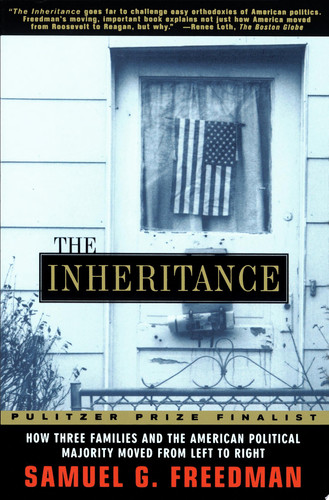
The inheritance: how three families and America moved from Roosevelt to Reagan and beyond

Freedman, Samuel G.
Orphan in the new world (Silvio Burigo) -- Liverpool on the Hudson (Lizzie Sanford Garrett) -- The dreamer and his son (Joseph Obrycki) -- The sewing room (Lizzie Garrett) -- The physics of cynicism (Joseph Obrycki) -- Worth two (Silvio Burigo) -- Voices from downstairs (Richie Garrett) -- Recessive genes (Silvio Burigo/Lorraine and Frank Trotta) -- Address as destiny (Vilma and Jack Maeby) -- Fence and basement (Silvio Burigo/Lorraine and Frank Trotta) -- Senator Clearwater (Richie Garrett) -- Uncle Paulie's Porch (Frank Trotta Jr.) -- The State Street Gang (Leslie Maeby) -- Poor snob (Tim Carey) -- Enchantment and its opposite (Frank Trotta Jr.) -- Incumbent protection (Leslie Maeby) -- Red suspenders (Tim Carey).
Simon & Schuster 1996 464 pages

The African worker

Freund, Bill
The African Worker, first published in 1988, was intended as a synthesis considering issues and debates from the work of many writers on labour history and labour studies in Africa. The development of a particular critical literature, spanning a number of disciplines, is critically considered. In some respects, the concerns of past generations have been to align the understanding of labour issues in Africa with those more generally in the modern world. In others, the emphasis remains on the specific and African. Both directions clearly emerge here. The bibliographical essay, as well as the bibliography itself, is meant to point readers further who want a higher order of detail, a regional focus or a more thorough-going theoretical treatment of all or some of the relevant issues.
Cambridge University Press 1988-08-25 200 pages