6 results for "World History"

Wanderlust

Solnit, Rebecca
Drawing together many histories-of anatomical evolution and city design, of treadmills and labyrinths, of walking clubs and sexual mores-Rebecca Solnit creates a fascinating portrait of the range of possibilities presented by walking. Arguing that the history of walking includes walking for pleasure as well as for political, aesthetic, and social meaning, Solnit focuses on the walkers whose everyday and extreme acts have shaped our culture, from philosophers to poets to mountaineers. She profiles some of the most significant walkers in history and fiction-from Wordsworth to Gary Snyder, from Jane Austen's Elizabeth Bennet to Andre Breton's Nadja-finding a profound relationship between walking and thinking and walking and culture. Solnit argues for the necessity of preserving the time and space in which to walk in our ever more car-dependent and accelerated world.
Verso 2002 326 pages

Ghostbusters: the ultimate visual history

Wallace, Daniel,Aykroyd, Dan,Reitman, Ivan
"Who you gonna call? The Ghostbusters saga has been thrilling fans around the world for over three decades, from the original movies to the animated shows, comics, video games, toys, and other collectibles. For the first time, Ghostbusters: The Ultimate Visual History takes a comprehensive look at the entire franchise, telling the complete story behind the creation of a true pop culture phenomenon. Beginning with an in-depth look at the original film, Ghostbusters: The Ultimate Visual History delves into the archives to showcase a wealth of never-before-seen concept art and photography that will take fans into the production of a true classic. Also featuring a large section on Ghostbusters II, the book brings together exclusive interviews with the key players from both films, including director Ivan Reitman; stars Dan Aykroyd, Ernie Hudson, and Sigourney Weaver; and producers Michael C. Gross and Joe Medjuck."--Provided by Amazon.com.
Insight Editions 2015-10-27 222 pages

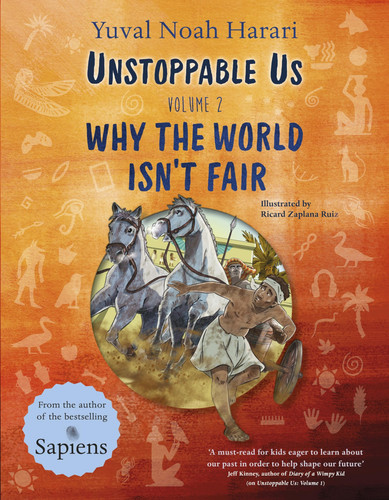
Unstoppable us: volume 2: why the world isn't fair

Harari, Yuval N.
Something really strange happened 10,000 years ago, and it changed everything. Why did millions of people agree to obey a few leaders? Where did kings and kingdoms come from? The answer to that is one of the strangest tales you'll ever hear. And it's a true story. Have you ever wondered how we got here? From gathering berries and hunting mammoths, to shopping at supermarkets and letting people tell us what to do? You might hear a lot of people say 'the world isn't fair'. But why isn't it? And how did it become so? In Unstoppable Us- Volume 1 , we learned how humans told stories to become rulers of the world - for good and bad. Now, in this next chapter of the incredible true tale of the Unstoppables, find out how humans learned to control animals like dogs, chicken and cows . . . And how a handful of humans learned to control everyone else. With full-colour illustrations showing the relentless rise and rise of the human race, this is history like you've never experienced it before.
Puffin Books 2024-03-07 187 pages

The gifts of Athena

Mokyr, Joel
The growth of technological and scientific knowledge in the past two centuries has been the overriding dynamic element in the economic and social history of the world. Its result is now often called the knowledge economy. But what are the historical origins of this revolution and what have been its mechanisms? In The Gifts of Athena , Joel Mokyr constructs an original framework to analyze the concept of "useful" knowledge. He argues that the growth explosion in the modern West in the past two centuries was driven not just by the appearance of new technological ideas but also by the improved access to these ideas in society at large--as made possible by social networks comprising universities, publishers, professional sciences, and kindred institutions. Through a wealth of historical evidence set in clear and lively prose, he shows that changes in the intellectual and social environment and the institutional background in which knowledge was generated and disseminated brought about the Industrial Revolution, followed by sustained economic growth and continuing technological change. Mokyr draws a link between intellectual forces such as the European enlightenment and subsequent economic changes of the nineteenth century, and follows their development into the twentieth century. He further explores some of the key implications of the knowledge revolution. Among these is the rise and fall of the "factory system" as an organizing principle of modern economic organization. He analyzes the impact of this revolution on information technology and communications as well as on the public's state of health and the structure of households. By examining the social and political roots of resistance to new knowledge, Mokyr also links growth in knowledge to political economy and connects the economic history of technology to the New Institutional Economics. The Gifts of Athena provides crucial insights into a matter of fundamental concern to a range of disciplines including economics, economic history, political economy, the history of technology, and the history of science.
Princeton University Press 2002 359 pages

The Russian revolutions of 1917: the origins of modern communism

Schapiro, Leonard
Few events in history have exerted a more profound effect on our lives than the two revolutions of February and October 1917, which first established communism and the Soviet state in Russia and which ever since have served as an ambiguous symbol to socialists and would-be revolutionaries, to be imitated or despised, but never ignored. More than sixty-five years after the revolution, we still want to know: exactly how did the Bolsheviks capture power in 1917; and, even more important, how did they manage to hold on to that power in the face of the Party’s growing unpopularity? Leonard Schapiro is the author of the standard history of the Soviet Communist party and, in this beautifully written and meticulously researched book, he has provided us with what is bound to become the definitive account of the Bolshevik seizure of power for years to come. Drawing on the latest research findings as well as on a lifetime of reading and reflection, he guides us through that fateful year, examines the causes for the Bolshevik triumph and follows the course of communist rule up to the death of Lenin in 1924. He explores the complex relation of Lenin to Stalin, the crucial role of the army and the Party’s activities in the provinces. Above all, he focuses on the emergence of communism as a state force, a force with which the rest of the world is still trying to live. –- Dust jacket.
Basic Books 1984 239 pages

Jew and Gentile in the ancient world: attitudes and interactions from Alexander to Justinian

Feldman, Louis H.
Relations between Jews and non-Jews in the Hellenistic-Roman period were marked by suspicion and hate, maintain most studies of that topic. But if such conjectures are true, asks Louis Feldman, how did Jews succeed in winning so many adherents, whether full-fledged proselytes or "sympathizers" who adopted one or more Jewish practices? Systematically evaluating attitudes toward Jews from the time of Alexander the Great to the fifth century A.D., Feldman finds that Judaism elicited strongly positive and not merely unfavorable responses from the non-Jewish population. Jews were a vigorous presence in the ancient world, and Judaism was strengthened substantially by the development of the Talmud. Although Jews in the Diaspora were deeply Hellenized, those who remained in Israel were able to resist the cultural inroads of Hellenism and even to initiate intellectual counterattacks. Feldman draws on a wide variety of material, from Philo, Josephus, and other Graeco-Jewish writers through the Apocrypha, the Pseudepigrapha, the Church Councils, Church Fathers, and imperial decrees to Talmudic and Midrashic writings and inscriptions and papyri. What emerges is a rich description of a long era to which conceptions of Jewish history as uninterrupted weakness and suffering do not apply.
Princetown University Press 1996 679 pages