9 results for "World Literature"

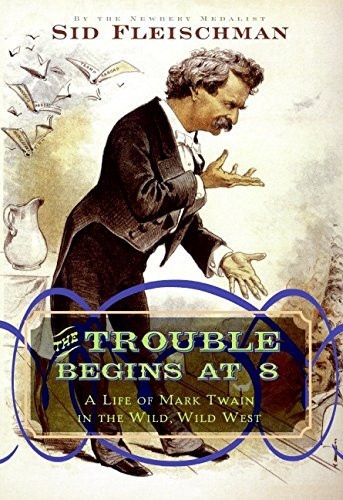
The trouble begins at 8: a life of Mark Twain in the wild, wild West

Fleischman, Sid
"Mark Twain was born fully grown, with a cheap cigar clamped between his teeth." So begins Sid Fleischman's ramble-scramble biography of the great American author and wit, who started life in a Missouri village as a barefoot boy named Samuel Clemens. Abandoning a career as a young steamboat pilot on the Mississippi River, Sam took a bumpy stagecoach to the Far West. In the gold and silver fields, he expected to get rich quick. Instead, he got poor fast, digging in the wrong places. His stint as a sagebrush newspaperman led to a duel with pistols. Had he not survived, the world would never have heard of Tom Sawyer or Huckleberry Finn—or red-headed Mark Twain. Samuel Clemens adopted his pen name in a hotel room in San Francisco and promptly made a jumping frog (and himself) famous. His celebrated novels followed at a leisurely pace; his quips at jet speed. "Don't let schooling interfere with your education," he wrote. Here, in high style, is the story of a wisecracking adventurer who came of age in the untamed West; an ink-stained rebel who surprised himself by becoming the most famous American of his time. Bountifully illustrated.
Greenwillow Books 2008 224 pages

Ex-friends

Podhoretz, Norman
Allen Ginsberg, Lionel and Diana Trilling, Lillian Hellman, Hannah Arendt, and Norman Mailer -- all are ex-friends of Norman Podhoretz, the renowned editor and critic and leading member of the group of New York intellectuals who came to be known as "the Family." As only a family member could, Podhoretz tells the story of these friendships, once central to his life, and shows how the political and cultural struggles of the past fifty years made them impossible to sustain. With wit, piercing insight, and startling honesty, we are introduced as never before to a type of person for whom ideas were often matters of life and death, and whose passing from the scene has left so large a gap in American culture. Podhoretz was the trailblazer of the now-famous journey of a number of his fellow intellectuals from radicalism to conservatism -- a journey through which they came to exercise both cultural and political influence far beyond their number. With this fascinating account of his once happy and finally troubled relations with these cultural icons, Podhoretz helps us understand why that journey was undertaken and just how consequential it became. In the process we get a brilliantly illuminating picture of the writers and intellectuals who have done so much to shape our world. Combining a personal memoir with literary, social, and political history, this unique gallery of stern and affectionate portraits is as entertaining as a novel and at the same time more instructive about postwar American culture than a formal scholarly study. Interwoven with these tales of some of the most quixotic and scintillating of contemporary American thinkers are themes that are introduced, developed, and redeveloped in a variety of contexts, with each appearance enriching the others, like a fugue in music. It is all here: the perversity of brilliance; the misuse of the mind; the benightedness of people usually considered especially enlightened; their human foibles and olympian detachment; the rigors to be endured and the prizes to be won and the prices to be paid for the reflective life. Most people live their lives in a very different way, and at one point, in a defiantly provocative defense of the indifference shown to the things by which intellectuals are obsessed, Norman Podhoretz says that Socrates' assertion that the unexamined life was not worth living was one of the biggest lies ever propagated by a philosopher. And yet, one comes away from Ex-Friends feeling wistful for a day when ideas really mattered and when there were people around who cared more deeply about them than about anything else. Reading of a time when the finest minds of a generation regularly gathered in New York living rooms to debate one another with an articulateness, a passion, and a level of erudition almost extinct, we come to realize how enviable it can be to live a life as poignantly and purposefully examined as Norman Podhoretz's is in Ex-Friends.
Free Press 1999-02-21 244 pages

Jerzy

Charyn, Jerome
"Jerzy Kosinski was a great enigma of post-World War II literature. When he exploded onto the American literary scene in 1965 with his best-selling novel The Painted Bird, he was revered as a Holocaust survivor and refugee from the world hidden behind the Soviet Iron Curtain. He won major literary awards, befriended actor Peter Sellers (who appeared in the screen adaptation of his novel Being There), and was a guest on talk shows and at the Oscars. But soon the facade began to crack, and behind the public persona emerged a ruthless social climber, sexual libertine, and pathological liar who may have plagiarized his greatest works. Jerome Charyn lends his unmistakable style to this most American story of personal disintegration, told through the voices of multiple narrators--a homicidal actor, a dominatrix, and Joseph Stalin's daughter--who each provide insights into the shifting facets of Kosinski's personality. The story unfolds like a Russian nesting doll, eventually revealing the lost child beneath layers of trauma, while touching on the nature of authenticity, the atrocities of WWII, the allure of sadomasochism, and the fickleness of celebrity."-- Page [4] of cover.
Bellevue Literary Press 2017 237 pages

The art of fiction

Salter, James
James Salter's exalted place in American letters is based largely on the intense admiration of other writers, but his work resonates far beyond the realm of fellow craftsmen, addressing themes--youth, war, erotic love, marriage, life abroad, friendship--that speak to us all. Following the publication of his first novel, Salter left behind a military career of great promise to write full-time and--through decades of searching, exacting work--became one of American literature's master stylists. Only months before he died, at the age of eighty-nine, he agreed to serve as the first Kapnick Writer-in-Residence at the University of Virginia, where he composed and delivered the three lectures presented in this book and introduced by his friend and fellow novelist, National Book Award-winning author John Casey. Salter speaks to us here with an easy intimacy, sharing his unceasing enchantment with the books that made up his reading life, including works by Balzac, Flaubert, Babel (whose prose is "like a handful of radium"), Dreiser, Celine, Faulkner. These talks provide an invaluable opportunity to see the way in which a great writer reads. They also offer a candid look at the writing life--the rejection letters, not one but two negative reviews in the New York Times for the same book, writing in the morning or at night and worrying about money during the long afternoons. Salter raises the question, Why does one write? For wealth? For admiration, or a sense of "importance"? Confronting a blank sheet that always offers too many choices, practicing a vocation that often demands one write instead of live, the answer for Salter was creating a style that captured experience, in a world where anything not written down fades away. -- Amazon.com.
University of Virginia Press 2016 77 pages

Conversations with James Salter

Salter, James
"James Salter (born James Horowitz in 1925) has been known throughout his career as a "writer's writer," acclaimed by such literary greats as Susan Sontag, Richard Ford, John Banville, and Peter Matthiessen for his lyrical prose, his insightful and daring explorations of sex, and his examinations of the inner lives of women and men. Conversations with James Salter collects interviews published from 1972 to 2014 with the award-winning author of The Hunters, A Sport and a Pastime, Light Years, and All That Is. Gathered here are his earliest interviews following acclaimed but moderately selling novels, conversations covering his work as a screenwriter and award-winning director, and interviews charting his explosive popularity after publishing All That Is, his first novel after a gap of thirty-four years. These conversations chart Salter's progression as a writer, his love affair with France, his military past as a fighter pilot, and his lyrical explorations of gender relations.The collection contains interviews from Sweden, Chile, France, and Argentina appearing for the first time in English. Included as well are published conversations from the United States, Canada, and Australia, some of which are significantly extended versions, giving this collection an international scope of Salter's wide-ranging career and his place in world literature"--
University Press of Mississippi 2015 236 pages

Forever fat: essays by the Godfather

Gutkind, Lee
Dubbed-some would say drubbed-the "godfather behind creative nonfiction" by Vanity Fair, Lee Gutkind takes the opportunity of these essays, and the rich material of his own life, to define, defend, and further expand the genre he has done so much to shape. The result is an explosive and hilarious memoir of Gutkind's colorful life as a motorcyclist, a medical insider, a sailor, a college professor, an over-aged insecure father, and a literary whipping boy. In Forever Fat Gutkind battles his weight, his ex-wives, his father, his rabbi, his psychiatrist, and his critics in a lifelong cross-country, cross-cultural search for stability and identity. And from Gutkind's battles, the reader emerges a winner, treated to a sometimes poignant, sometimes harrowing, sometimes uproarious, and always engrossing story of the simultaneous awakening of a man and his mission, and of the constant struggle, in literature and in life, to sort out memory and imagination. Here, enacted in technicolor terms, is the universal, symbolic truth that no matter how far you travel, over how many years, you will never completely shed the weighty baggage of adolescence. Yet, as Gutkind proves again and again, he has learned to describe his burden with an ever-lightening brilliance. Lee Gutkind is the founder and editor of the journal Creative Nonfiction. The author and editor of a dozen books, including the award-winning Many Sleepless Nights: The World of Organ Transplantation, he is a professor of English at the University of Pittsburgh and the director of the Mid-Atlantic Creative Nonfiction Writers' Conference at Goucher College.
University of Nebraska Press 2003 177 pages

Yom Kippur a go-go

Roth, Matthue
Yom Kippur A Go-Go is a mind-blowing meeting of pop culture, Orthodox faith, and hipster poetics. Matthue Roth is an American original: an Orthodox Jew who cites Outkast and Michelle Tea among his influences, who won’t touch a light switch on Shabbos but mimics a screaming orgasm onstage while reading his paean to Orthodox girls. From the World Bank riots (what can you do when the revolution starts on Shabbos?) to Thursday night tranny basketball in San Francisco’s Dolores Park, Matthue takes readers on a journey among the queer and hip streets of urban America in his exuberant memoir, Yom Kippur a Go-Go. With humor and insight, Roth describes the tension between contemporary life and the demands of faith. He falls in love and in lust with a panoply of girls, both strictly kosher and determinedly secular, to the accompaniment of MP3 rabbinical lectures on modesty ("Boys are nothing but perverts and filthy animals!”).
Cleis Press 2005 268 pages

A literary guide to Washington, DC: walking in the footsteps of American writers from Francis Scott Key to Zora Neale Hurston

Roberts, Kim
The site of a thriving literary tradition, Washington, DC, has been the home to many of our nation's most acclaimed writers. From the city's founding to the beginnings of modernism, literary luminaries including Walt Whitman, Paul Laurence Dunbar, Alice Dunbar-Nelson, Henry Adams, Langston Hughes, and Zora Neale Hurston have lived and worked at their craft in our nation's capital. In A Literary Guide to Washington, DC, Kim Roberts offers a guide to the city's rich literary history. Part walking tour, part anthology, A Literary Guide to Washington, DC is organized into five sections, each corresponding to a particularly vibrant period in Washington's literary community. Starting with the city's earliest years, Roberts examines writers such as Hasty-Pudding poet Joel Barlow and "Star-Spangled Banner" lyricist Francis Scott Key before moving on to the Civil War and Reconstruction and touching on the lives of authors such as Charlotte Forten Grimké and James Weldon Johnson. She wraps up her tour with World War I and the Jazz Age, which brought to the city some writers at the forefront of modernism, including the first American to win the Nobel Prize for Literature, Sinclair Lewis. The book's stimulating tours cover downtown, the LeDroit Park and Shaw neighborhoods, Lafayette Square, and the historic U Street district, bringing the history of the city to life in surprising ways. Written for tourists, literary enthusiasts, amateur historians, and armchair travelers, A Literary Guide to Washington, DC offers a cultural tour of our nation's capital through a literary lens.
University of Virginia Press 2018 228 pages