11 results for "World Literature"

Nowhere in Africa: an autobiographical novel

Zweig, Stefanie
Nowhere in Africa is the extraordinary tale of a Jewish family who flees the Nazi regime in 1938 for a remote farm in Kenya. Abandoning their once-comfortable existence in Germany, Walter Redlich, his wife Jettel, and their five-year-old daughter, Regina, each deal with the harsh realities of their new life in different ways. Attorney Walter is resigned to working the farm as a caretaker; pampered Jettel resists adjustment at every turn; while the shy yet curious Regina immediately embraces the country—learning the local language and customs, and finding a friend in Owuor, the farm's cook. As the war rages on the other side of the world, the family’s relationships with their strange environment become increasingly complicated as Jettel grows more self-assured and Walter more haunted by the life they left behind. In 1946, with the war over, Regina's fondest dream comes true when her brother Max is born. Walter's decision, however, to return to his homeland to help rebuild a new Germany puts his family into turmoil again. Visit the Web site for the film at www.nowhereinafrica.com
Terrace Books 2004 291 pages

The English German girl

Simons, Jake Wallis
"This powerful, meticulously researched novel is a moving tale of one girl's struggle against a world in turmoil. In 1930s Berlin, choked by the tightening of Hitler's fist, the Klein family are gradually losing everything that is precious to them. Their fifteen-year-old daughter, Rosa, slips out of Germany on a Kindertransport train to begin a new life in England. Charged with the task of securing a safe passage for her family, she vows that she will not rest until they are safe. But as war breaks out and she loses contact with her parents, Rosa finds herself wondering if there are some vows that can't be kept ...A sweeping tale of love and loss, with the poignant story of the Kindertransport at its heart, this is an exceptional accomplishment from one of Britain's bravest and most vibrant young writers."
Polygon 2011 377 pages

The little space: poems selected and new, 1968-1998

Ostriker, Alicia
In this selection of poems from thirty years of a distinguished writing career, we see the growth of a poet’s mind, heart, and spirit as Ostriker struggles to love “this wounded / World that we cannot heal, that is our bride.” Whether she probes the meaning of childhood, family, marriage, and motherhood, or art, history, politics, and God; whether she is celebrating sexuality or confronting mortality, the poet includes “whatever I can grasp of human experience within my art—the good and beautiful, the evil and chaotic. I tell my students that they must write what they are afraid to write; and I attempt to do so myself.”
University of Pittsburgh Press 1998 231 pages

No heaven

Ostriker, Alicia
Alicia Suskin Ostriker's voice has long been acknowledged as a major force in American poetry. In No Heaven, her eleventh collection, she takes a hint from John Lennon's "Imagine" to wrestle with the world as it is: "no hell below us, / above us only sky." It is a world of cities, including New York, London, Jerusalem, and Berlin, where the poet can celebrate pickup basketball, peace marches, and the energy of graffiti. It is also a world of families, generations coming and going, of love, love affairs, and friendship. Then it is a world full of art and music, of Rembrandt and Bonnard, Mozart and Brahms. Finally, it is a world haunted by violence and war. No Heaven rises to a climax with elegies for Yitzhak Rabin, assassinated by an Israeli zealot, and for the poet's mother, whose death is experienced in the context of a post-9/11 impulse to destroy that seems to seduce whole nations. Yet Ostriker's ultimate stance is to "Try to praise the mutilated world," as the poet Adam Zagajewski has counseled. At times lyric, at times satiric, Ostriker steadfastly pursuesin No Heaven her poetics of ardor, a passion for the here and now that has chastened and consoled her many devoted readers.
University of Pittsburgh Press 2005 136 pages

The Dreyfus affair: a trilogy

Whyte, George R.
The cause celebre of the 19th century, the Dreyfus Affair destabilized French society (1894-1906) and reverberated across the world. Its repercussions continue to this day. A deliberate miscarriage of justice, the public degradation of an innocent Jewish officer and his incarceration on Devil's Island, espionage, intrigue, media pressure, vehement antisemitism and political skulduggery--all these elements, based on historical records, are contained in George R. Whyte's trilogy of plays which also focuses on Emile Zola's letter to the President of France, J'Accuse, arguably history's most famous plea for human rights.
Oberon Books 2010 126 pages

The sensualist: a novella

Torday, Daniel
"Raised in Baltimore in the '90s, 17-year-old Samuel Gerson is ready to be rid of his high school baseball team, his protective upbringing, and the tight-knit Jewish community in which he's spent his whole life. But when he befriends enigmatic Dmitri Zilber, a recent Russian Jewish immigrant who is obsessed with the works of Dostoevsky, Samuel's world begins to shift. In the wake of his grandfather's suicide, as his life increasingly entangles with that of Dmitri and his beautiful sister Yelizaveta, it sets in motion a series of events that culminates in a disturbing act of violence. A quietly devastating portrait of late adolescence, The Sensualist examines the culture we inherit as it collides with the one we create"--from the cover.
Nouvella 2012 177 pages

The season of Pepsi Meyers

Rotenberg, Abie
The year is 2040 and it's been thirteen years since the New York Yankees played post-season baseball. With the number one pick in the draft, they choose a remarkably gifted ballplayer from the Binghamton, New York area, named Pepsi Meyers. Although just eighteen years old, Pepsi earns a place on the Major League roster and revitalizes the Yankees with his spectacular play. Pepsi also happens to be Jewish. As the season progresses, the city is energized by the newfound success of its beloved team. At the same time, Pepsi and his family discover a world they never knew existed, as they are exposed for the first time, to Torah and the way of life it endorses. Pepsi's struggle with the tug-of-war between the spiritual and the mundane and how it affects him, his teammates and the City of New York is both an entertaining baseball tale, and a study into the priorities and meaningful choices we all have to make in our lives.
Audley Street Books 2015-08-25 245 pages

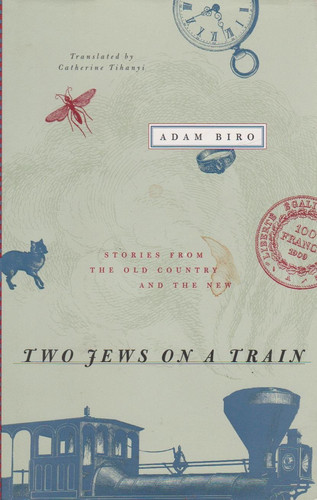
Two Jews on a train

Biro, Adam
"Two Jews were traveling on a train. . . . " Many Eastern European jokes—and several of the charming and often hilarious conversations in this book—begin this way. From all regions of the world and from all walks of life, the characters are young and full of life and old and ugly; they are rabbis, matchmakers, students, and immigrants. They gossip and speak about everything from the banalities of the world to the unspeakable evils of existence all for a single purpose: to laugh and to celebrate the good luck of being alive. As Biro recounts these tales, we hear not only his voice and the voice of his father, but those of generations of storytellers who have used humor to teach about the truly important issues in life—the delicacy of love, the fragility of friendship, the pitfalls of self-righteousness, the costs of narrow-mindedness, and the unpredictability of life itself. Biro artfully spins each story, lingering on the details, guiding the reader to the inevitable—yet always unexpected—punchline. Taken individually, these stories will make you laugh out loud; taken as a whole, they form an invaluable record of the sensibilities of an entire people. Biro writes: "These Jewish stories of which not a single one happened to me, and of which I did not invent a single one, do describe me, do characterize me, do explain me. They are always my own story. And yours."
University of Chicago Press 2001-05 128 pages

My mother's house

Tobias, Lily
A remarkable insight into Jewish history in Britain, 'My Mother's House' is a poignant story of belonging, nationhood and identity set in Wales, England and Palestine. The first novel from the acclaimed author of Eunice Fleet - a poignant story of belonging, nationhood and identity set in Wales, England and Palestine. First novel from the acclaimed author of EUNICE FLEET a poignant story of belonging, nationhood and identity set in Wales, England and Palestine Simon is a troubled young manborn in Wales, of Jewish heritage, and in love with Englishness and an English heiress. He determines to reject his Jewish and Welsh identity and the industrial valleys he grew up in and seeks to fulfil his ambition to rise in the Civil Service. His experiences in love and his professional life see him reject Edith on discovering that she is not what he believed her to be, and taking up arms in the fight against Englands enemies in the Great War. Ultimately, he must embrace his family and his heritage before he can experience a sense of wholeness. Simons experience raises questions of belonging, language, nationhood and identity that are as relevant now as they were in 1931 when the novel was first published. Lily Tobiass sensitive individual and communal portraits illuminate some of the most topical personal, social and political issues of the twenty-first century.
Honno 2015 543 pages

The cosmic follies

Louvish, Simon
This is the outer and inner journey of Mo Smith, a homeless vagrant who walks northward along the crowded island of Manhattan from the southern tip of Battery. Multiple voices, multiple personas, shifting identities and multiple tales accompany his stubborn journey. This is a novel of our post 9/11 world that looks at ordinary and extraordinary lives that teem in our chaotic times. It also makes the connections, so dramatically relevant now, between America and the Middle East.
ICA 2004 538 pages

Farewell, Leicester Square

Miller, Betty
"Betty Miller wrote this, her fourth novel, in 1935. But her publisher, Victor Gollancz, #x91;turned the book down flat,#x92; wrote Neal Ascherson in The New York Review of Books. #x91;It seems most likely that he saw it as terrifyingly provocative, not only an attack on the solid English assimilation of his own family but a tactless outburst against the English at precisely the moment, two years after Hitler's assumption of power, when their tolerance and hospitality were most needed.#x92; In the novel Alec Berman escapes from his restrictive Jewish family in Brighton, and although he has a successful career as a film-maker (perhaps modelled on that of Alexander Korda) and marries the very English Catherine, he always feels a #x91;Dago: Jew: Outsider.#x92; #x91;Yet,' continued Neal Ascherson, #x91;the rejection is not really the refusal of a snobbish Gentile world fully to accept him. The rejecting force comes from within himself.#x92; #x91;A thought-provoking insight into anti-semitism between the wars,' wrote the Guardian, 'not the violent prejudice of Mosley's fascists, but the discreet discrimination of the bourgeoisie.#x92;" -- Provided by publisher.
Persephone Books 2000 309 pages